1 Pendleton Place House
1 Pendleton Place | also 166 Franklin Avenue, 170 Franklin Avenue | New Brighton | built 1860
Open on the map9 entries

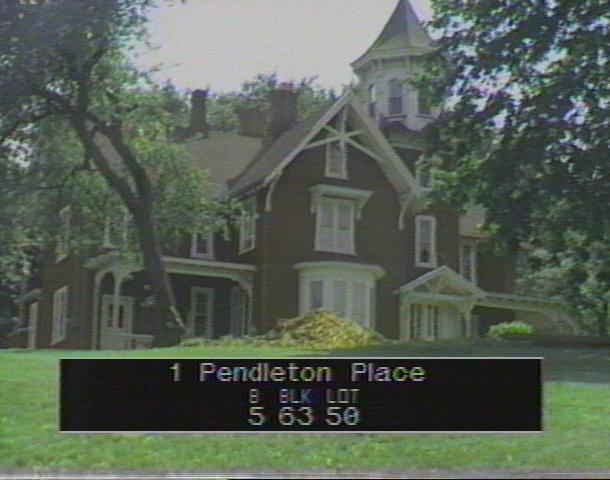
The city photographed every building for its tax records around 1940 and again in the 1980s. NYC Municipal Archives.
Written with AI from the source each entry cites, then fact-checked.
- 1854
William S. Pendleton maps a hillside suburb west of Hamilton Park
In 1854 William S. Pendleton bought a large tract between Franklin and Lafayette Avenues and laid it out with winding roads and irregular lots that followed the hills. He had built seven houses there by 1860, of which this one, 22 Pendleton Place and possibly 178 Franklin Avenue survive. Earlier, in Boston, Pendleton and his brother John had founded the first commercially successful lithography firm in the United States.
“…acquired a large tract of land extending from Franklin Avenue to Lafayette Avenue between Cassidy Place and Prospect Avenue in 1854…”
- 1860
Charles Duggin designs a towered picturesque villa for Pendleton
English-born architect Charles Duggin, who had arrived in New York in 1853, designed this house for William S. Pendleton in 1860, blending English Rustic and Swiss elements in a High Victorian villa. Set on a hillside that once commanded views of New York and New Jersey, it has a dominant tower and several porches under gabled roofs with exposed rafters, openwork brackets and decorative trusses. It and 22 Pendleton Place are counted as Duggin's best-known works.
“Constructed in 1860 by architect Charles Duggin for William S. Pendleton…”
- 1860
Stockbroker Thomas M. Rianhard leases the new house for his family
Soon after the house was finished it was leased to Thomas M. Rianhard, a stockbroker married to Jennie Baldwin, adopted daughter of corporate attorney John C. Work. The household counted the couple, two children, Thomas's father William, three maids and a coachman. They stayed until sometime in the 1870s.
- 1862
The Horticulturist magazine publishes Duggin's design for the house
Duggin had been writing for the Horticulturist, the journal that spread picturesque design across the country, since 1858. The magazine printed No. 1 Pendleton Place in January 1862 and again in February 1869.
“No. 1 Pendleton Place was published twice in the journal in January 1862 and February 1869.”
- 1892
Creditors foreclose and John M. Pendleton buys the house at auction
William H. Pendleton still owned the house when he died in July 1887 at 52. His widow Rebecca, short of money, mortgaged it in 1889, and in 1892 creditors foreclosed. William's brother John M. Pendleton bought it at auction, and in 1897-98 Rebecca was living here with her sons Arthur, Herbert and William Jr.
- 1910
Attorney William S. Ogilby rents the house for his family
After John M. Pendleton's death in 1900 the house sat empty during litigation over his estate. By 1910 attorney William S. Ogilby was leasing it, living here with his wife and their five middle-aged children. After the parents died, the five Ogilbys stayed on with a Polish housekeeper. Jennie Pendleton was living here herself by 1920, sharing it with a tenant.
- 1946
Journalist and tax commissioner William Wirt Mills dies at home here
William Wirt Mills, once night city editor of the New York Times, died here in January 1946. He had lost a city post in 1916 after successfully fighting plans to dump the city's garbage on Staten Island, and later ran the Department of Plant and Structures. Fiorello LaGuardia made him Staten Island's tax commissioner, and he led the city Tax Commission from 1941 through 1945.
- 1983
Episcopal priests Gerald Keucher and John Walsted buy and restore the house
In 1983 the Revs. Gerald W. Keucher and John H. Walsted acquired the house. Walsted became rector of Christ Church, New Brighton, the parish William S. Pendleton helped found as a churchwarden, and after retiring in 1994 painted religious images now in the Archbishop of Canterbury's palace, the Moscow Metropolitan's residence and the Cathedral of St. John the Divine. The pair replaced the roof and siding and rebuilt the porch floors, winning a Preservation League of Staten Island award in 2005.
“In 1983, it was acquired by the present owners, the Reverend Gerald W. Keucher and the Reverend John H. Walsted…”
- 2006
The Landmarks Preservation Commission designates 1 Pendleton Place
Following a December 2005 hearing, the Commission made the house a city landmark on March 14, 2006. Three speakers backed it, one of them speaking for Council member Michael McMahon. One owner did not oppose designation but objected to the Commission's regulations and to landmark owners getting no tax relief.
Further reading
- One Pendleton PlaceWikipedia
Nearby
- W. S. Pendleton House22 Pendleton Place | 2 entries
- Pritchard House66 Harvard Avenue | 2 entries
- Hamilton Park Cottage105 Franklin Avenue | 4 entries
- Christ Church New Brighton76 Franklin Avenue | 2 entries
- 106 Westervelt Avenue3 entries
- 100REAR Westervelt Avenue3 entries