Stuyvesant Town
1 Stuyvesant Oval | also 3 Stuyvesant Oval, 240 1st Avenue | Stuyvesant Town | built 1945
Open on the map11 entries

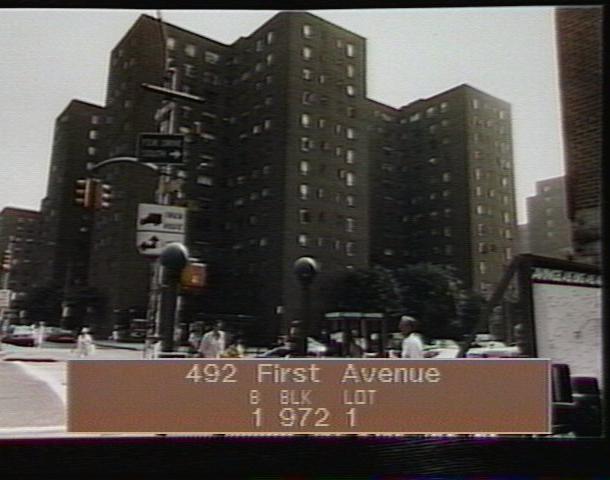
The city photographed every building for its tax records around 1940 and again in the 1980s. NYC Municipal Archives.
Written with AI from the source each entry cites, then fact-checked.
- 1872
Captain Alexander Williams is sent to the Gas House district and answers gang violence with clubs
The land under Stuyvesant Town was once the Gas House district, a rough area of tanks, tenements and street gangs. Alexander S. Williams, promoted to captain of police on May 31, 1872, was posted there and assembled a squad that beat gangsters with nightsticks. He later summed up his creed by saying the law was stronger at the end of a nightstick than in a Supreme Court ruling. The district was cleared decades later for the housing complex.
Source: Wikipedia
- 1898
A collapsing gas tank kills three people in the Gas House district
Before Stuyvesant Town, this stretch of the East Side was the Gas House district, named for the huge circular gas storage tanks that stood among its tenements. In 1898 one of those tanks collapsed, killing three people and seriously injuring thirteen. Residents already lived with leaks and a gang that reportedly staged about thirty holdups a night on 18th Street. The tanks were gone by the 1930s, and the cleared blocks later made room for the complex.
Source: Untapped New York
- 1943
The City Planning Commission approves Metropolitan Life's plan to raze the Gas House District
Backed by Robert Moses at Mayor La Guardia's request, Metropolitan Life's $50 million plan for a vast apartment complex was approved by the City Planning Commission on May 20, 1943, by a 5-to-1 vote. Clearing the site meant demolishing about 600 buildings in the Gas House District, displacing some 3,100 families along with 500 stores and small factories, three churches, three schools and two theaters.
Source: Wikipedia
- 1946
The last family leaves the Gas House district and the blocks are cleared for Stuyvesant Town
Clearing the site for Stuyvesant Town meant razing about 600 buildings: homes for some 3,100 families, along with 500 shops and small factories, two theaters, three schools and three churches. An estimated 11,000 people had to move out. The last family of the old Gas House district, the Delmans, left in May 1946, which let demolition finish soon afterward. The New York Times had already called the exodus the greatest mass movement of families in the city's history.
Source: Wikipedia
- 1947
The first tenants, two World War II veterans and their families, move in
Built between 1945 and 1947 with priority for returning veterans, the complex drew 7,000 applications on the first day it was offered and about 100,000 by the time the first building was ready. On August 1, 1947, two veterans and their families became the first tenants. Stuyvesant Town and Peter Cooper Village together hold 11,250 apartments in 110 red brick buildings.
Source: stpcvta.org
- 1947
A judge rules Stuyvesant Town may legally exclude Black tenants
A New York Supreme Court justice rules that Stuyvesant Town, though enabled by the city's use of eminent domain and a tax exemption, is a private development free to pick tenants by race. Metropolitan Life Insurance Company president Frederick H. Ecker has said plainly that "negroes and whites do not mix." The ruling lets MetLife maintain a whites-only rental policy that draws years of tenant protest.
Source: Wikipedia
- 1950
Math professor Lee Lorch loses a second job after letting a Black family stay in his Stuyvesant Town apartment
Lee Lorch, a mathematician who lived in Stuyvesant Town, became vice-chair of a tenants' committee fighting the complex's whites-only rule, and City College dismissed him. When he took a post at Pennsylvania State University, he kept his apartment and had a Black friend's family move in as guests, a way around the ban. The New York Times reported on April 10, 1950 that Penn State had fired him too, and a Times editorial the next day urged the school to reconsider.
“…rather than give up his apartment he asked a black friend and his family to move into his dwelling as "guests…”
Source: Wikipedia
- 2006
Metropolitan Life sells the complex to Tishman Speyer for $5.4 billion
In 2006 MetLife sold Stuyvesant Town and Peter Cooper Village to Tishman Speyer and BlackRock for $5.4 billion. In 2010 Tishman Speyer defaulted on the mortgage in what was called the largest commercial mortgage default in U.S. history. In 2015 Blackstone and Ivanhoé Cambridge bought the complex and agreed to keep about 5,000 units below market through 2035.
Source: Wikipedia
- 2009
The state's top court rules Stuy Town's owners had no right to deregulate about 4,440 apartments
On October 22, 2009, the New York Court of Appeals ruled 4-2 against Tishman Speyer, which had bought the complex in 2006. The court held that the landlord could not remove apartments from rent stabilization while it took the J-51 tax incentive, a program meant to encourage renovations. State officials had previously advised landlords that such deregulation was allowed. Lawyers for the market-rate tenants estimated the cost to the owners at more than $200 million.
Source: commercialobserver.com
- 2010
Tishman Speyer defaults on Stuyvesant Town's mortgage
Four years after paying $5.4 billion for the complex, Tishman Speyer and partner BlackRock default on their debt amid falling rents and stalled plans to convert apartments to market rate. It becomes the largest default on a commercial mortgage in United States history up to that time. Lenders spend years sorting out ownership before a 2015 sale to new buyers.
Source: Wikipedia
- 2012
Stuy Town tenants and owners sign a $146.9 million settlement over rent overcharges
After five years of litigation, tenants led by Amy Roberts and the complex's owners signed a settlement on November 29, 2012, worth roughly $146.9 million, with almost $68.8 million of it in cash for rent overcharges. The deal also retroactively re-stabilized rents through June 2010 on 4,311 formerly decontrolled apartments. The owners were then trusts run by CWCapital, which had taken over after Tishman Speyer defaulted, and MetLife paid part of the cash. A state judge gave preliminary approval the same day.
Source: therealdeal.com
Further reading
- Stuyvesant Town–Peter Cooper VillageWikipedia
Nearby
- Stuyvesant Town - 647, 649, 651, 653, 655 E14655 East 14th Street | 3 entries
- Church of the Immaculate Conception and Clergy Houses414 East 14th Street | 3 entries
- 518 East 13th Street1 entry
- 602 East 14th Street1 entry
- Former Grace Chapel406 East 14th Street | 3 entries
- 548 East 13th Street1 entry