Saint Thomas Church
1 West 53rd Street | also 678 5th Avenue | Midtown | built 1913
Open on the map12 entries

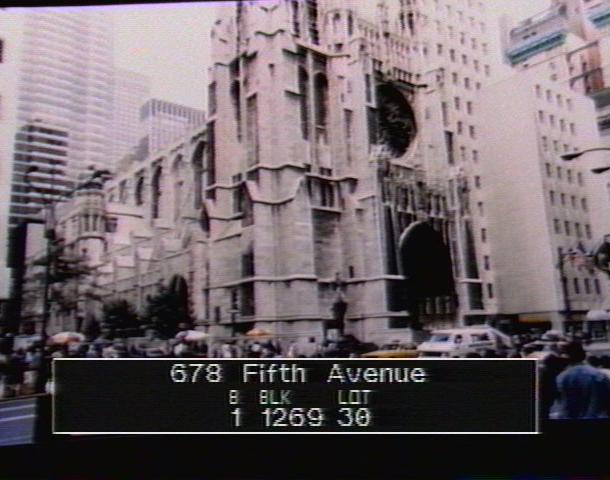
The city photographed every building for its tax records around 1940 and again in the 1980s. NYC Municipal Archives.
Written with AI from the source each entry cites, then fact-checked.
- 1823
Episcopalians from three parishes organize Saint Thomas Church
Members of three Lower Manhattan Episcopal parishes meet and organize Saint Thomas Church on October 12, 1823. Among them are the landowner William Backhouse Astor and Charles King, who later becomes president of Columbia University. The parish is incorporated in January 1824 and first builds on Broadway at Houston Street, long before it settles at Fifth Avenue and 53rd Street.
Source: Wikipedia
- 1870
The congregation moves into Richard Upjohn's church, an earlier building on this corner
The third Saint Thomas Church, an earlier building on this site, was designed by Richard Upjohn and his son Richard Michell Upjohn, and its cornerstone was laid on October 14, 1868. The congregation moved into it on October 6, 1870. A 260-foot tower, an Augustus Saint-Gaudens relief behind the altar and John LaFarge's murals gave this parish church the look of a cathedral.
Source: Wikipedia
- 1895
Consuelo Vanderbilt marries the Duke of Marlborough in an earlier church on this site
Consuelo Vanderbilt marries Charles Spencer-Churchill, 9th Duke of Marlborough, at Saint Thomas Church on November 6, 1895. The ceremony takes place in the congregation's third church, which stood on this site before the present building and hosted many high-society weddings. That church burns down in 1905.
Source: Wikipedia
- 1905
Fire destroys the Upjohn-designed Saint Thomas Church
Shortly after 6 a.m. on August 8, 1905, the rectory housekeeper finds a fire in the sanctuary and runs into the street, where she alerts a policeman. By 8 a.m. the Richard Upjohn-designed church, the congregation's third, is a smoking ruin. The fire destroys the interiors by John La Farge, including two important paintings, and sculptures by Augustus Saint-Gaudens.
Source: Daytonian in Manhattan
- 1906
Bertram Goodhue shapes asymmetrical elevations to fit a tight corner site
The Landmarks Preservation Commission credits Goodhue, who designed the church in 1906, with a fresh reading of Gothic as a living architectural language. Ralph Adams Cram was responsible for the plan. To give the nave width and height on a restricted site, Goodhue made the elevations asymmetrical, placing the main entrance on the nave's axis and joining it to a square corner tower.
“Goodhue created asymmetrical elevations ideally suited to the restricted site.”
- 1906
Rector Ernest Stires sends the church's rebuilding fund to earthquake victims
Within a day of the 1905 fire, rector Ernest M. Stires tells the press that the new church will be "all Gothic," and one parishioner has already offered $50,000. When the 1906 San Francisco earthquake strikes, Stires sends the whole building fund to California to help the victims. The congregation has to begin raising money again from the start.
Source: Daytonian in Manhattan
- 1911
The cornerstone is laid for a design that beat entries by George B. Post and Robert W. Gibson
The cornerstone of the current church was laid on November 21, 1911. The design by Cram, Goodhue and Ferguson had won an architectural competition, beating proposals from George Browne Post and from Robert W. Gibson. The church was consecrated on April 25, 1916.
“The cornerstone was laid on November 21, 1911, and the new building opened to congregants on October 4, 1913.”
Source: Wikipedia
- 1913
The current French Gothic Saint Thomas Church opens
Ralph Adams Cram and Bertram Grosvenor Goodhue win an architectural competition to design the parish's fourth church, a French High Gothic Revival building that rises 95 feet. It is built on the site of the burned third church from 1911 to 1913, and it opens to the congregation on October 4, 1913. It is consecrated on April 25, 1916.
Source: Wikipedia
- 1919
The Saint Thomas Choir School opens on 55th Street with 21 boys
The Saint Thomas Choir School dates from 1919 and was created at the urging of organist and choirmaster T. Tertius Noble, who had led the boys' choir at York Minster, where every boy singer attended a choir school. When the parish called him to New York in 1913, he accepted on the understanding that a choir school would be needed. The school opened on 55th Street with 21 boys and stayed there until it moved to a purpose-built building on 58th Street in 1987.
Source: saintthomaschurch.org
- 1966
The city designates the church and parish house a landmark with the rector's blessing
The Landmarks Preservation Commission designated Saint Thomas' Church and its parish house a landmark on October 19, 1966, after a May hearing at which three witnesses spoke in favor and none against. The church's rector wrote to the commission to approve the designation and offer the church's support and good will. The commission found the building an outstanding example of the French Gothic style.
- 1985
Andrew Lloyd Webber's Requiem has its world premiere at the church
Andrew Lloyd Webber's Requiem was given its world-premiere public performance at Saint Thomas Church on February 24, 1985, and taped there for a PBS broadcast on Exxon's Great Performances. Conductor Lorin Maazel and tenor Plácido Domingo were enlisted for the work, and the Orchestra of St. Luke's played. A reviewer in the Christian Science Monitor named the boy soprano the most impressive contributor.
Source: csmonitor.com
- 2001
Tony Blair addresses an interfaith service held days after the September 11 attacks
After the September 11 attacks, the church reached out to British expatriates, reflecting its Anglican heritage. The result was an interfaith service on September 20, 2001, at which Prime Minister Tony Blair spoke, carried live and in full across the United Kingdom.
Source: Wikipedia
Further reading
- Saint Thomas Church (Manhattan)Wikipedia
Nearby
- 660 Fifth Avenue666 5th Avenue | 15 entries
- Moses Allen Starr Mansion5 West 54th Street | 4 entries
- Philip Lehman House7 West 54th Street | 4 entries
- Goodwin Houses9 West 54th Street | 4 entries
- University Club of New York6 West 55th Street | 12 entries
- Rockefeller Apartments17 West 54th Street | 13 entries