Mercantile Building
10 East 40th Street | also 11 East 39th Street, 8 East 40th Street | Midtown | built 1928
Open on the map11 entries

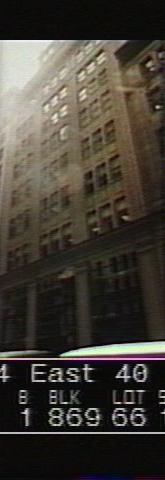
The city photographed every building for its tax records around 1940 and again in the 1980s. NYC Municipal Archives.
Written with AI from the source each entry cites, then fact-checked.
- 1927
Texas banker Jesse Jones buys the Hotel Touraine and neighboring buildings for a skyscraper site
The New York Evening Post reported on July 16, 1927 that Jesse H. Jones had bought the Hotel Touraine, a 12-story building at 9-11 East 39th Street, along with the properties numbered 10 through 14 East 40th, the lot where this tower would rise. He planned a 35-story skyscraper there, a figure he soon raised. The deal was put at about $5 million, and the Fifth Avenue department store Arnold, Constable & Co. had already leased the lowest six floors of the planned tower.
Source: Daytonian in Manhattan
- 1929
Jesse Jones opens a 45-story tower designed by Ludlow & Peabody
Texas banker Jesse H. Jones, who had bought the site in 1927, opened this 45-story office tower on May 1, 1929 at 80 percent occupancy. Ludlow & Peabody's Renaissance Revival design, topped by a hipped roof with oculi, made it the fourth-tallest building in the world at completion. Arnold, Constable & Co. leased the lower six floors for its department store.
Source: Daytonian in Manhattan
- 1930
A court bars tenant Hazel Christmas from further dealings in a Texas oil company's stock
Hazel Christmas, head of the Securities Service Company and Securserv, Inc., was among the building's tenants who ran into legal trouble after the 1929 crash. In an order dated February 25, 1930, Justice Harry E. Lewis barred her from further trading in Universal Oil and Gas Company stock. Her clients included former Police Commissioner Richard E. Enright, and the complaint called the information they received about the Texas oil and gas venture misleading.
Source: Daytonian in Manhattan
- 1930
Publicist Carl Byoir, with offices here, is named to a Cuba Good Will Committee
Carl Byoir, who published the Havana Post and the Havana Telegram, kept offices in the tower when he was named the Cuba Good Will Committee's secretary and treasurer on August 16, 1930. Jewish Telegraphic Agency reports later tied him to German propaganda work, and noted that the offices of George Sylvester Viereck, a defender of Hitler's Germany, adjoined his.
Source: Daytonian in Manhattan
- 1933
The New Amsterdam Brewing Company takes executive offices as Prohibition ends
The New York Times reported on March 6, 1933 that the New Amsterdam Brewing Company had taken executive offices in the building as Prohibition ended. The company had recently announced plans for a brewery at Little Village in Queens.
Source: Daytonian in Manhattan
- 1938
Frederick William Vanderbilt, the tower's owner, dies
Frederick William Vanderbilt owned the tower, then known as the Chase Tower after first tenant Chase Brass & Copper, until his death in 1938.
Source: Wikipedia
- 1946
The American Civil Liberties Union sets up its national headquarters here
By March 1946 the American Civil Liberties Union had made the tower its national headquarters, one of several advocacy and labor groups to take offices there after World War II, alongside the Newspaper Guild Club, which had moved in in 1942.
Source: Daytonian in Manhattan
- 1963
A secretary on her last day is honored for 550,000 miles of commuting
Helen K. Jones was hired as a secretary by the American Standard Association in 1926 and commuted from Westchester County for 37 years. On the morning of November 26, 1963, as she headed in for her last day before retirement, William R. Main, an assistant vice president of the New York Central Railroad, met her on the Pleasantville platform and gave her a scroll honoring her 550,000 miles of commuting without complaining.
Source: Daytonian in Manhattan
- 1969
Two men shoot an accounting firm employee in the elevator and take a $7,000 payroll
In 1969 many companies still paid their workers in cash. At 11:45 on the morning of April 6, Phillip Coore, 40, of the accounting firm David W. Katz & Co. on the 12th floor, withdrew the week's $7,000 payroll and headed back to the office. Two men rode up in the elevator with him, shot him when the doors closed and took the money. He was brought to St. Clare's Hospital, and his condition was serious.
Source: Daytonian in Manhattan
- 1970
A tenant lawyer is convicted of trying to sell letters Jacqueline Kennedy wrote to a colleague
The law firm of Carro, Spanbock & Londin had offices in the tower, and its attorneys included Roswell Gilpatric, a former deputy secretary of defense, and Theodore E. Donson. Donson was convicted in May 1970 of trying to sell a batch of letters Jacqueline Kennedy had written to Gilpatric, who said they were taken from a locked desk drawer in his office. Donson pleaded guilty to a misdemeanor and was fined $100.
Source: Daytonian in Manhattan
- 2007
The building becomes the last stop on Edison's direct current grid
On November 14, 2007, this tower was the final building in New York City disconnected from Thomas Edison's original direct-current electrical grid, shifting the job of converting power from Con Edison to an on-site converter after nearly 80 years.
Source: Wikipedia
Further reading
- 10 East 40th StreetWikipedia
- Ludlow & Peabody's 1929 10 East 40th StreetDaytonian in Manhattan
Nearby
- Stavros Niarchos Foundation Library455 5th Avenue | 6 entries
- 461 Fifth Avenue461 5th Avenue | 6 entries
- 425 Fifth Avenue425 5th Avenue | 5 entries
- 275 Madison Avenue13 entries
- Knox Building452 5th Avenue | 10 entries
- Lord & Taylor Building424 5th Avenue | 12 entries