Knickerbocker Village
10 Monroe Street | also 16 Monroe Street, 100 Cherry Street | Two Bridges | built 1935
Open on the map5 entries

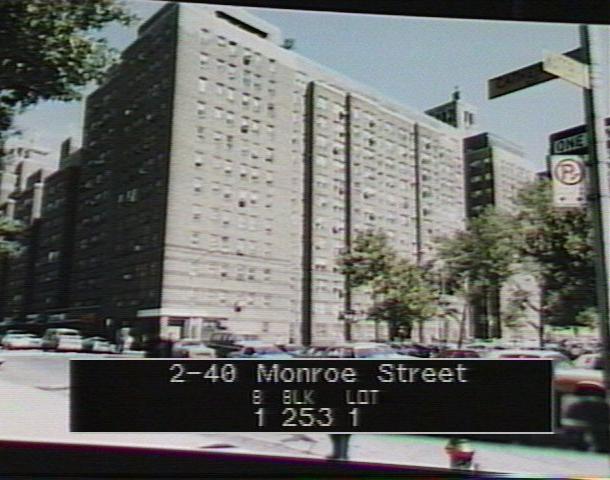
The city photographed every building for its tax records around 1940 and again in the 1980s. NYC Municipal Archives.
Written with AI from the source each entry cites, then fact-checked.
- 1933
Fred French secures the first federal loan for a US apartment complex
Developer Fred F. French begins construction of Knickerbocker Village in 1933 with a loan from the federal Reconstruction Finance Corporation covering 97 percent of its $10 million cost, the first time a US apartment development receives federal backing. The twelve thirteen-story buildings rise around two courtyards on the site of the old Lung Block slum. Construction finishes the following year.
Source: Wikipedia
- 1934
Knickerbocker Village opens on the site of the Lung Block
Developer Fred F. French built Knickerbocker Village in 1933 and 1934 on the site of the Lung Block, a tenement district named for its tuberculosis deaths, where about 650 families had lived. A Reconstruction Finance Corporation loan covered 97 percent of the $10 million cost, making it the first apartment development in the country to receive federal funding. Its twelve 13-story buildings hold 1,590 apartments, and its tenants became known for organizing.
Source: Wikipedia
- 1950
Julius and Ethel Rosenberg of 10 Monroe Street are arrested as atomic spies
Julius and Ethel Rosenberg, who met in 1935, lived in an apartment in this building at 10 Monroe Street. In 1950 they were arrested and charged with passing information about the atomic bomb to the Soviet Union, and the apartment was named as a place where the alleged espionage took place. Both were executed on June 19, 1953.
Source: theclio.com
- 2012
Hurricane Sandy floods Knickerbocker Village
Hurricane Sandy severely damages Knickerbocker Village in 2012, flooding the complex just blocks from the East River. The property later receives significant funding through the city's Build It Back program to repair the damage.
Source: Wikipedia
- 2019
A $3 million tax break ends a five-year fight over rent hikes
A five-year fight to keep Knickerbocker Village affordable ends in 2019 when the city grants the complex a $3 million tax break to preserve its below-market apartments. Without the deal, tenants had faced a rent increase that would have made the eighty-five-year-old complex unaffordable for most residents.
Source: Wikipedia
Further reading
- Knickerbocker VillageWikipedia
Nearby
- St. Joseph School1 Monroe Street | 4 entries
- The Lincoln84 Madison Street | 4 entries
- Nicholas Keane House96 Madison Street | 5 entries
- Knickerbocker Village150 Cherry Street | 4 entries
- Alfred E. Smith Houses, Building 1260 Madison Street | 2 entries
- William and Mary Bogart Clark House51 Market Street | 4 entries