Thomas Mulry House
10 Perry Street | West Village | built 1849
Open on the map6 entries

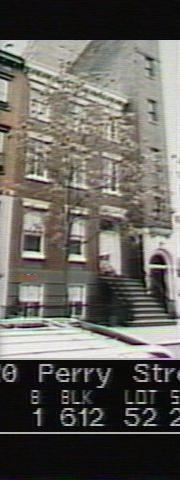
The city photographed every building for its tax records around 1940 and again in the 1980s. NYC Municipal Archives.
Written with AI from the source each entry cites, then fact-checked.
- 1849
One of a row of seven Italianate houses, it gains ornate double doors around 1860
Richard Moore, a blacksmith, built No. 10 in 1849 as part of a row of seven, of which only four survive. The Landmarks Commission calls it the prototype of the row and best shows the original look, with a rusticated base. About 1860 an ornate pair of paneled double doors in the French Second Empire manner was added at the entrance.
“Added about 1860 at the entrance of No. 10 are a superb pair of paneled double doors.”
- 1905
Mayor McClellan asks Thomas Mulry, a builder and Catholic lay leader, to be Tenement-House Commissioner
Thomas M. Mulry, whose construction firm was thriving, lived here and was president of the St. Vincent de Paul Society. On June 18, 1905, Mayor McClellan asked him to become Tenement-House Commissioner. The Evening World called him independent and well suited, noting he was one of the city's leading contractors with a heavy load of charity work.
Source: Daytonian in Manhattan
- 1905
Five Mulry brothers gather at the house to celebrate a new priest's ordination
About a month after the commissioner offer, the house hosted a reunion of the Mulry brothers for the ordination of Joseph Mulry. Rev. Patrick F. X. Mulry made the trip from the West Indies to attend. With Joseph ordained, every brother except Thomas was a Catholic priest.
Source: Daytonian in Manhattan
- 1912
Thomas Mulry receives the Laetare Medal before a crowd of 1,500
On May 12, 1912, Cardinal John Murphy Farley presented Mulry with Notre Dame's Laetare Medal, the highest honor in American Catholicism. Mulry had asked for a quiet ceremony, but the cardinal chose a larger one, and more than 1,500 people came to Cathedral College.
Source: Daytonian in Manhattan
- 1914
The Seventh Avenue extension misses the house by a few feet
When Seventh Avenue was cut south through the Village in 1914, No. 10 survived by only a few feet. Today its brownstone stoop can be seen curving over the property line of the newer building next door.
Source: Daytonian in Manhattan
- 1916
Thomas Mulry dies of pneumonia at home with a cardinal at his bedside
Mulry came home ill on March 8, 1916, and died of pneumonia on March 10, with his family and Cardinal Farley beside him. About four months earlier he had been installed as head of the St. Vincent de Paul Society's national Superior Council. His estate proved far smaller than New Yorkers expected.
Source: Daytonian in Manhattan
Further reading
- The Thomas Mulry House -- No. 10 Perry StreetDaytonian in Manhattan
- Then & Now photos: 10 Perry StreetVillage Preservation: Greenwich Village Then & Now
Nearby
- Mayfield Apartments159 7th Avenue South | 1 entry
- 175 7th Avenue South1 entry
- 15 Charles Street3 entries
- 53 Greenwich Avenue1 entry
- 51 Greenwich Avenue1 entry
- 55 Greenwich Avenue2 entries