Staten Island Borough Hall
10 Richmond Terrace | St. George | built 1906
Open on the map6 entries

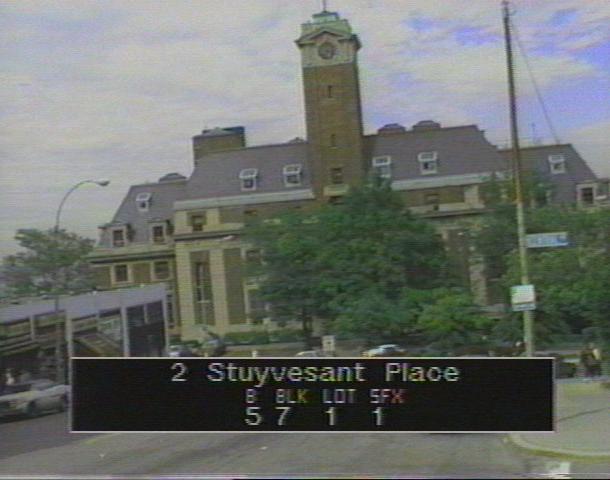
The city photographed every building for its tax records around 1940 and again in the 1980s. NYC Municipal Archives.
Written with AI from the source each entry cites, then fact-checked.
- 1903
Carrère & Hastings design Borough Hall in an early French Renaissance brick style
Rather than the stone used for their other government buildings, the firm modeled the hall on the sober brick architecture of the reigns of Henry IV and Louis XIII, the style of the Place des Vosges in Paris. The landmark report calls it perhaps the firm's finest work in that mode and suggests brick may have been required because brickmaking was a major island industry, or chosen to recall Staten Island's French Huguenot settlers.
“…the program may have required a brick building since the manufacture of brick was a major industry on Staten Island…”
- 1904
Staten Island lays the cornerstone of its new Borough Hall
Before consolidation in 1898, the county's government sat at Richmondtown; borough offices were then moved to St. George, the ferry terminus. When the cornerstone was laid in 1904, The New York Times described the ceremony as Staten Island proudly proclaiming itself part of Greater New York. Until the hall was ready, civic offices worked out of the Richmond Building in New Brighton.
- 1906
Borough Hall opens on its hilltop above the St. George ferry terminal
The building was first occupied on May 21, 1906. At first it stood among undistinguished wooden and brick buildings, but George Cromwell, the borough's first president, dreamed of surrounding it with a full civic center. Courts, a police station and a post office followed over the next decades.
- 1936
Artist Frederick Charles Stahr wins WPA funding to paint Borough Hall's 13 murals
Stahr, raised on Staten Island and trained in Munich and Rome, had been promised the commission by John Carrère, but there was no money for murals when the building opened in 1906. Three decades later he applied to the Works Progress Administration, which approved the project in 1936. Over two years he painted the canvases in a third-floor studio and had each one cemented to the walls as he finished it.
Source: Wikipedia
- 1937
Stahr's murals put Bayonne Bridge designer Othmar Ammann on Borough Hall's walls
The 13 panels run from Verrazzano's arrival in 1524 through the 1776 peace conference at the Conference House to the 19th-century Hotel Castleton, whose operators were freed Black men. One shows a stagecoach at the Black Horse Tavern, torn down in 1934 for road widening three years before the 1937 painting. The last depicts a well-dressed Ammann watching his Bayonne Bridge go up.
“…a stagecoach stopping at the Black Horse Tavern, which had been destroyed to accommodate road widening in 1934, three years prior to the 1937 painting…”
Source: Wikipedia
- 1982
The Landmarks Preservation Commission designates Staten Island Borough Hall a landmark
The commission held its public hearing on September 9, 1980, when five witnesses spoke in support and nobody opposed. It designated the hall and its lot on March 23, 1982. The report noted that the brick building and its tall clocktower, set on a hill above the St. George terminal, are seen by everyone who comes to the island by ferry.
Further reading
- Staten Island Borough HallWikipedia
Nearby
- Richmond County Courthouse18 Richmond Terrace | 6 entries
- St. George Theatre19 Hyatt Street | 8 entries
- Old Administration Building, Third District Lighthouse Depot5B Borough Place | 5 entries
- Brighton Heights Reformed Church320 St Marks Place | 2 entries
- Empire Outlets35B Richmond Terrace | 4 entries
- National Lighthouse Museum200 The Promenade | 6 entries