Bloomingdale's flagship store
1000 3rd Avenue | also 743 Lexington Avenue | Upper East Side | built 1868
Open on the map7 entries

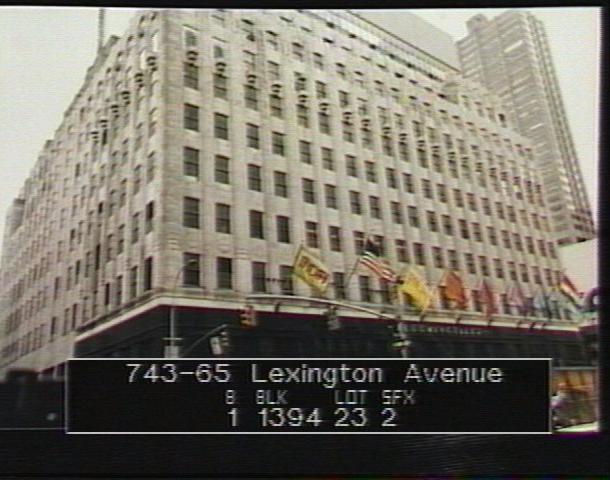
The city photographed every building for its tax records around 1940 and again in the 1980s. NYC Municipal Archives.
Written with AI from the source each entry cites, then fact-checked.
- 1886
Joseph and Lyman Bloomingdale open their new store between Third and Lexington avenues
The Bloomingdale brothers, Joseph and Lyman, open their new department store on the block bounded by Third and Lexington avenues and 59th and 60th streets in 1886. Herman J. Schwarzmann and Albert Buchman designed it as the third relocation of the brothers' Great East Side Bazaar. Buchman & Deisler later add a Renaissance-style annex and a wing running to 59th Street in 1893.
Source: Wikipedia
- 1902
Samuel Bloomingdale turns the trolley hub at the store into the slogan 'All Cars Transfer to Bloomingdale's'
Samuel J. Bloomingdale, son of Lyman, builds an advertising campaign in 1902 on the store's position at a hub of the city's horse-drawn trolley lines. Its slogan promises that all cars transfer to Bloomingdale's. The campaign is the largest of its era, running on billboards and on more than 5,000 beach umbrellas handed out free to street vendors and delivery cart drivers.
Source: fundinguniverse.com
- 1918
The store shifts its main entrance to Lexington Avenue and lends a floor to the Red Cross
After the subway opens, Bloomingdale's moves its primary entrance to the Lexington Avenue side in 1918 to draw shoppers coming from the nearby 59th Street stop. With the United States in World War I, Samuel Bloomingdale lets the American Red Cross use a whole floor of the store for free until the war ends. By 1927 the company controls the entire block.
“…the store's primary entrance was shifted to its Lexington Avenue side in 1918 ... Samuel Bloomingdale gave the American Red Cross free use of an entire floor there until the war ended.”
Source: Wikipedia
- 1930
Starrett & Van Vleck fill out the block and give the store its Art Deco Lexington Avenue front
Starrett & Van Vleck expand Bloomingdale's to occupy the entire city block in 1930, adding the signature Art Deco facade along Lexington Avenue. In the 1980s the architect William J. Conklin calls the original construction and later additions a complete mess architecturally, yet Federated Department Stores does not go ahead with his plans to restore the exterior.
“Starrett & Van Vleck expanded the store to occupy the entire city block with the 1930 expansion, which also added the signature Art Deco facade along Lexington Avenue.”
Source: Wikipedia
- 1971
'The Cave,' a model room wrapped in white polyurethane, typifies the store's retail theater
By the time Bloomingdale's reaches its 100th anniversary in 1972, its in-store displays are so elaborate that retail analysts coin the phrase retailing as theater. Model rooms grow showier still, and a 1971 display called The Cave rises as a multi-level structure wrapped entirely in white polyurethane. By 1972 the flagship's yearly sales are estimated at $100 million.
Source: fundinguniverse.com
- 1972
Marvin Traub calls Saturdays at the store 'the biggest party in town' on its 100th anniversary
On the store's 100th anniversary in 1972, president Marvin Traub tells the New York Times that Saturdays at Bloomingdale's are the biggest party in town. He says it is a place where young people make dates for the night, and that more people have started calling it Bloomie's. A survey of the time finds over 60 percent of customers live and work in nearby luxury towers.
Source: fundinguniverse.com
- 1976
Queen Elizabeth and Prince Philip spend an afternoon shopping at Bloomingdale's
On her second visit to New York, Queen Elizabeth spends an afternoon at Bloomingdale's with Prince Philip. Traffic on Lexington Avenue is reversed so she can step out of her car on the right side. She walks floor to floor, sees a fashion show and meets designers including Calvin Klein, while the Prince is shown best sellers such as a talking calculator and a pet rock.
Source: Untapped New York
Further reading
- Bloomingdale's flagship storeWikipedia
Nearby
- Bloomberg Tower151 East 58th Street | 10 entries
- Trump Plaza1030 3rd Avenue | 7 entries
- Argosy Book Store116 East 59th Street | 6 entries
- Serendipity 3225 East 60th Street | 4 entries
- Tower 57135 East 57th Street | 10 entries
- The Galleria117 East 57th Street | 8 entries