Van Nuyse-Magaw House
1041 East 22nd Street | Midwood | built 1901
Open on the map4 entries

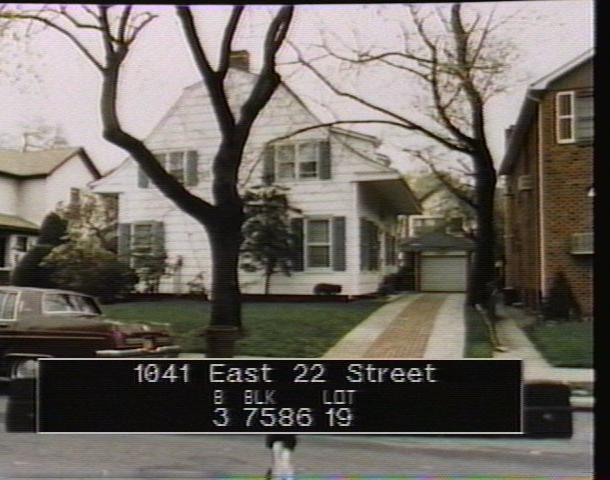
The city photographed every building for its tax records around 1940 and again in the 1980s. NYC Municipal Archives.
Written with AI from the source each entry cites, then fact-checked.
- 1800
Johannes Van Nuyse marries Nellie Lott and starts building a farmhouse on his father's land
Johannes Van Nuyse (1736-1826), born on the Flatlands plain to the Dutch farmer Joost Van Nuyse, married Nellie Lott on April 2, 1800. About then he began building his home at the west end of his father's eighty-five-acre farm. Tradition holds that it was finished around 1803, with a kitchen wing at one end.
- 1909
Frederick Magaw is believed to have sold the Van Nuyse farmhouse in 1909, after his father Robert bought it
The landmarks commission believed Robert Magaw bought the house sometime between 1844 and the 1850s, which gives the building its second family name. It also believed that one of his three sons, Frederick, sold it in 1909. The report states both as beliefs, and the exact purchase year is uncertain.
- 1916
George C. Case buys the house, moves it to its present site and removes the kitchen wing
George C. Case bought the farmhouse in 1916 and moved it to its present site on East 22nd Street. Around the same time he took off the kitchen wing and added new dormer windows.
- 1969
The city designates the Van Nuyse-Magaw House a landmark as a rare surviving Dutch Colonial farmhouse
On February 11, 1969, the Landmarks Preservation Commission designated the house, a shingle-covered two-and-a-half-story frame dwelling with a gambrel roof whose curved eaves project beyond the walls. The commission called it a well-preserved, outstanding Dutch Colonial farmhouse of about 1800 with only minor twentieth-century alterations, and one of very few of its type left in the city.
“…outstanding example of an 1800 Dutch Colonial farmhouse with minor Twentieth Century modifications…”
Nearby
- Van Nuyse-Magaw House1041 East 22nd Street | 1 entry
- East Midwood Jewish Center1625 Ocean Avenue | 7 entries
- Di Fara Pizza1424 Avenue J | 6 entries
- Avenue H Station House1518 Avenue H | 5 entries
- Edward R. Murrow High School1600 Avenue L | 5 entries
- Van Nuyse-Coe House1128 East 34th Street | 5 entries