John Birks "Dizzy" Gillespie Residence
105-19 37th Avenue | also 34-68 106th Street | North Corona | built 1920
Open on the map7 entries

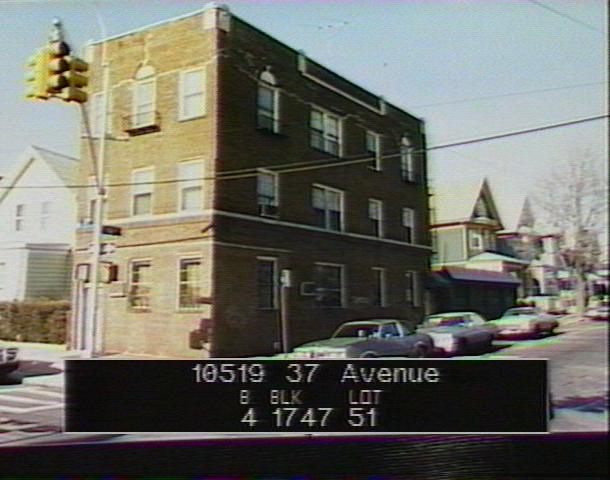
The city photographed every building for its tax records around 1940 and again in the 1980s. NYC Municipal Archives.
Written with AI from the source each entry cites, then fact-checked.
- 1922
A red-brick house goes up and is sold to the Schneller family
The three-story red-brick house went up around 1922 as a one-family home, on land that had been part of a tract called Louona Park in the late 1800s and was later owned by Helen Kolsch. In 1922 Kolsch sold the property to Beatrice Schneller, whose family stayed until 1953. During their years here, in the 1940s, the house was split into apartments for several families.
“Kolsch sold the property with the house in 1922 to Beatrice Schneller, who lived there with her family until 1953…”
- 1953
Dizzy Gillespie buys the house with a loan from the owner of Birdland
Jazz trumpeter Dizzy Gillespie and his wife Lorraine, then renting on 76th Road in Flushing, wanted this house around the corner from Louis Armstrong. Because a mortgage was hard to get, business manager Walter "Foots" Thomas arranged an interest-free down-payment loan from Birdland owner Morris Levy, taken out of Dizzy's pay at the club. The couple bought the house in June 1953. Years later Levy gave all the money back in a shoe box.
- 1956
Edward R. Murrow interviews the Gillespies at home for Person to Person
In 1956 Gillespie led an integrated band on the government's first jazz "Good Will Tour," through Europe, South Asia, the Middle East and South America. When he got back that June, newsman Edward R. Murrow interviewed him and Lorraine here in Corona on the television program Person to Person. Murrow returned in 1958 for a second interview and remarked on how freely Gillespie shared his musical knowledge with young players.
“Edward R. Murrow interviewed Dizzy Gillespie and his wife Lorraine at their home in Corona, on his popular "Person to Person" television program…”
- 1958
Young musicians learn harmony in Gillespie's basement rehearsal studio
Gillespie ran a rehearsal studio in the basement and invited other musicians in. Pianist Junior Mance, a member of his band from 1958 to 1961, remembered hours down there learning chord changes that were new to him. Tenor saxophonist Benny Golson recalled that Dizzy held nothing back, and alto saxophonist Phil Woods said a visit to the Corona house gave him confidence.
“I remember spending several hours at a time in his basement studio being shown chord changes that I never knew existed.”
- 1964
Gillespie runs a brief campaign for president while living in Corona
In 1964 and 1965, while still living in this Corona house, Gillespie made a brief run for president. He was inspired by Martin Luther King Jr.'s ideas about civil rights, and his real goal was to push the Democratic Party to focus more on them.
- 1965
The Gillespies move out but keep the house for another two decades
After releasing the Caribbean-flavored album Jambo Caribe in 1965, Dizzy and Lorraine Gillespie left 105-19 37th Avenue in late 1965 or early 1966. They held on to the property until April 1985, owning it for 32 years in all.
- 2023
The city designates the Gillespie residence a landmark over its owner's objection
The Landmarks Preservation Commission calendared the house on April 4, 2023, held a hearing on June 6 and designated it on June 27. The Historic Districts Council, the Corona East Elmhurst Preservation Society and two individuals spoke in favor, and letters of support came from the New York Landmarks Conservancy and Assemblymember Jeffrion L. Aubry. Two representatives of the owner spoke against it.
“Two representatives of the owner spoke in opposition.”
Nearby
- Louis Armstrong House34-56 107th Street | 7 entries
- Engine Company 289, Ladder Company 13897-28 43rd Avenue | 4 entries
- Edward E. Sanford House102-45 47th Avenue | 3 entries
- New York Hall of Science47-01 111th Street | 8 entries
- Arthur Ashe Stadium122-02 Roosevelt Avenue | 8 entries
- Grandstand6 Meridian Road | 5 entries