1065 Clay Avenue
Concourse Village | built 1902
Open on the map3 entries

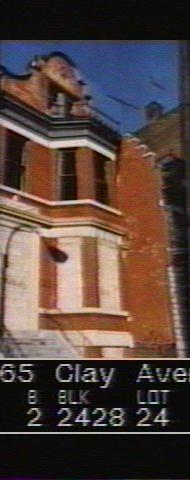
The city photographed every building for its tax records around 1940 and again in the 1980s. NYC Municipal Archives.
Written with AI from the source each entry cites, then fact-checked.
- 1900
Ernest Wenigmann buys the Clay Avenue land, partly from a Morris heir
Bronx builder Ernest Wenigmann, whose office was at East 179th Street and Morris Avenue, acquired the Clay Avenue land in 1900, buying some plots straight from Juliet M. Livingston, an heir of the Morris family, and others from intermediaries. He then built this house and the rest of the block's two-family houses in 1901-02.
- 1902
Warren C. Dickerson gives No. 1065 a stepped Flemish gable
Designed by Warren C. Dickerson and finished in 1901-02 for developer Ernest Wenigmann, No. 1065 forms a mirror pair with No. 1063. It is faced in beige Roman brick with a three-sided bay, and its Flemish-style gable, with one step and a tall rounded peak, frames two windows under a galvanized-iron cartouche bearing a fleur-de-lis.
- 1994
No. 1065 stands vacant when Clay Avenue is landmarked
When the Landmarks Preservation Commission designated the Clay Avenue Historic District in 1994, No. 1065 was empty. Its doors and window sash had been removed, while the beige brick of its twin, No. 1063, remained unpainted.
“At the time of designation, No. 1065 was vacant and the window sash and doors had been removed.”
Nearby
- 1063 Clay Avenue2 entries
- 1067 Clay Avenue3 entries
- 1061 Clay Avenue3 entries
- 360 East 166th Street2 entries
- 1059 Clay Avenue2 entries
- 1064 Clay Avenue2 entries