Congregation Tifereth Israel
109-18 54th Avenue | Corona | built 1931
Open on the map8 entries

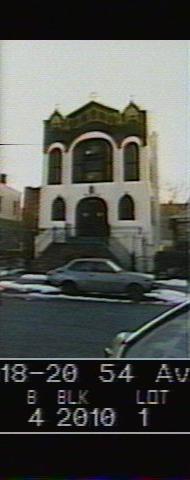
The city photographed every building for its tax records around 1940 and again in the 1980s. NYC Municipal Archives.
Written with AI from the source each entry cites, then fact-checked.
- 1908
Josephine Esther Mentzer, the future Estée Lauder, is born; she grows up in this congregation
Josephine Esther Mentzer, born in 1908, was one of the synagogue's early congregants. Her parents, Rose and Max Mentzer, ran a hardware store two blocks away, and she spent her youth in Corona, where she started selling products door to door. As Estée Lauder she went on to lead a multi-billion-dollar company that controlled 45 percent of the cosmetics market in American department stores.
“One of the synagogue's early congregants was a young woman named Josephine Esther Mentzer, who would grow up to become the immensely successful cosmetics entrepreneur Estée Lauder.”
- 1911
Another Corona synagogue's president auctions off honors at the cornerstone laying
The congregation bought the lot at 136 Home Street, renamed 54th Avenue around 1925, in April 1911 and laid the cornerstone on August 13. A crowd watched Dr. Peyser, president of Corona's Smith Street synagogue, act as auctioneer, selling ceremonial privileges that raised $350. A local paper predicted the finished building would rank among Corona's most imposing houses of worship.
- 1911
Lower East Side transplants incorporate the congregation known as the Home Street Synagogue
Organized around 1907 by Jews who had mostly come from the Lower East Side, the congregation incorporated in 1911 with Philip Worth as president, Solomon Dauber as vice president, Jacob Teitelbaum as secretary and Hersch Eisenstein as treasurer. Its full name, Congregation Independent Chevra Tyfers Israel Anshei Corona, proved unwieldy, so people called it the Home Street Synagogue after its street.
“Its officers at the time of incorporation were Philip Worth, president; Solomon Dauber, vice president; Jacob Teitelbaum, secretary; and Hersch Eisenstein, treasurer.”
- 1911
C. L. Varrone gives the wooden synagogue onion-domed towers like Lower East Side shuls
Local architect Crescent L. Varrone, who kept an office in Corona, designed a two-story wood-frame synagogue on the pattern of Lower East Side shuls squeezed onto tenement lots: a three-part front with a central door and corner towers capped by onion domes. Pointed-arched windows and a Star of David roundel in colored glass complete the Gothic and Moorish mix. Little else is known about Varrone, who designed many homes and shops over a career of nearly fifty years.
- 1997
Courts side with Bukharan newcomers locked out of the dwindling synagogue
Bukharan Jews had prayed in the basement since the mid-1990s, but tension flared in spring 1997 after Amnun Khaimov became their rabbi. Synagogue president Benjamin Fried, 82, began locking them out except on the Sabbath and holidays. Member Violet Milne, a Holocaust survivor, sued for them; a rabbinical court ordered the synagogue open to all, the State Supreme Court upheld that on September 24, and Khaimov's congregation took over.
“…on September 24, the State Supreme Court upheld that ruling. Khaimov and his congregation took over the synagogue.”
Source: Wikipedia
- 2002
Tifereth Israel becomes the first Queens synagogue on the National Register
The New York Landmarks Conservancy's Sacred Sites program began working with the congregation in 1999, funding a building survey and later exterior repairs, and the Queens Historical Society named it a Queensmark that year. On November 21, 2002, the National Register of Historic Places took in the synagogue together with the rabbi's residence, making it the first Queens synagogue on that list.
“…added to the National Register of Historic Places on November 21, 2002, the first synagogue in Queens to be listed…”
Source: Wikipedia
- 2008
The basement ceiling collapses weeks before the synagogue becomes a city landmark
By 2008 the building had termites, leaks and peeling paint, and in January its basement ceiling fell in. The Landmarks Preservation Commission designated it a city landmark that February, noting its original windows, wood ornament and Moorish pressed-metal details. Exterior repairs alone were estimated at $1.4 million, and more than $1 million in city and state money was held up because the synagogue was a private religious nonprofit.
Source: Wikipedia
- 2010
A $275,000 gift launches a $1.5 million restoration to strip the stucco
Money came from a state environmental fund, the New York Community Trust and the Ronald and Leonard Lauder families, and by 2010 a $275,000 donation from Arnold Goldstein had started $1.5 million in restoration work. The plan called for removing the stucco and bringing back the wood clapboard, windows and doors, Moorish metal domes and finials, and repainting in the original colors.
Source: Wikipedia
Further reading
Nearby
- Congregation Tifereth Israel mikveh109-20 54th Avenue | 1 entry
- Terrace on the Park52-11 111th Street | 8 entries
- Flushing Meadows Carousel16 Zoo Path | 7 entries
- New York Hall of Science47-01 111th Street | 8 entries
- Queens Museum52-01 Grand Central Parkway | 9 entries
- Edward E. Sanford House102-45 47th Avenue | 3 entries