Doering-Bohack House
1090 Greene Avenue | also 1 Goodwin Place | Bushwick | built 1901
Open on the map8 entries

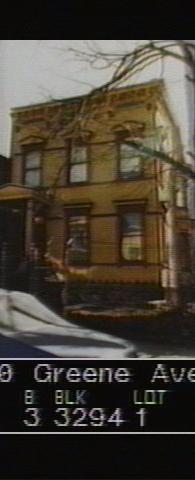
The city photographed every building for its tax records around 1940 and again in the 1980s. NYC Municipal Archives.
Written with AI from the source each entry cites, then fact-checked.
- 1887
Frederick and Rosa Doering buy a Central Place lot and hire Theobald Engelhardt to design their house
Frederick Doering, a mason in his father's building firm, and his wife Rosa, the daughter of florist Charles Krick, bought a 40-by-100-foot lot at 44 Central Place, now Goodwin Place. They hired Engelhardt, an architect their family's masonry firm had worked with, to plan a frame house of two and a half stories. This house was later moved to its present corner on Greene Avenue.
- 1887
Engelhardt's frame house mixes neo-Grec and Queen Anne detail
The house is a two-and-a-half-story frame building on a brick basement with a habitable attic. Its details include incised neo-Grec window surrounds, lintels with a sunburst motif, a cornice with paired acanthus-leaf brackets, and a two-story oriel on the side facade. Engelhardt designed three nearly identical houses at 46 to 50 Central Place the same year.
“…almost identical in design to the three houses at 46 to 50 Central Place (aka 46-50 Goodwin Place), which are documented Engelhardt works, dating from 1887…”
- 1902
Central Place neighbors petition against Henry Bohack's warehouse plan for the Doering house lot
The Brooklyn Daily Times reported that residents of Central Place were up in arms over grocer Henry Bohack's plan to extend his Broadway store onto the Doering lot. A petition against it gathered hundreds of signatures, and bills were introduced in the state legislature to bar business from the street. Bohack had already spent $25,000, and Engelhardt filed plans for a brick warehouse and stable on February 7, before any law could take effect.
“…residents of Central Place were up in arms, that a petition to block the store had garnered hundreds of signatures…”
- 1902
Bohack buys the lot and its older De Coudres house to receive the Doering house
An older house, the De Coudres house, stood on this 39-by-109-foot corner lot before the Doering house arrived. Bohack, reluctant to lose the Doering house when it was only about 15 years old, finalized his purchase of 1090 Greene Avenue on January 30, 1902. Within about a week, Engelhardt applied for a permit to move the existing building and put up a brick foundation.
- 1902
Henry and Emma Bohack settle into the relocated house
By October 1902 the alterations at 1090 Greene Avenue were finished, and Henry C. Bohack and his wife Emma were living there with at least one live-in servant. They stayed until 1921, joined after 1911 by Bohack's nephew and namesake, Henry C. Bohack Jr. Sometime in 1904-1908 Bohack built a one-story extension onto the rear of the house.
- 1921
The Bohacks sell the house and move to Kew Gardens as the grocery chain grows
Henry and Emma Bohack sold the house to Pauline Rothenberg, wife of Arnold Rothenberg, and moved to Kew Gardens. Bohack, a German immigrant who arrived in 1882 at age 17, had incorporated his business in 1903. When he died in 1931 the chain ran 740 grocery and meat stores, and it ceased operations in May 1977.
- 1928
Catherine Scuderi buys the house, and her son Dr. Samuel Scuderi later gets a medical office in it
After her husband Arnold died in December 1927, Pauline Rothenberg sold the house to Catherine Scuderi in late January 1928. The 1930 census listed Angelo and Catherine Scuderi in the house with six grown children. One of them, Dr. Samuel F. Scuderi, was a physician tied to Kings County Hospital, and in the 1930s the basement and front yard were altered to create a medical office for him.
- 2014
The city designates the house a landmark, after first hearing it as the De Coudres-Bohack House
The Landmarks Preservation Commission first heard the case on June 25, 2013 under the name De Coudres-Bohack House. Four speakers backed it, among them a representative of Council Member Diana Reyna and speakers for the Historic Districts Council, the New York Landmarks Conservancy and the Victorian Society New York. At a second hearing on October 29, 2013, no one spoke, and no one opposed it at either. The commission designated the Doering-Bohack House on September 30, 2014.
“…the item had been previously heard on June 25, 2013 (Item No. 2) as the De Coudres-Bohack House. At that hearing there were four speakers in favor…”
Nearby
- Peter P. and Rosa M. Huberty House1019 Bushwick Avenue | 7 entries
- South Bushwick Reformed Church855 Bushwick Avenue | 8 entries
- Rugged Cross Baptist Church1084 Lafayette Avenue | 4 entries
- Ridgewood Masonic Temple1054 Bushwick Avenue | 4 entries
- St. Augustine's Home for the Aged797 Bushwick Avenue | 5 entries
- Brooklyn Public Library, DeKalb Branch790 Bushwick Avenue | 5 entries