Thomas Lynch Stable
11 Weehawken Street | also 9 Weehawken Street, 177 Christopher Street | West Village | built 1900
Open on the map6 entries

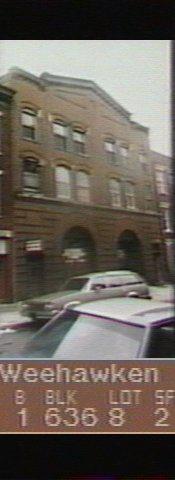
The city photographed every building for its tax records around 1940 and again in the 1980s. NYC Municipal Archives.
Written with AI from the source each entry cites, then fact-checked.
- 1905
Two brick tenements, earlier buildings on the site, pass from the Beadleston family to a truckman
Before the stable, two brick tenements stood at Nos. 9 and 11 Weehawken Street, put up by Henry Beadleston, a founder of the nearby brewery at Nos. 3-5. The Beadleston family kept them until April 1905, when Thomas Lynch, a truckman with a delivery business at 25 West Broadway, bought them. He waited until 1908 to demolish the tenements and start building.
Source: Daytonian in Manhattan
- 1908
George M. McCabe designs a neo-Romanesque stable for Thomas Lynch at 9-11 Weehawken Street
In 1908 Thomas Lynch built a stable with a single-family apartment on the third story, designed by George M. McCabe, an architect who specialized in stables. The red brick front has rock-faced stone trim, a rusticated ground story with two large round arches flanked by smaller entrances, and a corbeled cornice with a central pediment. The Landmarks Preservation Commission found it contributes to the character of the Weehawken Street Historic District.
- 1922
Thomas Lynch turns his stable into a garage for 50 vehicles
Lynch began a renovation in 1921 that was finished in 1922. It put a garage on the ground floor, rated for 50 vehicles, and storage on the second floor, where horses had been stabled. He leased the building to the Thos. Lynch Garage, Inc. In June 1923 the Fire Commissioner ruled that the third-floor living quarters could be used only by the owner.
Source: Daytonian in Manhattan
- 1947
The Oelhaf family begins nearly four decades of ownership of 9-11 Weehawken Street
From 1944 to 1947 the building was owned by the Weehawken Realty Co. and occupied by Ray Electric Co., a marine electrical contracting firm that Joseph Buehler Jr. and George Frick had started in 1919. In 1947 the Oelhaf family took it over and kept it until 1984 for their marine repair firm, Meier & Oelhaf Co. In 1971-72 the lot was merged with 7 Weehawken Street and 177 Christopher Street, and in 1984 the property was acquired by William Gottlieb.
“…was owned by the Oelhaf family and used by the Meier & Oelhaf Co., the marine repair firm…”
- 1954
The Rainbow Room's Wurlitzer pipe organ is installed in an apartment at 9-11 Weehawken Street
In 1954 the Rainbow Room, atop Rockefeller Center, installed air conditioning that pushed out the Art Deco Wurlitzer organ it had put in during 1934. Dick Leibert, the Radio City Music Hall organist, arranged its sale to Joseph Oelhaf, a marine repair partner devoted to organ music. The instrument, with 1,400 pipes and three keyboards, was installed in the Oelhafs' third-floor apartment.
Source: Daytonian in Manhattan
- 1956
Organists crowd into the Oelhaf apartment for an all-night impromptu concert
During the American Guild of Organists convention in June 1956, organists who had played the Paramount Theatre's organ until 4:00 a.m. accepted an invitation from Joseph and Anna Oelhaf. A taxi caravan followed, and the apartment at 9-11 Weehawken Street filled with what seemed like half the Paramount audience. Ray Bohr performed while the hosts served refreshments, and guests with violin, oboe, flute, piano and French horn improvised until dawn.
Source: Daytonian in Manhattan
Further reading
- An Improbable Site for Music History --The 1908 Thomas Lynch Stable - 9-11 Weehawken StreetDaytonian in Manhattan
Nearby
- Jacob P. Roome House7 Weehawken Street | 5 entries
- 177 Christopher Street3 entries
- 5 Weehawken Street2 entries
- 3 Weehawken Street1 entry
- 185 Christopher Street3 entries
- 304 West 10th Street5 entries