Isaac T. Hopper House
110 2nd Avenue | East Village | built 1838
Open on the map3 entries

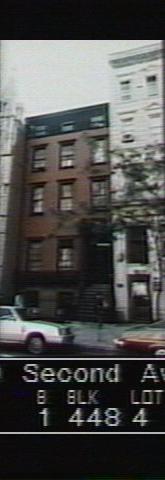
The city photographed every building for its tax records around 1940 and again in the 1980s. NYC Municipal Archives.
Written with AI from the source each entry cites, then fact-checked.
- 1838
Ralph Mead and his brothers build a row of Greek Revival houses
Ralph Mead and his brothers Staats M. and Benjamin Mead erect four Greek Revival rowhouses on Second Avenue, then one of the city's most fashionable residential blocks. Their house, later numbered 110 Second Avenue, rises with a brownstone portico, fluted Ionic columns, and cast-iron balconies. Ralph Mead, owner of a wholesale grocery business, reclaims the property at an 1844 foreclosure auction and moves in the following year, marrying Ann Van Wyck Mead in 1846.
Source: Daytonian in Manhattan
- 1874
The Women's Prison Association buys the house for released female prisoners
The Women's Prison Association, whose founders included Isaac T. Hopper's daughter Abigail Hopper Gibbons and novelist Catherine Sedgwick, buys the former Mead residence in 1874. Renamed the Isaac T. Hopper Home, it trains and shelters women recently released from prison, many of them Irish immigrants struggling with alcohol addiction.
Source: Daytonian in Manhattan
- 2009
The city designates the Isaac T. Hopper House a landmark
New York City designates the former Isaac T. Hopper Home an individual landmark, recognizing the 1838 Greek Revival rowhouse and its long use sheltering women leaving prison. The Women's Prison Association has long operated from the building. In December 2020, a fire next door at Middle Collegiate Church causes smoke and water damage but leaves the house standing.
Source: Wikipedia
Further reading
- Isaac T. Hopper HouseWikipedia
- The 1838 Ralph Mead House (Isaac T. Hopper Home) -- 110 Second AvenueDaytonian in Manhattan
- 110 Second AvenueVillage Preservation: East Village Building Blocks
- An 1838 East Village townhouse’s radical historyEphemeral New York
Nearby
- Hebrew Free Loan Association building108 2nd Avenue | 4 entries
- Middle Collegiate Church112 2nd Avenue | 5 entries
- 104 2nd Avenue1 entry
- 303 East 6th Street1 entry
- Middle Collegiate Church House50 East 7th Street | 5 entries
- 307 East 6th Street2 entries