F. W. Devoe & Co. Factory
110 Horatio Street | also 108 Horatio Street | West Village | built 1900
Open on the map8 entries

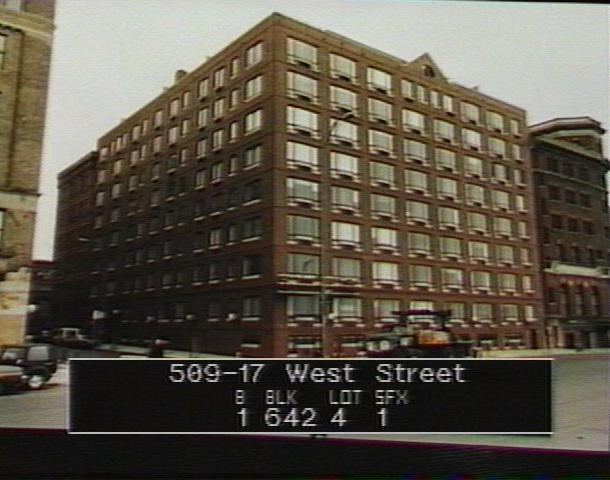
The city photographed every building for its tax records around 1940 and again in the 1980s. NYC Municipal Archives.
Written with AI from the source each entry cites, then fact-checked.
- 1845
Garret and Edward Green buy the land for a lumber yard before the paint works arrives
In 1845 Garret and Edward Green bought the parcel that later held the Devoe factory, adding it to their lumber business at the northeast corner of West and Horatio Streets. Lumber yards were common in the Far West Village because so many local industries served the building trades, which made the neighborhood a logical home for a paint manufacturer.
- 1855
Raynolds & Devoe buys its first Horatio Street lots and puts a chemist in charge
In 1855 the paint firm Raynolds & Devoe bought its first parcels of land along Horatio Street's south side, from West Street to Washington Street, and moved its offices to Fulton Street. James F. Drummond, a trained chemist from Boston, was put in charge of the new manufacturing works on Horatio Street, a job he kept for decades.
“…bought their first parcels of land on the south side of Horatio Street between West and Washington Streets…”
- 1869
F.W. Devoe & Co. introduces ready-mixed paint and grows its Horatio Street works
By 1869 Devoe had put out one of the country's first ready-mixed paints. In the early 1870s the company acquired lots next to its existing plant, including the land where the 1883 factory now stands, and filed permits for new factory buildings. By the mid-1870s the complex had grown from a modest white-lead works into a large operation that also made the cans for its paint.
- 1883
Kimball & Wisedell design a six-story brick-and-terra-cotta factory for Devoe
The six-story factory at 110-112 Horatio Street was designed by Kimball & Wisedell, a firm better known for theaters such as the Casino on Broadway, and built in 1882-83. Works manager James Drummond knew the architects, who had renovated his house in early 1882. Its red terra cotta was made by the Boston Terra Cotta Company, and cartouches above the brick piers carry symbols of the paint industry.
- 1884
Scientific American publishes a tour of the Devoe works on Horatio Street
In 1884 Scientific American described the Horatio Street works in detail, listing a product range that went from ground colors and ready-mixed paints to coach and railway-car varnishes, brushes, artists' materials and surveyors' instruments. Later records show that the 110-112 Horatio factory held the brush-making department, color-grinding rooms and storage and shipping areas.
- 1918
Devoe sells the Horatio Street works and the factory becomes a storage warehouse
In 1918 F.W. Devoe & C.T. Raynolds Co. moved its manufacturing to Brooklyn, Chicago and Newark and sold the Horatio Street complex to Amalgamated Warehouses, Inc. Afterward all but two of the old paint buildings came down, and a garage for commercial vehicles replaced them. The factory at 110-112 Horatio was turned into a public storage warehouse, in step with the shipping boom around the new Gansevoort and Chelsea Piers.
“…in 1918 sold off the Horatio Street complex to Amalgamated Warehouses, Inc.”
- 1984
The old factory is converted into an annex of a new apartment building
The Far West Village changed rapidly once the Miller Elevated Highway closed in 1974 and was demolished in the 1980s. In 1984 the former Devoe factory became an annex of an apartment building built next door. Many of the neighborhood's old factories were replaced or heavily altered in these years, which left this one as a rare survivor with its facade largely intact.
“The former factory at 110-112 Horatio Street was itself converted to an annex of a new apartment building erected immediately adjacent in 1984.”
- 2008
The Landmarks Preservation Commission designates the Devoe factory an individual landmark
After a public hearing on June 24, 2008, where nine speakers supported designation, the Landmarks Preservation Commission designated the building on October 28, 2008. Backers at the hearing included representatives of the Municipal Arts Society, the Historic Districts Council, Community Board 2 and the Greenwich Village Society for Historic Preservation. The report calls it a rare reminder of the Far West Village's industrial past.
Nearby
- The Jane Hotel113 Jane Street | 10 entries
- West Coast Apartments (Manhattan Refrigerating Company)107 Horatio Street | 7 entries
- 91 Horatio Street2 entries
- 803 Washington Street2 entries
- 799 Washington Street3 entries
- 805 Washington Street1 entry