Belasco Theatre
111 West 44th Street | Times Square | built 1907
Open on the map13 entries

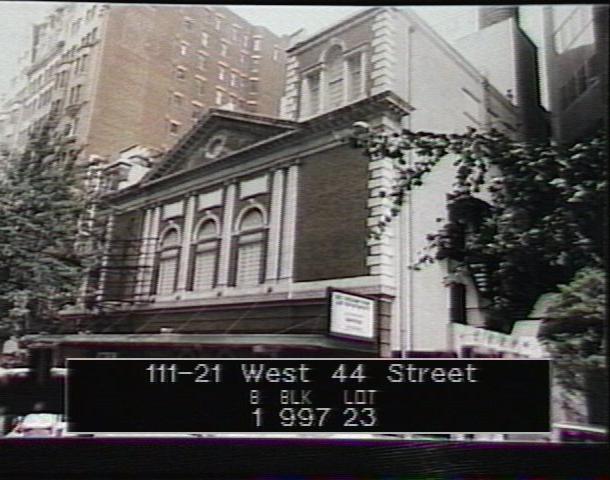
The city photographed every building for its tax records around 1940 and again in the 1980s. NYC Municipal Archives.
Written with AI from the source each entry cites, then fact-checked.
- 1906
Blanche Bates lays the cornerstone of Belasco's new theater as her castmates look on
On December 5, 1906, the cast of The Rose of the Ranchero, then Belasco's current hit, gathered on West 44th Street for the cornerstone ceremony of his new theater. Its star, Blanche Bates, spread the mortar herself and voiced the hope that the producer's friends would stay as loyal to him as the mortar would hold the stone. Belasco pictured the house as a living room where guests would spend an evening, and the warm scene suited that idea.
“The cornerstone was laid on December 5, 1906, as the cast of "The Rose of the Ranchero" looked on. Its leading lady, Blanche Bates, laid the mortar…”
- 1907
The Stuyvesant Theatre opens on West 44th Street for David Belasco
Meyer R. Bimberg developed the neo-Georgian theater, designed by George Keister at a planned cost of about $300,000. David Belasco named it for Peter Stuyvesant, the New Amsterdam director-general. It opened with A Grand Army Man, featuring Antoinette Perry, and one critic called it "the most complete and satisfactory playhouse in existence."
Source: Wikipedia
- 1909
Belasco builds a ten-room rooftop apartment filled with Napoleon relics and a Gothic room
In 1909 Belasco added a ten-room duplex above the eastern end of his theater and made it his home. Its contents were as eccentric as the owner: a crypt-like installation of ancient glass, a museum of Napoleonic objects with a prized lock of the emperor's hair, a Japanese-style bedroom, and a Gothic Room mixing medieval art with erotica, lit by hidden switches. After he died in 1931, his books went to the New York Public Library, some trappings went to a Belasco Room at Sardi's, and most of the rest was auctioned.
- 1910
David Belasco renames the theater after himself
The Stuyvesant Theatre became the Belasco Theatre in September 1910. Belasco produced or directed almost 50 productions there over the next two decades. In the 1910s and 1920s he was closely involved in developing actresses including Katharine Cornell, Jeanne Eagels, and Lenore Ulric, whom historian Ken Bloom called "Belasco heroines."
Source: Wikipedia
- 1931
Katharine Cornell leases the Belasco within months of its founder's death
David Belasco died in May 1931, just as the Depression was closing many Broadway houses. His theater was rescued almost at once by Katharine Cornell, who was starring in The Barretts of Wimpole Street and also worked as a producer and manager. She took a two-year lease beginning September 21, 1931, intending to turn the house's repertory into her own with productions by herself and her husband, Guthrie McClintic.
- 1935
The Group Theatre's Dead End begins a record 684-performance run
The Group Theatre began presenting its productions at the Belasco in late 1934. Its later shows there included Dead End, which ran 684 performances before closing in 1937. That made it the theater's longest-running play, a record that lasted eight decades.
Source: Wikipedia
- 1944
Trio, a play about lesbianism, is forced to close at the Belasco after two months
Trio opened at the Belasco in December 1944 and treated the subject of lesbianism, which made it one of the theater's most controversial productions. It was forced to close in February 1945. In the aftermath, the theater's owners evicted the lessee, Max Jelin, who won reinstatement only in January 1946 after suing in the state Supreme Court. When The Killing of Sister George, more explicit on the same theme, played the house in 1966, it ran without incident.
“A particularly controversial production was Trio, which discussed the topic of lesbianism when it opened in December 1944, but which was forced to close two months later in February 1945.”
Source: Wikipedia
- 1946
Marlon Brando has his first widely noticed success in Truckline Cafe at the Belasco
In 1946 Marlon Brando drew his first wide notice in Truckline Cafe at the Belasco. A year earlier, Judy Holliday's first major success, Kiss Them for Me, had played the house. Other shows of the decade included Home of the Brave, Burlesque with Bert Lahr, and The Madwoman of Chaillot with Martita Hunt and Estelle Winwood.
“Judy Holliday had her first major success in Kiss Them for Me (1945), while Marlon Brando had his first widely noticed success in Truckline Cafe (1946).”
Source: Wikipedia
- 1949
NBC turns the Belasco into a broadcast studio, removing the orchestra seats
Like many other Broadway houses, the Belasco was converted into a radio studio for NBC. The orchestra seats were taken out and sound booths put in, and theater lovers mourned a playhouse long admired for its glamor. From 1949 to 1953 Eddie Cantor hosted the quiz program Take It or Leave It there, and the stage recalled its past only through Theatre Guild on the Air. In 1953 the house went back to legitimate theater.
“From 1949 to 1953 the Belasco broadcast the quiz show "Take it or Leave it," hosted by Eddie Cantor.”
- 1971
Oh! Calcutta!, a revue with an entirely nude cast, moves in and the resident ghost reportedly stays away
In 1971 the off-Broadway revue Oh! Calcutta!, whose cast appeared entirely nude, moved from the Eden Theatre to the Belasco. Legend holds that David Belasco's ghost sits in an empty box on opening nights. By one account the ghost stopped appearing after Oh! Calcutta! played there, though by the 2000s people again reported seeing it.
Source: Wikipedia
- 1975
The Belasco swaps orchestra seats for cabaret tables to stage The Rocky Horror Show
In 1975 the Belasco was altered for a short-lived cabaret production of The Rocky Horror Show. Service stands were installed and the orchestra seats were replaced with tables and chairs. The cabaret setup did not last, and in 1976 the theater returned to conventional legitimate stage use.
- 1987
The city designates both the facade and interior as landmarks
On November 4, 1987, the Landmarks Preservation Commission designated the Belasco's facade and interior as landmarks, as part of its wide push that year to protect Broadway theaters. The Shuberts, Nederlanders, and Jujamcyn sued in 1988 to overturn the designations of 22 theaters, but the designations were upheld in 1992.
Source: Wikipedia
- 2019
Netflix leases the Belasco to screen The Irishman, the theater's first film showing
In November 2019 Netflix leased the Belasco to show Martin Scorsese's film The Irishman. It was the first film screening in the theater's history. To prepare, the house was equipped with a booth, surround sound and a screen. The theater went back to live shows with Girl from the North Country in early 2020, until it closed on March 12, 2020 because of the pandemic.
Source: Wikipedia
Further reading
- Belasco TheatreWikipedia
Nearby
- Hotel Gerard123 West 44th Street | 4 entries
- Millennium Times Square133 West 44th Street | 10 entries
- The Town Hall113 West 43rd Street | 13 entries
- Lambs Club Building130 West 44th Street | 5 entries
- Hudson Theatre139 West 44th Street | 13 entries
- Americas Tower1177 Avenue of the Americas | 8 entries