112 Greene Street (112 Workshop)
112 Greene Street | SoHo | built 1884
Open on the map7 entries

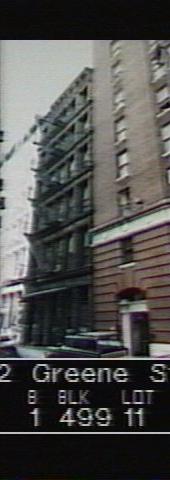
The city photographed every building for its tax records around 1940 and again in the 1980s. NYC Municipal Archives.
Written with AI from the source each entry cites, then fact-checked.
- 1884
Henry Fernbach's six-story iron-front store and loft building at 112 Greene Street is completed
Work began in May 1883 on a six-story, five-bay cast-iron building at 112 Greene Street, designed by Henry Fernbach for Stillwell & Goldenberg. The city's district survey records it as completed on January 31, 1884, and lists its original use as a store and lofts. It notes that the same facade elements were later used at 132-140 Greene Street.
- 1970
Jeffrey Lew and Rachel Wood buy a former rag warehouse and open it as 112 Greene Street
Sculptor Jeffrey Lew and his wife, Rachel Wood, bought the building outright, with Wood supplying the purchase money. It had been a rag-picking warehouse, and Wood later recalled bales of old rags and mice running everywhere. In October 1970 Lew opened the loft, 10 by 33.5 meters with seven Corinthian columns, as an artist-run exhibition space.
Source: tate.org.uk
- 1970
George Trakas pushes a timber-and-glass structure through the floor of the 112 Greene Street gallery
In the gallery's first year, George Trakas built The Piece that Went Through the Floor, a timber-and-glass construction that punched from the street-level gallery down into the basement. Lew was alarmed, Trakas recalled, but the episode showed that artists at 112 could cut into the building itself. Gordon Matta-Clark, soon known for cutting buildings apart, was among the artists working in the same space.
Source: hyperallergic.com
- 1971
Vito Acconci locks himself in a tiny room with a fighting rooster at 112 Greene Street
In 1971 Vito Acconci shut himself in a tiny room with a fighting rooster for his piece Combination at 112 Greene Street. The bird escaped and had to be trapped by Girouard. It was one of many experiments in the loft that year, when Alice Aycock filled the space with sand and scavenged industrial fans and Harris and Rachel Wood danced against huge rubber sheets strung between the Corinthian columns.
Source: hyperallergic.com
- 1972
Gordon Matta-Clark, who lived in the basement, installs Walls Paper at 112 Greene Street
Matta-Clark said his interest in buildings grew from the period in 1970 when he lived in the basement of 112 Greene Street. In 1972 he showed Walls Paper there, a set of colored screenprints of cropped, enlarged views of crumbling walls and interiors, hung like a tapestry among the loft's columns. Critic April Kingsley wrote that the gallery looks like the sites his pieces were removed from, which makes his work hard to see as art. The work is now in the Tate collection.
Source: tate.org.uk
- 1974
Dealer Leo Castelli is held as a "hostage" in the basement of 112 Greene Street
In the 1974 video performance Prisoner's Dilemma, devised by Richard Serra and Robert Bell, art dealer Leo Castelli was detained in the basement of 112 Greene Street as a "hostage". Spalding Gray and G.H. Hovagimyan played hooligans in an experiment with live feeds and several video channels.
Source: hyperallergic.com
- 1983
The recording studio at 112 Greene Street is renamed Greene St. Recording and becomes a hip-hop hub
A recording studio started at 112 Greene Street in the early 1970s became a partnership with producer Steve Loeb, who bought out his partner in 1983 and renamed it Greene St. Recording. Through the 1980s and 1990s it was an early center of hip-hop recording, and Sonic Youth made Daydream Nation there. A tape label Chuck D posted in 2014 indicates Public Enemy used it for "Fight the Power". The studio closed in 2001.
Source: Wikipedia
Nearby
- 114 Greene Street1 entry
- Charles Broadway Rouss Annex104 Greene Street | 4 entries
- 118 Greene Street1 entry
- 100 Prince Street2 entries
- 122 Greene Street1 entry
- 131 Mercer Street2 entries