Estey Piano Company Factory (Clock Tower Building)
112 Lincoln Avenue | Mott Haven | built 1920
Open on the map5 entries

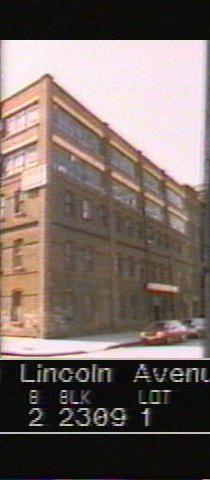
The city photographed every building for its tax records around 1940 and again in the 1980s. NYC Municipal Archives.
Written with AI from the source each entry cites, then fact-checked.
- 1886
The Estey Piano Company finishes its clock-towered factory at Lincoln Avenue and Southern Boulevard
Organ maker Jacob Estey of Brattleboro, Vermont, and Bronx piano pioneer John B. Simpson organized the Estey Piano Company in 1885 and hired A.B. Ogden & Son to design its plant. Work started in August 1885 and the factory was done in February 1886 for about $40,000. In 1889 Musical Courier credited it with giving piano makers' move to the area east of Third Avenue "an unusual stimulus."
- 1890
Tuner Stephen Brambach is credited with the Estey piano's new mechanical and acoustic ideas
Piano tuner and regulator Daniel Spillane praised the Estey as a very excellent instrument and gave much of the credit to Stephen Brambach, whom he ranked among New York's best tuners. Though Brambach had apparently started his own piano firm in 1885, he was still working with Estey in 1890, originating its new mechanical and acoustic ideas. His brother Carl, an expert tuner, also worked for the company.
- 1912
Workers strike the Estey factory over recognition of the piano makers' union
The Estey plant saw open conflict between labor and management in 1912. Its workers walked out, as did workers at other Bronx piano firms whose owners refused to recognize the piano makers' union or to bar non-union hands from the shop floor. By then Estey pianos were sold at Loeser's department store in Brooklyn and advertised on the reputation of the Estey Organ.
“…in 1912, workers struck Estey and other Bronx piano manufacturers that would not recognize the piano makers' union…”
- 1919
George B. Gittins buys Welte and expands the Estey factory for reproducing pianos
George B. Gittins, a former Kohler & Campbell president, took control of Estey in 1917 at age 37. In 1919 he bought M. Welte & Sons, maker of the Welte-Mignon reproducing piano, began closing its Poughkeepsie plant and hired architect George F. Hogue to add two stories and an elevator shaft to the factory's northern wing for about $25,000. The addition's wide bands of industrial sash followed the daylight-factory model of the time.
- 1995
The empty piano factory is sold and remade as live-in artists' studios
Estey's successor firm went into receivership in 1929 and the factory was emptied, later housing sheet-metal, furniture, plastics, drapery and textile makers. In 1995, mostly vacant, it was bought by Truro College, which planned dormitories or a liberal arts program there. When those plans collapsed, the college sold the Clock Tower Building to Carnegie Management, which rebuilt the interior as live-in studios for artists.
Nearby
- St. Jerome's Church and School222 Alexander Avenue | 4 entries
- St. Jerome's Church230 Alexander Avenue | 3 entries
- 40th Precinct Station House257 Alexander Avenue | 2 entries
- 261 Alexander Avenue1 entry
- 262 Alexander Avenue2 entries
- 263 Alexander Avenue1 entry