Church of the Most Precious Blood
113 Baxter Street | Little Italy | built 1900
Open on the map11 entries

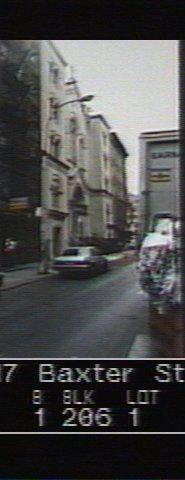
The city photographed every building for its tax records around 1940 and again in the 1980s. NYC Municipal Archives.
Written with AI from the source each entry cites, then fact-checked.
- 1891
Scalabrinian Fathers begin an Italian national church, then run out of money
Italians in Manhattan were often sent to the basement when they worshipped at St. Patrick's and Transfiguration, and Irish Catholics looked down on their processions and feast days. In 1891 the Scalabrinian missionaries, an order founded in 1887 to help Italian immigrants, laid the foundation for a church of their own at 113 Baxter Street. By 1894 only the basement had been built and roofed over, and the Franciscans of the Immaculate Conception Province bought the unfinished church.
“Italian congregants had been denied full access to the Catholic churches of St. Patrick's and Transfiguration, where they were sent to the basement to worship.”
Source: National Register nomination
- 1901
Archbishop Corrigan lays the cornerstone of the Italian church on Baxter Street
The Franciscans built the upper church over the basement where Masses had been said, and the cornerstone was laid on July 7, 1901, with Archbishop Corrigan presiding. The nomination notes that the shrine on Mulberry Street honors San Gennaro, patron saint of Naples, for the many Neapolitans living there.
Source: National Register nomination
- 1904
The Franciscans finish William Schickel's Italian Franciscan church with Buongiorno's murals
The Franciscans assumed the parish and finished the church in 1904. William Schickel & Company designed it in an Italian Franciscan style, with marble main and side altars by Borgia Marble Works of New York. Donatus Buongiorno painted thirty oil murals on the walls and ceiling for the Neapolitan Baroque interior.
Source: Wikipedia
- 1926
Immigrants from Naples hold a one-day Mulberry Street block party that grows into the San Gennaro feast
In 1926 Neapolitan immigrants gathered for a single-day party on Mulberry Street in honor of San Gennaro, the patron saint of their home city. A century later the feast is still tied to this church: a solemn Mass is said here on the saint's feast day, and the church keeps relics of San Gennaro.
Source: thetablet.org
- 1996
Mayor Giuliani bans casino-style games from the San Gennaro feast, ending a source of church income
In 1996 Mayor Rudy Giuliani reworked the Feast of San Gennaro in an effort to clean out corruption and alleged mob influence, and dropped its casino-style gambling and games of chance. Father Fabian Grifone of Most Precious Blood said poker, blackjack and roulette had raised more than $25,000 a year for the church during the ten-day festival. In 2012 he said he had never forgiven the mayor and would push the city to let the church host such games again.
Source: dnainfo.com
- 1997
Cardinal O'Connor re-consecrates the church after a renovation, and its Neapolitan Baroque murals remain
William Schickel & Company designed the church in an Italian Franciscan style, with marble altars by the Borgia Marble Works of New York. The interior is Neapolitan Baroque, and Donatus Buongiorno painted thirty oil murals on the walls and ceiling. The Gargiulo Brothers renovated the building in 1995 to repair damage from water leaks and neglect, and Cardinal John O'Connor re-consecrated it on February 7, 1997.
“Donatus Buongiorno created thirty oil painting murals for the walls and ceiling.”
Source: Wikipedia
- 2012
Hurricane Sandy damages Donatus Buongiorno's murals in the church
Hurricane Sandy damaged the church's murals by Donatus Buongiorno (1865-1935) in 2012. The paintings show major episodes from the lives of Christ, St. Francis of Assisi and St. Anthony of Padua. By early 2018 restoration was under way, and the first to be saved was a work pairing St. Francis with Dante Alighieri and Christopher Columbus.
Source: italianenclaves.org
- 2014
The Franciscans withdraw, and the church joins the parish of Old St. Patrick's the next year
Short of priests, the Franciscans left the Most Precious Blood in March 2014 and the church came under diocesan administration. In 2015 the church joined the parish of St. Patrick's Old Cathedral, with the two churches sharing priests and administrative staff. In 2018 the rectory on Mulberry Street was put up for sale.
Source: Wikipedia
- 2015
Closing of St. Joseph's Church on Monroe Street sends statues, relics and feasts to Most Precious Blood
With the closing of St. Joseph's Church at 5 Monroe Street in 2015, Most Precious Blood took in its statues, relics and feasts, including those honoring San Vincenzo Martire di Craco and San Rocco di Potenza. The church also gained two Marian images: the Madonna delle Grazie statue, tied to Santa Caterina Villarmosa in Sicily, and the Madonna di Ripalta icon, tied to Cerignola in Puglia. They joined a southern Italian collection that already included a statue of San Calogero from Sciacca.
Source: italianenclaves.org
- 2015
The church becomes a site of the Holy Doors during the Jubilee of Mercy
Most Precious Blood served as one of the places with a Holy Door during the Extraordinary Jubilee of Mercy, a special year that began on the Immaculate Conception, December 8, 2015, and ended on the Feast of Christ the King, November 20, 2016.
“During the Extraordinary Jubilee of Mercy, from December 8, 2015, the Feast of the Immaculate Conception, to November 20, 2016…”
Source: Wikipedia
- 2018
The parish rectory on Mulberry Street is put up for sale
The parish rectory on Mulberry Street was put on the market in 2018. By then the Franciscans had left, the church was part of the Old St. Patrick's parish, and Mass was held at Most Precious Blood on Wednesdays and Sundays.
“In 2018, the parish rectory on Mulberry Street was listed for sale.”
Source: Wikipedia
Further reading
Nearby
- Forlini's (91-93 Baxter Street)93 Baxter Street | 4 entries
- Lt. Kimlau Post 1291 building191 Canal Street | 6 entries
- P.S. 130 Hernando De Soto School143 Baxter Street | 3 entries
- Italian flag painted Apartments187 Hester Street | 2 entries
- Umberto's Clam House132 Mulberry Street | 2 entries
- Howard Street Garage209 Centre Street | 2 entries