114 Waverly Place
Greenwich Village | built 1826
Open on the map3 entries

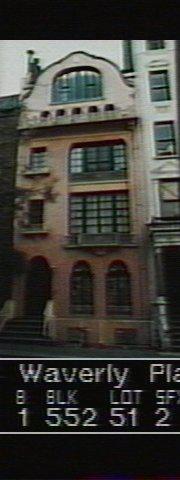
The city photographed every building for its tax records around 1940 and again in the 1980s. NYC Municipal Archives.
Written with AI from the source each entry cites, then fact-checked.
- 1826
Thomas Mercein builds a Federal rowhouse at No. 114
Thomas R. Mercein, who heads the New York Equitable Fire Insurance Company, completes a row of nine Federal-style rowhouses on Waverly Place in 1826, including No. 114. The brick house has a dormered attic and paneled brownstone lintels. An accountant named Richard R. Smarte lives there by 1842, and in 1893 the baritone Edward L. Connell and the artist Frederick Marschall are residents.
Source: Daytonian in Manhattan
- 1920
Architect William Sanger converts the house into artist studios
Artist Murray Percival Bewley hires architect William Sanger in 1920 to turn the Federal house into artists' studios. Sanger covers it in stucco and adds decorative pseudo-balconies, arched openings and a sweeping curved roofline with a large studio window, giving the building a hint of Italy. Bewley, who studied under Robert Henri and William Merritt Chase and exhibited at the Paris Salon, keeps a studio here until 1924.
Source: Daytonian in Manhattan
- 1943
WPA muralist Jacob Getlar Smith lives in the building
Painter Jacob Getlar Smith, whose muscular style produced several Federal Art Project works including murals, lives and works at No. 114 Waverly Place in 1943. In January of that year the Brooklyn Eagle announces his exhibition of 26 watercolors, among them "Waverly Residence," a view of a brownstone house. He is one of the artists who occupy the studios Sanger created in 1920.
Source: Daytonian in Manhattan
Further reading
- The Surprising Studio at No. 114 Waverly PlaceDaytonian in Manhattan
- Then & Now photos: 114 Waverly PlaceVillage Preservation: Greenwich Village Then & Now
Nearby
- 112 Waverly Place4 entries
- The Cecelia116 Waverly Place | 3 entries
- 112 Waverly Place2 entries
- 108 Waverly Place2 entries
- 122 Waverly Place3 entries
- 124 Waverly Place3 entries