Greenpoint Manufacturing and Design Center
1155 Manhattan Avenue | also 1205 Manhattan Avenue | Greenpoint | built 1906
Open on the map6 entries

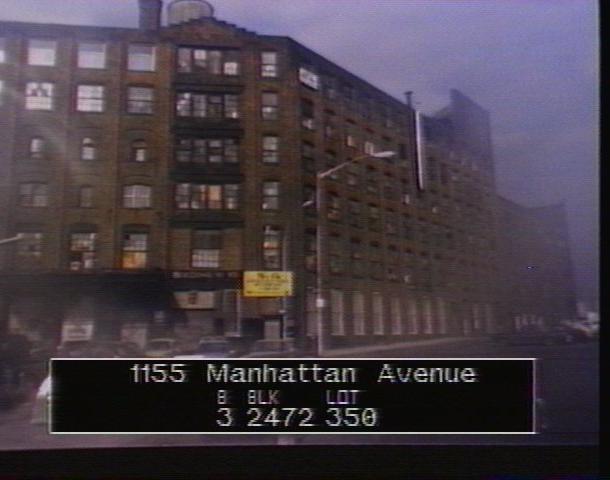
The city photographed every building for its tax records around 1940 and again in the 1980s. NYC Municipal Archives.
Written with AI from the source each entry cites, then fact-checked.
- 1868
Chelsea Fiber Mills builds its first rope mill on the Newtown Creek shore
The first building at 1155 Manhattan Avenue went up in 1868 for the Chelsea Fiber Mills, a jute mill that made marine rope for the shipyards along the East River. It stood where Newtown Creek meets the East River, and fiber arrived directly from boats on the creek. The complex reached its current form of eight connected buildings in 1903 and had its own steam power generator.
Source: Untapped New York
- 1900
George Pratt, son of the Astral Oil president, serves as treasurer of Chelsea Fiber Mills
Brownstoner reports that in 1900 the treasurer of the Chelsea Fiber Mills was the industrialist George Pratt, son of Charles Pratt, president of Greenpoint's Astral Oil. The company turned raw jute, manila, sisal and hemp, unloaded from ships on Newtown Creek, into marine rope.
Source: brownstoner.com
- 1945
With demand for fiber rope falling, the mill buildings turn to textiles and dyeing after World War II
Marine rope kept the mills busy through both world wars, with workers coming from Greenpoint and across the Vernon Avenue Bridge from Queens. By the end of the Second World War, changing ships and technology had cut demand for fiber rope. The Chelsea Fiber buildings were then taken over by textile and sewing plants and fabric dyeing mills.
Source: brownstoner.com
- 1974
New York City takes the mill complex in a tax foreclosure and rents it out month to month
By 1974 the complex belonged to New York City through a tax foreclosure, after earlier owners failed to keep the building financially secure enough to maintain it properly. The city offered month-by-month leases to small manufacturers, but tenants still could not earn enough to cover maintenance. Plans were floated to demolish the site and perhaps rebuild it as housing, but they were dropped.
Source: Untapped New York
- 1992
The city sells the old mill to the new Greenpoint Manufacturing and Design Center for one dollar
In 1992, after local activists and tenants met with the North Brooklyn Economic Development Corporation in the late 1980s, the city sold the building to the newly formed Greenpoint Manufacturing and Design Center for a single dollar. The group aimed to preserve the historic buildings and keep rents affordable for industrial tenants. By 2012 it had leveraged $8 million for rehabilitating the site.
Source: Untapped New York
- 2012
A metal spinner whose shop shaped lamp holders for Central and Prospect Parks works in the building
In 2012 Untapped Cities profiled Fransico Useche, as the article spells his name, one of the oldest tenants at GMDC, who had been in the building since the uncertain years of the 1970s. His metal spinning shop takes custom orders, shaping flat metal circles into curved light fixtures, and it once shaped the light holders for the street lamps in Central Park and Prospect Park. Close to 80 percent of his products are sold in the metro area.
Source: Untapped New York
Nearby
- Greenpoint Glass Works complex99 Commercial Street | 4 entries
- 1160 Manhattan Avenue1 entry
- North Brooklyn Community Boathouse51 Ash Street | 2 entries
- 173 Green Street1 entry
- Eagle Street Rooftop Farm32 Eagle Street | 1 entry
- Engine Company 258, Ladder Company 11510-40 47th Avenue | 5 entries