117-119 Hudson Street warehouse
117 Hudson Street | also 119 Hudson Street, 54 North Moore Street | Tribeca | built 1889
Open on the map5 entries

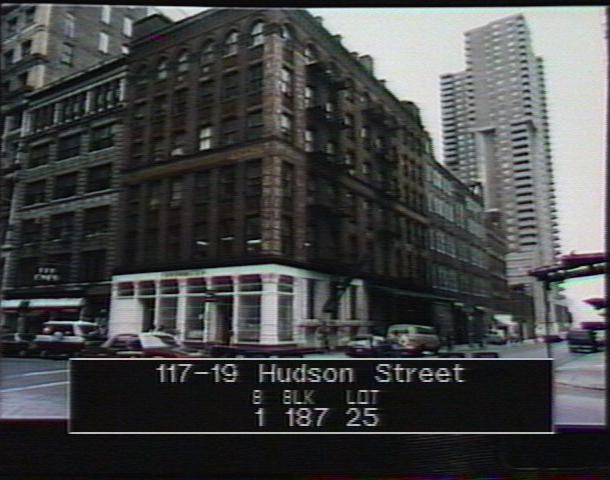
The city photographed every building for its tax records around 1940 and again in the 1980s. NYC Municipal Archives.
Written with AI from the source each entry cites, then fact-checked.
- 1888
Jackson designs the warehouse base to let air through for perishable food
Thomas R. Jackson gave the Romanesque Revival building, which fronts Hudson and North Moore Streets, a cast-iron base designed for ventilation. The wide bays were originally filled only with folding iron shutters under glass transoms, so air could pass through to the perishable food stored inside. Many of the shutters still fold back into the piers, and it was the first of three corner buildings Jackson designed for the Castree family nearby.
“The functional base of the building, dictated by its original use for the temporary storage of perishable foodstuffs, was so designed to provide ventilation.”
- 1889
John Castree, an Irish-born grocer, finishes a provisions warehouse here and dies months later
John Castree arrived from Ireland as a toddler in 1814 and trained in the grocery trade. By 1888 he owned real estate around the old St. John's Park area and hired architect Thomas R. Jackson to build a six-story warehouse for the provisions district, directly across Hudson Street from his own former home at No. 121. Castree died in 1889, only a few months after the building was completed.
Source: Daytonian in Manhattan
- 1907
Ketchup maker E. C. Hazard and Company, headquartered here, goes bankrupt
Edward C. Hazard built his fortune on Shrewsbury Tomato Ketchup, grown on New Jersey land he bought in 1883, and sold it from this building along with canned goods and imported delicacies. He advertised in streetcars with a series of Shakespeare quotations, and his business once grossed as much as $5 million a year. After he died in 1905 his son and three investors took over, and the New-York Tribune reported the firm's bankruptcy on August 22, 1907, with more than 200 creditors.
Source: Daytonian in Manhattan
- 1915
A Bayer chemist working here is exposed as an agent buying chemicals for Germany
In 1911 the German dye firm Farbenfabriken was in this building, and a year later it was absorbed by the Bayer Company. In August 1915 the New York World revealed that chemist Hugo Schweitzer, who worked for Bayer here, was supplying chemicals to the German government for munitions, including a scheme involving $1,400,000 of phenol from Thomas Edison's factory. The Alien Property Custodian took over Bayer in January 1918, and five company officials were arrested that August.
Source: Daytonian in Manhattan
- 1927
Thieves haul away $90,000 of aspirin from the Bayer stockroom
In January 1927 burglars broke into the Bayer stockroom here and carried off 1,286 cartons of aspirin worth about $90,000, which the New York Times said would have needed two trucks. They ignored the dyes and other stock. Police arrested thirteen men by February 27 and recovered nearly all of the aspirin.
Source: Daytonian in Manhattan
Further reading
- The 1888 Nos. 117-119 Hudson StreetDaytonian in Manhattan
Nearby
- 111 Hudson Street2 entries
- 56 North Moore Street3 entries
- Powell Building105 Hudson Street | 4 entries
- Franklin Inn176 Franklin Street | 5 entries
- 178 Franklin Street2 entries
- 55 North Moore Street2 entries