Sheppard Knapp House
118 West 12th Street | West Village | built 1850
Open on the map5 entries

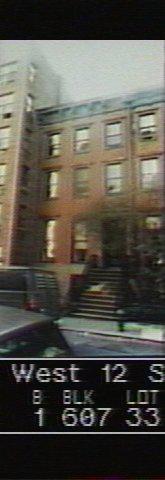
The city photographed every building for its tax records around 1940 and again in the 1980s. NYC Municipal Archives.
Written with AI from the source each entry cites, then fact-checked.
- 1847
Mason Abraham Frazee completes twin Greek Revival houses at 118 and 120 West 12th Street
In 1847 the mason Abraham Frazee finished two identical brick houses at what was then 118 and 120 Twelfth Street; the West was added in 1858. Each was three stories high above a brownstone English basement and had a smaller house in the rear yard. The first tenants of No. 118 were a carpenter and a stonecutter, possibly men who had worked on its construction, and the back house held a cabinetmaker, a stairbuilder and another carpenter.
Source: Daytonian in Manhattan
- 1859
Publisher George Wilkes, head of the firm behind Porter's Spirit of the Times, moves in
Around 1859 George Wilkes, a publisher, took up residence at 118 West 12th Street. He headed George Wilkes & Co., which published sporting periodicals such as Porter's Spirit of the Times and the Racing Calendar & Trotting Record; a November 1858 advertisement billed Porter's as a chronicle of the turf, field sports and literature. The Presbyterian Church acquired the house in 1862.
Source: Daytonian in Manhattan
- 1867
Rev. Joseph McElroy, pastor of the Scotch Presbyterian Church, lives in the parsonage here
By about 1867 the house was serving as the parsonage for the Scotch Presbyterian Church at 58 West 14th Street. Its pastor, Rev. Joseph McElroy, moved in as a 75-year-old widower; born in Pennsylvania in 1792, he had led the congregation since 1822 and still preached every Sunday. Having outlived four wives, he remarked in 1869 that he had followed nineteen funerals out of his house. He died on September 16, 1876, aged 84.
Source: Daytonian in Manhattan
- 1933
Dr. Edward Donlin, coroner's physician in the Molineux poisoning case, dies in the house
Dr. Edward Joseph Donlin, a coroner's physician and surgeon with the New York police, bought the house in March 1903 and kept his office there. When he died here on September 24, 1933, aged 76, the Hartford Courant noted that his name was linked with spectacular crimes of old Gotham, including the famous Molineux poisoning case and the poisoning of the Texas millionaire William Rice. His three unmarried daughters inherited the house.
Source: Daytonian in Manhattan
- 1997
Actor and director Mitchell Lichtenstein buys the house for $2.52 million
The house was later owned by the art dealer Jason McCoy and his wife, Diana Burroughs, whom The New York Times described as vigorous hosts. In 1997 McCoy sold it for $2.52 million to actor and director Mitchell Lichtenstein, son of the Pop artist Roy Lichtenstein, and his husband, Vincent Sanchez. After two decades they listed it in 2017 for $25 million, and it sold in May 2021 for $14.9 million.
Source: Daytonian in Manhattan
Further reading
- The 1847 Sheppard Knapp House -- 118 West 12th StreetDaytonian in Manhattan
- Then & Now photos: 118 West 12th StreetVillage Preservation: Greenwich Village Then & Now
Nearby
- The Revere (Martin Payne Building)130 West 12th Street | 6 entries
- 475 Avenue of the Americas1 entry
- Capt. Edward Slevin House121 West 11th Street | 3 entries
- Charles B. Macy House117 West 12th Street | 5 entries
- 473 Avenue of the Americas1 entry
- Peter McLaughlin House105 West 11th Street | 5 entries