12 Gay Street
West Village | built 1828
Open on the map4 entries

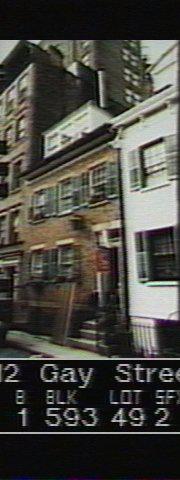
The city photographed every building for its tax records around 1940 and again in the 1980s. NYC Municipal Archives.
Written with AI from the source each entry cites, then fact-checked.
- 1827
Builders Weed and Baldwin put up a Federal house for Abraham Hitchcock of Hackensack
No. 12 Gay Street was built in 1827-28 by the builders Daniel H. Weed and Joseph D. Baldwin as one of a pair with No. 14. Its owner was Abraham Hitchcock of Hackensack, New Jersey. The brick facade is laid in Flemish bond, and the front doorway has slender Doric columns. The areaway gate carries an iron arch with a lifting bar, and the wrought-iron stoop railings end in cast-iron newels that may be original.
“No. 12 was built for Abraham Hitchcock of Hackensack, N. J., while No. 14 was erected for Curtis Hitchcock of New York, a plough manufacturer.”
- 1830
The Hitchcocks sell Nos. 12 and 14 Gay Street at a loss
Within three years of their completion, the two Hitchcock houses were sold in 1830 to Thomas Cumming and James Pollock. The sale lost money for the Hitchcocks. Cumming and Pollock took over the mortgage payments as part of the deal.
“In 1830 both houses were sold to Thomas Cumming and James Pollock at a loss, with the stipulation that they would assume the mortgage payments.”
- 1855
A woman run over by an express wagon after leaving a streetcar is brought to the house
In August 1855 Mrs. Patton, who lived at 276 West 29th Street, was taken to No. 12 Gay Street. She had stepped down from an Eighth Avenue streetcar carrying a baby when a heavy express wagon knocked her down and ran over her. A policeman then escorted her to her sister's home on Gay Street.
Source: Daytonian in Manhattan
- 1920
The Pirate's Den, a pirate-themed speakeasy, operates out of the house during Prohibition
During the 1920s, No. 12 was home to an illegal bar called the Pirate's Den, whose metal arch in front of the house is said to have marked the basement entrance. Ephemeral New York, quoting George Chauncey's Gay New York, describes clanking chains, cutlasses, ship's lanterns and eye-patched waiters. The blog calls it more a tourist trap than a neighborhood hangout and adds that after the bar closed, Mayor Jimmy Walker moved a showgirl mistress into the house.
Source: Ephemeral New York
Further reading
- Then & Now photos: 12 Gay StreetVillage Preservation: Greenwich Village Then & Now
- A haunted speakeasy in a Greenwich Village alleyEphemeral New York
Nearby
- 10 Gay Street2 entries
- Ruth McKenney's My Sister Eileen house14 Gay Street | 5 entries
- 16 Gay Street1 entry
- 22 Christopher Street1 entry
- 18 Gay Street2 entries
- Fellows Company Building30 Christopher Street | 4 entries