The Dakota
121 Central Park West | also 1 West 72nd Street, 2 West 73rd Street | Upper West Side | built 1884
Open on the map21 entries

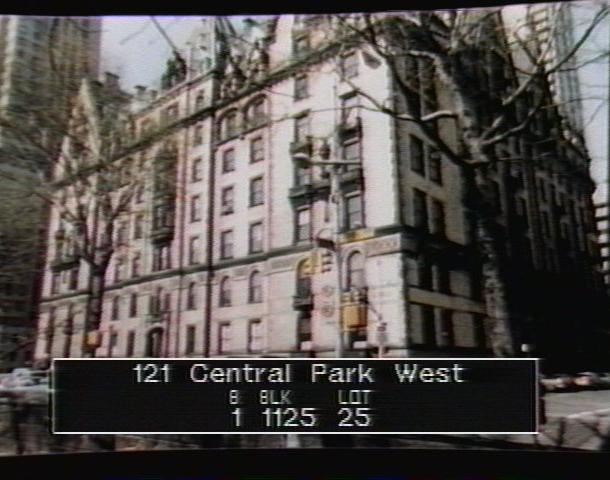
The city photographed every building for its tax records around 1940 and again in the 1980s. NYC Municipal Archives.
Written with AI from the source each entry cites, then fact-checked.
- 1882
Edward Clark dies two years before his Dakota is finished
Edward Cabot Clark, Isaac Singer's lawyer and later his partner in the sewing machine company, began the Dakota in 1880 and set aside the grandest apartment for his own family: 17 rooms, 17 fireplaces, silver-plated doorknobs and a drawing room 24 by 49 feet. He died of malarial fever on October 14, 1882, two years before construction ended. The project went ahead without him.
Source: Daytonian in Manhattan
- 1884
Piano makers, music publishers and a subway builder move into the Dakota
Daytonian in Manhattan lists some of the first tenants: the family of Theodor Steinway of the piano firm, music publisher Gustav Schirmer and his wife, and John Browning, who founded the Browning School for boys. Edward Bascomb Harper, founder of an insurance company, and engineer John B. McDonald, builder of the first subway, also lived here, along with a chewing-gum executive named John D. Adams.
Source: Daytonian in Manhattan
- 1884
The Dakota opens with every apartment rented
Edward Cabot Clark, head of the Singer Manufacturing Company, built the Dakota in 1880–84 to a German Renaissance design by Henry Janeway Hardenbergh, and it opened in October 1884 fully rented. The story that it was named for being as remote as Dakota Territory was first recorded only in 1933; Clark more likely picked it out of fondness for western place names, which he had once proposed for Upper West Side avenues.
Source: Wikipedia
- 1890
The New York Sun grumbles about one Dakota tenant's $5,000 wall decorations
The Dakota drew wealthy tenants who were willing to spend heavily on their flats. In May 1890 the New York Sun complained in print that one resident, who held a five-year lease, had put $5,000 into decorating the walls of his apartment alone. Daytonian in Manhattan notes the sum equals nearly $150,000 today, and that the people living here could afford it.
Source: Daytonian in Manhattan
- 1897
Singer Sewing Machine president Frederick Bourne is thrown from his horse and carried home to the Dakota
Frederick G. Bourne, who headed the Singer Sewing Machine Company, kept an apartment at the Dakota. On February 23, 1897, his saddle horse bolted along the Park Driveway in Central Park and threw him to the pavement. He broke his arm, and the New-York Tribune reported that a carriage took him back to his home in the Dakota flats.
Source: Daytonian in Manhattan
- 1910
A boiler explosion severely injures a laundry worker
A boiler in the laundry room under the Dakota's tennis courts explodes, hurling a piece of iron into employee Ellen Cleary's leg and forcing doctors to amputate the limb. The blast blows out several lower-floor windows and sends other workers fleeing before they return to help her.
Source: Daytonian in Manhattan
- 1933
Edward S. Clark dies and his brother Stephen takes over the Dakota
Edward S. Clark died in 1933, not long before the Dakota turned 50, and Stephen Carlton Clark, his brother, took charge of the building. Stephen meant to keep running it and to preserve the garden on its west side. Two tenants had been there since the opening, and four more of the original tenants had died within the previous three years. For the next three decades the Dakota changed little, and it even kept its original elevators.
“Edward S. Clark died in 1933, just before the Dakota's 50th anniversary, and his brother Stephen Carlton Clark took over the building's operation.”
Source: Wikipedia
- 1959
The New York Times profiles a Dakota full of diplomats, actors and publishers
Nan Robertson's New York Times survey of September 7, 1959 sorted the tenants into diplomats, show business figures and publishers. Ambassadors from the Netherlands, Portugal and Finland lived here, along with Boris Karloff, Judy Holliday, Jose Ferrer, Rosemary Clooney and set designer Jo Mielziner. The Clark family still owned the building and kept a staff of 52, and former servants' rooms upstairs rented for $25 to $30 a month.
Source: Daytonian in Manhattan
- 1961
Tenants buy the Dakota and turn it into a co-op
In November 1961 the residents bought the building and converted it to a housing cooperative, taking over maintenance costs the Clark family had carried. The city designated the Dakota a landmark on February 11, 1969, and it became a National Historic Landmark on December 8, 1976. Its residents have included Leonard Bernstein, Lauren Bacall and Boris Karloff.
Source: Wikipedia
- 1968
Roman Polanski films Rosemary's Baby at the Dakota
Roman Polanski uses the Dakota as the filming location for his psychological horror movie about a young wife who suspects her neighbors of plotting against her unborn child. Released the same year, the film cements the building's eerie reputation in popular culture for decades afterward.
Source: Daytonian in Manhattan
- 1969
The city designates the Dakota a landmark
The Landmarks Preservation Commission designates the Dakota an individual New York City landmark, protecting Henry Hardenbergh's 1884 German Renaissance design. The building is added to the National Register of Historic Places in 1972 and named a National Historic Landmark in 1976.
Source: Wikipedia
- 1973
John Lennon and Yoko Ono move into the Dakota and gradually take over five apartments
John Lennon and Yoko Ono moved into an apartment at the Dakota in 1973, adding their names to a list of residents that already included Leonard Bernstein, Roberta Flack and Lauren Bacall. They kept expanding. Seven years later the couple had acquired five apartments with 26 rooms in total, along with a ground-floor office.
Source: Daytonian in Manhattan
- 1974
Dakota owners choose a $160,000 roof waterproofing over a $1 million restoration
In 1974 the co-op board learned that the slate roof was shedding tiles and the copper trim was failing. Experts hired by the Landmarks Preservation Commission put a full restoration at $1 million, or an extra $10,000 for each of the 95 tenants. The board chose a smaller job instead, paying the Joseph K. Blum Company $160,000 to waterproof the roof. In 1975 residents also voted to ban air conditioners that stuck out through the facade.
“The Joseph K. Blum Company added waterproofing to the Dakota's roof for $160,000…”
Source: Wikipedia
- 1979
Comedian Gilda Radner buys a Dakota apartment for $150,000
Gilda Radner bought her Dakota apartment in 1979 for $150,000. John Madden later paid $625,000 for the two-bedroom unit, which CNBC cited as one of at least two Dakota apartments that passed from one celebrity to another. In 2012 it was listed at $3.9 million, cut from a 2011 asking price of $4.9 million.
Source: cnbc.com
- 1980
John Lennon is shot and killed outside the Dakota
John Lennon, the former Beatle, lived at the Dakota with Yoko Ono and was murdered outside the building on December 8, 1980, four years to the day after it was named a National Historic Landmark. The Dakota had long drawn well-known tenants, from actor Boris Karloff to conductor Leonard Bernstein.
Source: Wikipedia
- 1990
Leonard Bernstein dies in his Dakota apartment
On October 9, 1990, Leonard Bernstein said he was retiring from conducting. Five days later he died at 72 in his apartment at the Dakota, of a heart attack linked to a pleural tumor. Along the route of his funeral procession through Manhattan, construction workers took off their hats and called out a farewell to Lenny. He is buried at Green-Wood Cemetery in Brooklyn.
Source: Wikipedia
- 1992
A $5 million facade cleaning and brick repair gets under way at the Dakota
By 1992 the facade was being cleaned, and the light new mortar showed sharply against the darkened bricks. The board decided to repair only the worst bricks instead of replacing the whole front. The work cost $5 million, or about $50,000 per tenant. The Landmarks Preservation Commission gave craftsmanship awards in 1994 to the restoration architects, Ehrenkrantz & Eckstut, and to the contractor Remco.
“The repairs ultimately cost $5 million, amounting to an average assessment of $50,000 for each tenant.”
Source: Wikipedia
- 1995
Rudolf Nureyev's Dakota apartment contents sell at Christie's for $7.9 million
Rudolf Nureyev kept an enormous Dakota apartment as just one of several homes around the world. After the dancer died of AIDS at 54, Christie's auctioned the apartment's contents in 1995. The 500 lots included costumes, memorabilia, paintings, furniture, an antique bathtub and a harpsichord, and the sale raised $7.9 million.
Source: cnbc.com
- 2004
The Dakota restores its courtyard amid a dispute over the glass breezeway
In 2002 the board announced plans to restore the interior courtyard, hiring Higgins & Quasebarth as consulting architect. The upper level leaked badly, and the breezeway on the west side was in poor shape. Some residents wanted the glass breezeway removed for aesthetic reasons, but preservationists noted that the public could not see it anyway. Work began in February 2004 and finished about seven and a half months later.
Source: Wikipedia
- 2012
CNBC details how the Dakota's co-op board turns away celebrities
CNBC's 2012 tour of the Dakota described the board package applicants must submit: years of tax records and financial statements, plus thousands of dollars to pay for a background check, with no guarantee of approval. The celebrities it listed as turned down included Cher, Billy Joel, Madonna, Carly Simon, baseball star A-Rod, Judd Apatow and Tea Leoni. Filmmaker Albert Maysles said in 2005 that the building was drifting away from creative people.
Source: cnbc.com
- 2014
Lauren Bacall dies at her Dakota apartment
Lauren Bacall, the Hollywood actress, suffered a stroke at her Dakota apartment on August 12, 2014. She died at New York-Presbyterian Hospital at age 89. She was buried in California, at Forest Lawn Memorial Park in Glendale.
Source: Wikipedia
Further reading
- The DakotaWikipedia
- The 1884 Dakota Apartments - 1 West 72nd StreetDaytonian in Manhattan
- Five ghosts who supposedly haunt the DakotaEphemeral New York
- The Dakota almost alone on the Upper West SideEphemeral New York
Nearby
- The Langham135 Central Park West | 8 entries
- The Majestic115 Central Park West | 11 entries
- Hotel Olcott27 West 72nd Street | 4 entries
- The San Remo145 Central Park West | 13 entries
- 101 Central Park West2 entries
- Vedanta Society of New York34 West 71st Street | 6 entries