Museum of the City of New York
1220 5th Avenue | East Harlem | built 1930
Open on the map10 entries

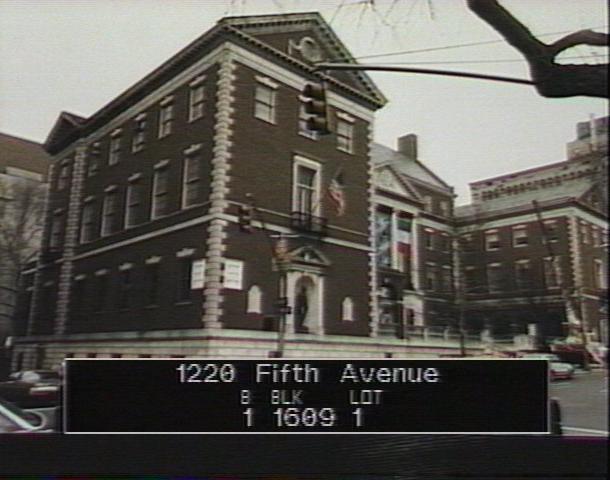
The city photographed every building for its tax records around 1940 and again in the 1980s. NYC Municipal Archives.
Written with AI from the source each entry cites, then fact-checked.
- 1928
Joseph H. Freedlander wins the competition to design the museum
After trustees removed founder Henry Collins Brown in 1926, they held a competition among five architects for a permanent home on Fifth Avenue. Joseph H. Freedlander won on April 15, 1928, proposing a U-shaped Colonial-style building with a formal garden facing Central Park, on a budget capped at $900,000.
Source: Daytonian in Manhattan
- 1932
The Museum of the City of New York dedicates its Fifth Avenue building
Founded by Henry Collins Brown in 1923 to preserve the city's history, the museum dedicated its neo-Georgian home by Joseph H. Freedlander on January 11, 1932. Marble statues of Alexander Hamilton and DeWitt Clinton by Adolph Weinman stand on the facade. Its collection of more than 1.5 million items includes over 3,000 Currier and Ives prints and photographs by Jacob Riis and Berenice Abbott.
Source: Wikipedia
- 1935
The Cherry Street Alcove opens as one of the museum's period rooms
By May 1935 the museum had opened its Cherry Street Alcove, a period room furnished with pieces dating from 1760 to 1770. It was one of several alcoves installed in the Fifth Avenue building alongside paintings, the maritime collection and thousands of New York relics. The Nassau Daily Review reported on May 16 that the newly opened space was a delightful alcove with period-correct furniture.
Source: Daytonian in Manhattan
- 1938
Two rooms from John D. Rockefeller's demolished mansion are installed in the museum
In 1938 John D. Rockefeller Jr. demolished the mansion at 4 West 54th Street that had been his father's, to make room for the Museum of Modern Art, and two of its rooms and their original furniture were moved into the Museum of the City of New York. That same year The New York Times noted that annual attendance had topped 200,000 and that the building was already too small. The planned expansion to the rear was put off.
Source: Daytonian in Manhattan
- 1939
A Dutch Alcove opens, recreating a living room from a New York Dutch house
In 1939 the museum added a Dutch Alcove to its series of period rooms. The New York Times, on November 28, 1939, described the newest room as the front living room of a New York Dutch house, complete with heavy ceiling beams, a Dutch door, a casement window and wide floorboards. It joined the Cherry Street Alcove and the Rockefeller rooms among the interiors visitors could walk through on Fifth Avenue.
Source: Daytonian in Manhattan
- 1941
Sculptor Adolph Weinman's statues of Hamilton and Clinton are unveiled
Nine years after the museum opened, bronze statues of Alexander Hamilton and DeWitt Clinton by sculptor Adolph Alexander Weinman were unveiled on its facade on January 13, 1941. The two figures, representing early shapers of New York City, still flank the Fifth Avenue entrance.
Source: Daytonian in Manhattan
- 1967
The Landmarks Commission designates the museum building and its site a city landmark
After a public hearing on November 10, 1966, the Landmarks Preservation Commission designated the museum at 1220-1227 Fifth Avenue a landmark on January 24, 1967. Two witnesses spoke in favor and none opposed, and the museum's president wrote to say the institution welcomed the nomination. The commission judged the Late Georgian style fitting for a building whose collections tell the story of New York, the first seat of the national capital.
“…the Late Georgian Style, employed for the Museum, is appropriate for a building whose contents depict the history of New York City…”
- 2000
Mayor Giuliani's administration proposes moving the museum to the Tweed Courthouse
Mayor Rudy Giuliani's administration told the museum in 2000 that it could move to the historic Tweed Courthouse near City Hall. El Museo del Barrio would then have crossed the street to occupy the Fifth Avenue building. The incoming Bloomberg administration reversed the plan by giving the courthouse to the new Department of Education, and museum director Robert R. McDonald resigned. Susan Henshaw Jones took over in 2002.
“El Museo del Barrio would then have moved across the street to occupy the current Museum of the City of New York building.”
Source: Wikipedia
- 2008
The museum opens a glass addition designed by the Polshek Partnership
Under director Susan Henshaw Jones, the museum broke ground in August 2006 on a two-story, 3,000-square-foot glass addition designed by the Polshek Partnership. Completed in February 2008 at a cost of $28 million, the addition added a vault for the silver collection, a research room, and space to handle artifacts.
Source: Wikipedia
- 2020
The exhibition City/Game opens to trace the history of basketball in New York
In February 2020 the museum opened City/Game: Basketball in New York, an exhibition on how the sport grew across the city and on players such as Kareem Abdul-Jabbar and Bob Douglass. It followed an exhibition marking the centennial of Jackie Robinson's birth, which featured memorabilia, rare footage and magazines from the Robinson family and ran until September 15, 2019.
“In February 2020, the exhibit "City/Game: Basketball in New York" opened.”
Source: Wikipedia
Further reading
- Museum of the City of New YorkWikipedia
- The Museum of the City of New York - 1220 Fifth AvenueDaytonian in Manhattan
Nearby
- El Museo del Barrio (Heckscher Building)1230 5th Avenue | 7 entries
- Mount Sinai Hospital1468 Madison Avenue | 8 entries
- Jackie Robinson Educational Complex (Graffiti Hall of Fame)1573 Madison Avenue | 2 entries
- Mount Sinai Kravis Children's Hospital1184 5th Avenue | 3 entries
- Cristo Rey New York High School112 East 106th Street | 3 entries
- Davis Center106-51 East Drive | 9 entries