Webster Hall
125 East 11th Street | also 119 East 11th Street | East Village | built 1920
Open on the map13 entries

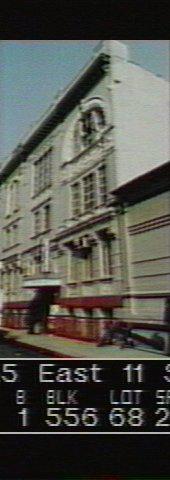
The city photographed every building for its tax records around 1940 and again in the 1980s. NYC Municipal Archives.
Written with AI from the source each entry cites, then fact-checked.
- 1886
Charles Rentz designs Webster Hall for owner Charles Goldstein
Architect Charles Rentz designs Webster Hall in the Queen Anne style, crowned by an ornate mansard roof, for owner Charles Goldstein, who rents the hall out for dances, meetings, and union rallies. A matching Renaissance Revival addition at 125 East 11th Street follows in 1892. Fires in 1902, 1911, 1930, 1938, and 1949 repeatedly damage the building, likely destroying the original roof.
- 1898
Tammany boss Richard Crocker courts deaf voters at a Webster Hall meeting
In October 1898 Richard Crocker of Tammany Hall held a meeting at Webster Hall aimed at winning the votes of deaf New Yorkers. As the Times reported, some Republican deaf voters came to win over their acquaintances, but one red-haired man signed back that he was a thorough Democrat who would vote for Van Wyck, and the Republican gave up. Webster Hall had been a frequent venue for political meetings since its earliest days.
Source: Daytonian in Manhattan
- 1912
Margaret Sanger leads striking Lawrence millworkers' children to a meal at Webster Hall
In 1912 the birth control pioneer Margaret Sanger led a march that brought the children of striking millworkers from Lawrence, Massachusetts, to Webster Hall for a meal, a gesture meant to dramatize the workers' plight. The event was one of many labor and political gatherings at the hall, which had also hosted figures such as Samuel Gompers, Emma Goldman and Dorothy Day.
“…the 1912 march, led by birth control pioneer Margaret Sanger, bringing the children of striking Lawrence, Mass., millworkers to Webster Hall for a meal…”
- 1913
A fundraiser for The Masses magazine launches Webster Hall's masquerade balls
A 1913 fundraiser for the socialist magazine The Masses at Webster Hall gives rise to the venue's famous masquerade balls, which continue through the 1920s and draw bohemian artists and writers. The hall is already a hub for labor and radical politics: the Amalgamated Clothing Workers of America holds its founding convention there in December 1914, and organizers including Emma Goldman and Dorothy Day use the space for meetings.
- 1914
The Amalgamated Clothing Workers of America is founded at Webster Hall
The Amalgamated Clothing Workers of America was founded at Webster Hall in 1914, representing about 40,000 workers. Other labor events in the 1910s included the International Ladies' Garment Workers' Union using the hall as its strike headquarters in 1916, and a Jewelry Workers Union meeting there to vote on a strike for an eight-hour day. Meetings of the Sacco-Vanzetti Defense Committee followed around 1920.
“…the founding of the Amalgamated Clothing Workers of America in 1914, representing about 40,000 workers…”
- 1917
The Blind Man's Ball at Webster Hall protests the rejection of Duchamp's Fountain
The Blind Man's Ball of 1917 was held at Webster Hall to protest the Society of Independent Artists' refusal to show Marcel Duchamp's Fountain in its exhibition. Duchamp attended, along with the artists Joseph Stella, Man Ray and Francis Picabia. Prohibition did little to slow the flow of liquor at the hall's costume balls, which also drew Charles Demuth, F. Scott Fitzgerald and Djuna Barnes.
“The Blind Man's Ball (1917), to protest the Society of Independent Artists' refusal to accept Marcel Duchamp's "Fountain" in its exhibition…”
- 1930
A mysterious explosion and fire destroys Webster Hall's top floors and mansard roof
In 1930 a blaze that followed what the papers called a mysterious explosion destroyed Webster Hall's two top floors, including its mansard roof, with damage put at about $200,000. That was almost exactly what the owners had spent on a remodeling two years earlier. The hall was rebuilt minus its mansard roof, and Webster Manor, Inc. took a lease on it in 1932 for dancing and catering.
Source: Daytonian in Manhattan
- 1933
John Sloan designs the poster for a Depression-era artists' costume ball
The Artists & Writers Dinner Club, which provides free nightly meals to struggling artists during the Depression, sponsors its annual costume ball and carnival at Webster Hall, by then nicknamed the Devil's Playground for its bohemian parties. Village painter John Sloan designs the promotional poster, showing a woman in stockings and heels fending off a wolf in a dinner jacket, a wry comment on artists and their models.
Source: Ephemeral New York
- 1953
RCA Victor turns Webster Hall into a recording studio famed for its acoustics
From 1953 to 1968 RCA Victor Records ran a recording studio in Webster Hall, prized for its sound. Pop, jazz, Latin, folk and gospel albums were made there, along with Broadway cast albums, among them Peter Pan with Mary Martin, Hello, Dolly! with Carol Channing and Flora, the Red Menace with Liza Minnelli. An RCA producer recalled that its first experiments with live stereo orchestral recording took place in the hall on October 6, 1953, with Leopold Stokowski.
“…from 1953 to 1968 RCA Victor Records operated a notable sound recording studio here, which was famed for its acoustics.”
- 1962
Bob Dylan plays harmonica on his first professional recording session
RCA Records, which has converted Webster Hall into a recording studio, hosts a young Bob Dylan for his first professional session, where he plays backing harmonica. The studio becomes a fixture of the recording industry through the 1950s and 60s, producing the cast album of Hello, Dolly! and sessions with Elvis Presley and Frank Sinatra; pianist Bill Evans records a Grammy-winning album there in October 1968.
Source: Wikipedia
- 1980
The Ritz rock club takes over Webster Hall and pioneers the video club
From 1980 to 1989 the building housed the rock club The Ritz, whose stage saw acts including B.B. King, Kiss, Sting, Tina Turner, Eric Clapton, Prince and Madonna. Writer Terry Miller called it the first club designed with a video component, a style later copied across the country. Scenes of Raging Bull and Big were also filmed in the hall, and the Ballinger brothers brought back the Webster Hall name in 1990.
- 2008
The city designates Webster Hall a landmark
The New York City Landmarks Preservation Commission designates Webster Hall an individual landmark, protecting the Queen Anne hall more than a century after its construction. The Ballinger family had restored the building in 1992, reopening it after the nightclub the Ritz relocated in 1989; the Ritz had hosted acts including Prince, U2, and Guns N' Roses since opening in 1980.
Source: Wikipedia
- 2019
Webster Hall reopens with a Jay-Z concert after AEG's two-year renovation
Webster Hall was sold to Brooklyn Sports Entertainment, part of AEG, in 2017, and the club closed after its last show on August 9 of that year. Following about $10 million of renovation work, the venue reopened with a Jay-Z concert on April 26, 2019. The new owners planned fewer dance nights and more concerts.
Source: Wikipedia
Further reading
- Webster HallWikipedia
- The Resiliant 1887 Webster Hall -- 121 East 11th StreetDaytonian in Manhattan
- 125 East 11th Street; 119-125 East 11 StreetVillage Preservation: East Village Building Blocks
- Webster HallPlace Matters
- A decadent costume ball at Webster HallEphemeral New York
Nearby
- St. Ann's School117 East 11th Street | 4 entries
- 120 East 12th Street4 entries
- Schuchman Apartments126 East 12th Street | 4 entries
- Amc Theatre Village66 3rd Avenue | 2 entries
- 74 3rd Avenue2 entries
- Cooper Station Post Office93 4th Avenue | 5 entries