Orpheum Theatre
126 2nd Avenue | East Village | built 1930
Open on the map10 entries

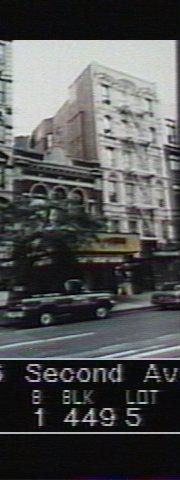
The city photographed every building for its tax records around 1940 and again in the 1980s. NYC Municipal Archives.
Written with AI from the source each entry cites, then fact-checked.
- 1837
Two matching Greek Revival houses begin rising at 126 and 128 Second Avenue
Construction began in 1837 on a pair of nearly identical Greek Revival houses, Nos. 126 and 128 Second Avenue, and No. 126 is the lot of today's Orpheum. Each was three bays wide and three and a half stories tall, with wrought-iron basket newels at a shared stoop, paneled double doors and a stone balustrade above the cornice.
Source: Daytonian in Manhattan
- 1860
A women's infirmary buys the house at 126 Second Avenue
In 1860 the New-York Infirmary for Indigent Women and Children, through its trustees, bought No. 126, a 25-foot-wide house they called well suited to patients. The institution was then at Bleecker and Crosby Streets, and the Times reported on May 7 that year that its dispensary and infirmary patients kept increasing. By the turn of the century the infirmary was gone and the neighborhood had become the center of German immigrant life.
Source: Daytonian in Manhattan
- 1908
Plans are filed to remodel the restaurant and concert hall at 126 Second Avenue
The New-York Tribune reported on February 14, 1908, that plans had been filed to remodel the restaurant and concert hall in the older house at 126 Second Avenue, for the Orpheum Garden Company. The Orpheum Garden was a pleasure garden on Second Avenue. The interior was later turned into a silent film theater, and a January 1913 inspection of picture houses visited a moving picture theater at this address.
Source: Daytonian in Manhattan
- 1914
The building is rebuilt as a small movie theater named the Orpheum
Owner Nathan Bloch hired architect Harold L. Young to replace the older structure on the Second Avenue lot with a small theater modeled on the 1819 Burlington Arcade in London. The $10,000 building took the name Orpheum from an open-air pleasure garden that had occupied the site around the turn of the century.
Source: Daytonian in Manhattan
- 1958
The American Mime Theatre opens and critic Arthur Gelb is unimpressed
The American Mime Theatre opened in the renovated theater in 1958, bringing live performance where movies had been shown. Reviewing opening night on September 24, the Times critic Arthur Gelb likened the troupe to young people playing charades and told them to return once they knew who they were. The venue still became a popular off-Broadway house, and its next productions included My Old Friends and Chic.
Source: Daytonian in Manhattan
- 1959
Little Mary Sunshine launches Eileen Brennan's career at the Orpheum
The spoof operetta opened at the Orpheum on November 18, 1959, a year after the theater had returned to live drama with the American Mime Theatre. Eileen Brennan's performance in the title role won her an Obie Award and helped establish the small East Village house as an off-Broadway destination.
Source: Daytonian in Manhattan
- 1979
Harvey Fierstein brings Fugue in a Nursery to the Orpheum and plays Arnold himself
In December 1979 Harvey Fierstein staged his play Fugue in a Nursery here and took the role of Arnold. The Times critic John Corry was lukewarm, crediting Fierstein with warm intentions and affection for his characters while noting a streak of vanity in the casting.
Source: Daytonian in Manhattan
- 1981
An Evening with Joan Crawford, played largely by female impersonators, opens to a harsh review
An Evening with Joan Crawford opened on January 29, 1981, with a cast made up mostly of female impersonators. John Corry of the Times called it a ramshackle musical that swung between ridicule and adoration of the star. He concluded that the actors seemed to be sitting around swapping Crawford stories and expecting the audience to find them as funny as they did.
Source: Daytonian in Manhattan
- 1982
Little Shop of Horrors opens for a five-year run at the Orpheum
The musical about a man-eating plant opened at the Orpheum on July 27, 1982, and ran for five years, one of the longest engagements the small East Village house had hosted. Its success cemented the Orpheum's reputation as an off-Broadway venue for offbeat shows, a role it kept up when Stomp moved in years later.
Source: Daytonian in Manhattan
- 1994
Stomp begins a 29-year run at the Orpheum
The percussion show, which turns brooms, garbage cans and other found objects into instruments, opened at the Orpheum in 1994. It stayed until 2023, racking up more than 11,000 performances and making the small Second Avenue theater synonymous with the show for a generation of visitors.
Source: Wikipedia
Further reading
- Orpheum Theatre (Manhattan)Wikipedia
- The Orpheum Theater - 126 Second Avenue Daytonian in Manhattan
- 126 Second AvenueVillage Preservation: East Village Building Blocks
Nearby
- 49 East 7th Street1 entry
- 118 2nd Avenue1 entry
- 53 East 7th Street1 entry
- 55 East 7th Street1 entry
- 57 East 7th Street2 entries
- 59 East 7th Street1 entry