Radio City Music Hall
1260 Avenue of the Americas | also 1270 Avenue of the Americas | Midtown | built 1932
Open on the map21 entries

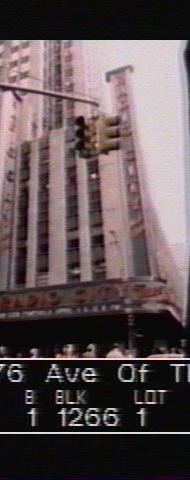
The city photographed every building for its tax records around 1940 and again in the 1980s. NYC Municipal Archives.
Written with AI from the source each entry cites, then fact-checked.
- 1928
Rockefeller signs a 24-year lease on Columbia’s land for a Metropolitan Opera site
The Metropolitan Opera began looking for a new home in 1926, and in 1928 land owned by Columbia University between 48th and 51st Streets and Fifth and Sixth Avenues was proposed. John D. Rockefeller Jr. agreed to lease the three blocks for 24 years at more than $3 million a year, under a contract dated October 1, 1928. The 1929 crash ended the partnership and left him with the costly lease, and Radio City Music Hall was later built within the development.
“…a contract between Rockefeller and Columbia University was drawn up on October 1, 1928; Rockefeller agreed to lease the three blocks owned by Columbia for a period of 24 years…”
- 1930
RCA signs for space including two theaters after Raymond Hood proposes it as anchor tenant
With the opera gone, the architect Raymond Hood suggested that the Radio Corporation of America and its subsidiaries NBC and RKO become the major tenants of the project. RCA signed a contract in June 1930 for space that included two theaters. The complex was popularly called Radio City at first and was officially named Rockefeller Center in 1932.
“Raymond Hood, who suggested that the Radio Corporation of America (RCA) ... be major tenants of the enterprise. RCA signed a contract for space, including two theaters, in June, 1930.”
- 1931
Roxy tours Europe with two of the hall’s architects and finds little to borrow
In September 1931 the impresario Samuel Rothafel, known as Roxy, left for Europe to study new developments in music, theater and broadcasting. Architects L. Andrew Reinhard and Wallace K. Harrison went along, as did stage designer Peter Clark and several NBC officials. The Music Hall’s plan was already fixed, so the group borrowed little from what it saw. Roxy spent the trip recruiting performers and noting Europe’s taste for spectacle.
“Roxy departed in September, 1931, on a European tour to observe recent developments in music, theater, and broadcasting. Two of the architects ... L. Andrew Reinhard and Wallace K. Harrison, accompanied him…”
- 1931
Roxy counts elevator stools and dressing-room chairs to claim 6,201 seats
Roxy Rothafel wanted the Music Hall to hold at least 6,201 seats so it would outsize his earlier Roxy Theatre. The auditorium actually had only 5,960 audience seats. Roxy reached exactly 6,201 by counting stools in the elevators, seats in the orchestra pit and chairs in dressing rooms. He also demanded red seats and an oval auditorium, believing the first would help the theater succeed and the second improve its acoustics.
Source: Wikipedia
- 1932
Radio City Music Hall opens with a six-hour variety show that flops
The Art Deco hall, with architecture by Edward Durell Stone and interiors by Donald Deskey, opened on December 27, 1932, with a stage show that ran from 8 p.m. to 2 a.m. and featured Ray Bolger and Martha Graham. Critics panned it, and on January 11, 1933, after losing $180,000, the hall switched to films plus a stage show, starting with Frank Capra's The Bitter Tea of General Yen.
Source: Wikipedia
- 1932
Ezra Winter paints the grand foyer’s giant Fountain of Youth mural in an indoor tennis court
Ezra Winter won the Music Hall’s first mural commission, a roughly 60-by-40-foot painting for the grand foyer that was said in 1932 to be the largest of its kind. The scene comes from an Oregon Indian legend. Winter worked on it in two parts, with an indoor tennis court on Long Island serving as his studio.
- 1932
Twenty-year-old Gwen Lux designs Eve, one of the hall’s three aluminum statues
One of three cast-aluminum statues commissioned for the Music Hall, Eve stands in a marble niche at the top of the southern staircase leading down to the main lounge. Its creator, Gwen Lux, was only twenty when she designed it. Born in Chicago in 1912, she had studied at the Maryland Institute and the Boston Museum School and spent three years in Europe, and she later exhibited at the Whitney Museum.
“This statue is entitled "Eve" and was designed by Gwen Lux, who was only twenty years old at the time.”
- 1932
Roxy keeps two of the three aluminum nudes out of sight on opening night
Three nude statues cast in aluminum were commissioned for the Music Hall, but Roxy judged them unsuitable for a family venue. On opening night only Robert Laurent’s Goose Girl, a nude beside a slender aluminum goose, was on display on the first mezzanine, even though the Rockefellers loved the sculptures. The other two, Eve by Gwen Lux and Spirit of the Dance by William Zorach, went on view later and remain at Radio City.
“Roxy thought that they were inappropriate for a family venue. Although the Rockefellers loved the sculptures, the only one that was displayed on opening night was "Goose Girl" by Robert Laurent…”
Source: Wikipedia
- 1932
Stuart Davis paints Men Without Women for the downstairs men’s lounge
Stuart Davis made his Cubist mural Men Without Women for the basement men’s lounge in 1932. It uses a car, a barber pole, a cigar, a pipe, a playing card and a cigarette pack as symbols of masculinity. A plaque says the Rockefeller Center Art Committee named it after Hemingway’s story, a title the Whitney says Davis disliked. He later revisited the composition in a 1941 painting.
Source: Internet Archive
- 1932
Legend says Rockefeller’s trustees pick Wurlitzer to build the hall’s giant organ
Roxy planned the largest theater organ ever built and approached Kimball, which had made three organs for his Roxy Theatre. According to legend, the Rockefeller trustees felt the country’s most prestigious theater should have an instrument from the top theater-organ maker, so Wurlitzer got the contract. The 1932 organ has 58 ranks and 4,178 pipes in eight chambers, played from two independent four-manual consoles.
Source: Internet Archive
- 1932
Russell Markert's Rockettes make Radio City their permanent home
Russell Markert's precision dance troupe, previously called the Roxyettes at the nearby Roxy Theatre, moves into Radio City Music Hall in November 1932, shortly after the hall opens. The company is soon renamed the Rockettes and becomes a fixture of the venue's stage shows for decades. Radio City remains their permanent headquarters.
Source: Wikipedia
- 1933
Radio City abandons stage-only shows for a movie-and-stage format
Two weeks after Radio City Music Hall's disastrous opening-night variety show, management scraps the stage-only format. On January 11, 1933, the hall premieres Frank Capra's film "The Bitter Tea of General Yen" paired with a live stage spectacle, establishing the movie-and-stage-show model the venue keeps for decades.
Source: Wikipedia
- 1933
Radio City hosts the world premiere of King Kong
Radio City Music Hall hosts the premiere of the monster film "King Kong" in 1933, one of more than 650 movie premieres the theater holds over its history. Later premieres include "Breakfast at Tiffany's" in 1961, "Mary Poppins" in 1964, and "The Lion King" in 1994. The film program runs alongside the venue's live stage shows for decades.
Source: Wikipedia
- 1963
Radio City closes for a full day for the first time after Kennedy is assassinated
Radio City shut down temporarily in 1963 over fears of a power failure. On November 26 of that year, following the assassination of President John F. Kennedy, it closed for a full day for the first time in its history. The theater had stayed open daily through most of its three decades, closing only partly after Franklin Roosevelt’s death in 1945 and during a fuel shortage the following year.
Source: Wikipedia
- 1965
A five-day closure scrubs a quarter inch of dirt from the walls and ceiling
In March 1965 Radio City closed for five days for its first full cleaning. Seating areas and floors had been cleaned regularly, but the walls and ceilings had gathered a layer of dirt almost a quarter inch thick. Two or three hundred workers worked around the clock, changed the curtains and repainted the ceiling, and the hall reopened on March 8 with the film Dear Heart.
Source: Wikipedia
- 1970
Radio City opens at 7:15 a.m. to show Airport as its Easter-week movie
A Cue listings issue for the week of March 28, 1970 shows Airport, the disaster film starring Burt Lancaster, as the Easter-week feature at Radio City Music Hall. The Ephemeral New York writer called the choice strange. The writer was just as struck that the hall was a regular movie house then, with doors opening at 7:15 in the morning.
Source: Ephemeral New York
- 1978
Landmark designation saves the Music Hall from closing
By 1978 falling attendance had the Music Hall facing closure and possible demolition. The city designated it a landmark on March 28, 1978, which protected the building and cleared the way for its later restoration. The auditorium seats about 5,960 people.
Source: Wikipedia
- 1979
The last film-and-stage show runs and the hall closes for renovation
The movie-plus-stage format that had defined Radio City since 1933 ended on April 25, 1979, with a screening of The Promise. The theater closed immediately for renovation and reopened with a ceremony on May 31, 1979. Robert F. Jani took over its programming intending to return the venue to its original condition, while a proposed office tower cantilevered over the hall was never built.
Source: Wikipedia
- 1980
The Grateful Dead play eight shows in nine days, ending on Halloween
In October 1980 the Grateful Dead took over Radio City for eight shows in nine days, finishing on Halloween. Two of the concerts were released as the video Grateful Dead: Dead Ahead. The run came the year after the hall began producing its own concerts, which Wikipedia says later helped it post its first profit in three decades by appealing to younger viewers.
Source: Wikipedia
- 1999
A $70 million renovation reopens Radio City with a gala concert
Radio City closed on February 16, 1999 for a full renovation, with curtains, seats, carpets, doorknobs and light fixtures cleaned or replaced. Workers hung a 112-foot gold-silk curtain and installed 5,901 salmon-upholstered seats, and John Canning restored the ceiling. The job was budgeted at $25 million but ended at $70 million, and a gala concert on October 4 marked the reopening.
“Radio City was closed on February 16, 1999, for a comprehensive renovation. ... The renovation was originally projected to cost $25 million, but the cost increased to $70 million…”
Source: Wikipedia
- 2004
The New York Liberty play six home games at Radio City on Madison Square Garden’s court
During the summer of 2004, with Madison Square Garden being readied for the Republican National Convention, New York’s WNBA team, the Liberty, played six of its home games at Radio City. The Garden’s court was moved to the Music Hall, with courtside seats on the sides of the stage. The first game, against the Detroit Shock in July, drew 5,945 fans, and the Rockettes performed at halftime.
Source: Wikipedia
Further reading
- Radio City Music HallWikipedia
- Dreaming on the elevated tracks at 47th StreetEphemeral New York
- Radio City: “A must on every visitor’s list”Ephemeral New York
- Going to the movies on March 28, 1970Ephemeral New York
Nearby
- Comcast Building1250 Avenue of the Americas | 18 entries
- Time & Life Building1271 Avenue of the Americas | 16 entries
- Associated Press Building50 Rockefeller Plaza | 9 entries
- Black Rock51 West 52nd Street | 13 entries
- 10 Rockefeller Plaza25 West 48th Street | 9 entries
- 75 Rockefeller Plaza36 West 52nd Street | 10 entries