129 East 10th Street
East Village | built 1854
Open on the map3 entries

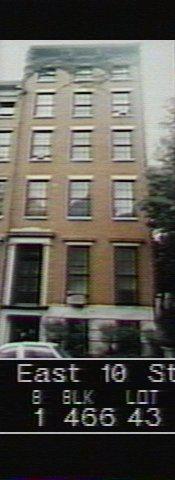
The city photographed every building for its tax records around 1940 and again in the 1980s. NYC Municipal Archives.
Written with AI from the source each entry cites, then fact-checked.
- 1854
The 1854 house keeps a Greek Revival-to-Italianate doorway and a measured parlor floor
Read more
The house at 129 East 10th Street was built in 1854 for Bartolome Blanco. Its original doorway survives, a transitional design in which the brownstone frame is Greek Revival but the door, rope molding and paneled pilasters are in the later Italianate style. In the 1930s the Index of American Design made measured drawings of its parlor floor, holding it up as a fine Italianate example.
“The Index of American Design in the 1930's recorded by measured drawing, details of the parlor floor as excellent examples of the Italianate style.”
- 1862
In 1862 Benjamin Winthrop says digging this lot uncovered part of Stuyvesant's house foundation
In a speech to the New-York Historical Society on February 4, 1862, Benjamin Winthrop, a son of Judith Stuyvesant Winthrop, reported that digging the site of No. 129 East 10th Street had exposed a piece of the foundation of Director General Peter Stuyvesant's house, which would make it an earlier structure on this lot. The row house went up here in 1854. The landmarks commission cites the remark as one of two special notes about the building.
- 1919
The house is run as the Petrus Stuyvesant Club, a residence club with studio rooms
By 1919, 129 and its twin at 127 were operated together as a residence club called the Petrus Stuyvesant Club, which was granted a certificate of occupancy in 1922 for studio rooms and club rooms. In the early 1920s St. Mark's Church, which also owned several other houses on the street, remodeled them into more studio rooms as an adjunct to the club.
“By 1919 the houses were operated as a residence club, called the Petrus Stuyvesant Club. (This was granted a C.O. 1344-1922 for studio rooms and club rooms.)…”
Further reading
- 129 East 10th StreetVillage Preservation: East Village Building Blocks
Nearby
- 127 East 10th Street2 entries
- Charles Lewis Tiffany House125 East 10th Street | 4 entries
- William Sackett Jr. House123 East 10th Street | 4 entries
- 121 East 10th Street2 entries
- John Allen House119 East 10th Street | 4 entries
- 128 East 10th Street4 entries