William Dawes House
129 Spring Street | SoHo | built 1817
Open on the map6 entries

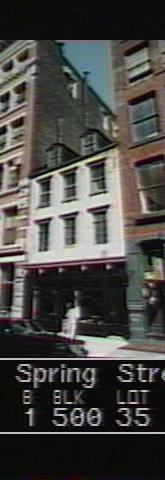
The city photographed every building for its tax records around 1940 and again in the 1980s. NYC Municipal Archives.
Written with AI from the source each entry cites, then fact-checked.
- 1800
Burr and Hamilton defend the accused in a murder tied to a well said to lie under this address
Gulielma Sands left her boarding house on December 22, 1799, and was later found dead in a Manhattan Company well in what was then Lispenard's Meadow. Levi Weeks was tried for the murder, with Henry Brockholst Livingston, Aaron Burr and Alexander Hamilton defending him, and the jury acquitted him after five minutes. The case remains unsolved. Gothamist reports that the well now lies inside 129 Spring Street, which was built around it in 1817, though Daytonian in Manhattan places the well at 89 Greene Street.
Source: gothamist.com
- 1817
William Dawes builds a three-and-a-half-story Federal house on Spring Street
Dawes put up the Flemish-bond brick house in 1817, when this part of Manhattan had only recently been farmland. By 1819 the south side of Spring Street between West Broadway and Wooster Street, a block away, had filled with similar homes. Dawes probably built, too, the deep brick cistern that sat behind the house. A shop had taken over the ground floor by the 1850s, and there Andre Sabatier sold varnishes and polishes.
Source: Daytonian in Manhattan
- 1871
Veterans meeting upstairs gather 500 signatures against a change to the bounty-land law
After a Post Office station opened on the ground floor in 1862, the second floor became a rented meeting room. The Society of Soldiers' and Sailors' met in the room on March 9, 1871, to object to an amendment forcing land-grant recipients to settle in the West, and in under two weeks it gathered about 500 signatures for a petition to Congress. That year the room was also used by the Hackmen's Association, an early cab drivers' union.
Source: Daytonian in Manhattan
- 1893
A young post office clerk is led away by police for forging the postmaster's signature on money orders
The Post Office's Station A had operated at 129 Spring Street since May 1862. In 1891 it hired Richard Banse, then 23, at $600 a year for the money order department. Banse used a stamp of Postmaster Dayton's signature to make money orders payable to himself, and on November 28, 1893 police escorted him out of the branch. The Evening World reported charges of forgery and fraud over several months, and he could not post $2,000 bail.
Source: Daytonian in Manhattan
- 1961
Struggling artist Miles Forst raises a family in the upstairs duplex for $50 a month
The DaGrossa family bought the building in 1954 and opened a hero sandwich shop downstairs, while the upper meeting rooms reverted to a two-story apartment. In 1961 it housed the artist Miles Forst, his wife and their two children. Forst told a reporter they lived here because they could not afford Greenwich Village. They paid $50 a month, an early sign of SoHo's artist migration.
Source: Daytonian in Manhattan
- 1980
Digging in the basement revives a ghost story about the 1799 murder victim
In 1974 a Greene Street shop owner claimed his building was haunted by Gulielma Sands, the woman found dead in a well on Greene Street in 1799. In 1980 the old Dawes cistern was unearthed beneath the Manhattan Bistro, and the haunting story moved to 129 Spring Street. The address later appeared on a Travel Channel list of America's ten most haunted places, though the author notes the well stood at 89 Greene Street.
Source: Daytonian in Manhattan
Further reading
- The 1817 Wm. Dawes House -- No. 129 Spring StreetDaytonian in Manhattan
Nearby
- 89 Greene Street1 entry
- 131 Spring Street1 entry
- 135 Spring Street1 entry
- Catharine Lorillard Wolfe's 121 Spring Street90 Greene Street | 4 entries
- 100 Wooster Street1 entry
- 119 Spring Street1 entry