13 South William Street
also 57 Stone Street | Financial District | built 1903
Open on the map4 entries

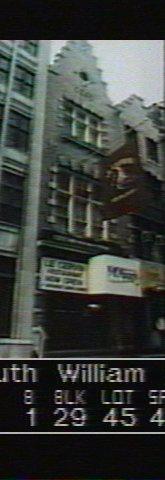
The city photographed every building for its tax records around 1940 and again in the 1980s. NYC Municipal Archives.
Written with AI from the source each entry cites, then fact-checked.
- 1646
Dutch sloop captain Wessel Evertsen acquires the homestead that includes this lot
This lot was the northern third of a large homestead that Wessel Evertsen, a sloop captain working for the Dutch West India Company, acquired in 1646. By 1660 a large double house stood on its eastern side, and Evertsen's heirs held the land until 1726. After it was subdivided, later owners of the lot included the merchants Nicholas and Henry H. Cruger.
- 1839
Tobacconist James Bryar builds a store and loft building after the Great Fire
A Webster family house on the site was lost in the Great Fire of December 1835, when the tobacconist James Bryar owned the lot at 57 Stone Street. By 1839 he had put up a store and loft building, occupied by the merchants Joseph L. Moore & Company. Later occupants included Bartolome Blanco, an importer and consul, and Shortland Brothers & Company, merchants who dealt in lighters, the barges used to load ships.
- 1903
Amos F. Eno has C. P. H. Gilbert remake the building with Dutch stepped gables
Amos F. Eno bought 57 Stone Street in 1903, when it was largely empty apart from a first-floor shop, and hired C. P. H. Gilbert to turn it into offices. Gilbert cut the building down by two stories, raised the third floor, and gave it two new neo-Dutch Renaissance facades, with the South William Street side as the main entrance. The numerals 1903 appear above the third story. Eno was a son of the dry goods merchant and developer Amos R. Eno.
- 1903
William P. Eno, a founder of modern traffic rules, shares his brother's office here
Amos Eno kept his office at 13 South William Street, and his brother William P. Eno (1858-1945) shared the space. William wrote traffic rules that New York adopted in 1903 and Paris took up afterward, and the Landmarks Preservation Commission honors him as the Father of Traffic Regulation. He endowed the Eno Foundation for Highway Traffic Control in 1921.
Further reading
- Nos. 13 and 15 South William StreetDaytonian in Manhattan
Nearby
- 15 South William Street2 entries
- 9 South William Street4 entries
- 17 South William Street2 entries
- 19 South William Street3 entries
- Block Hall21 South William Street | 5 entries
- 1 William Street3 entries