Almanac House
130 West 10th Street | West Village | built 1862
Open on the map3 entries

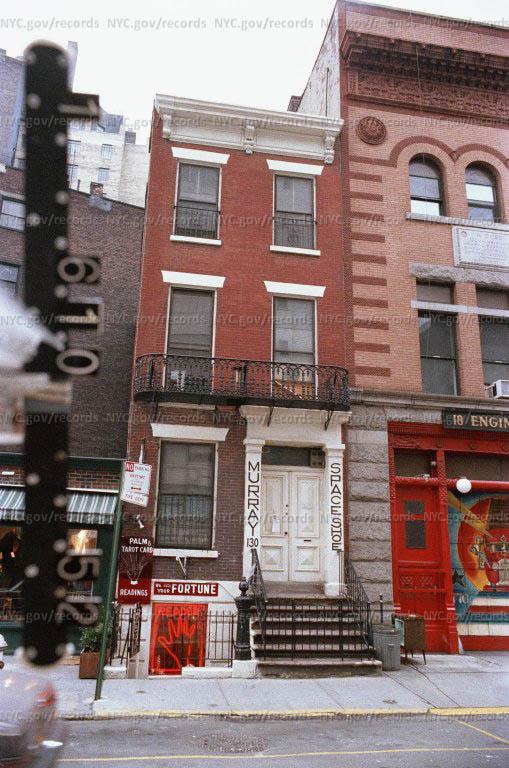
The city photographed every building for its tax records around 1940 and again in the 1980s. NYC Municipal Archives.
Written with AI from the source each entry cites, then fact-checked.
- 1862
A butcher's small late-Italianate house goes up at 130 West 10th Street
The Landmarks Preservation Commission's 1969 Greenwich Village report describes the house as built in 1862 for George Starr, a butcher. The ironwork and cornice mark it as a late Italianate design, though the pilastered doorway could almost belong to the Greek Revival period. Round-arched cast-iron railings at the stoop, areaway and second-floor balcony, and three foliate console brackets under the cornice, reflect the later style.
“…built in 1862 for George Starr, a butcher, is - if we may judge by the ironwork and cornice - a late example of the Italianate style.”
- 1941
The Almanac Singers share a brownstone here and hold basement concerts
After reaching New York in 1941, Woody Guthrie joined Pete Seeger, Bess Lomax and Lee Hays in a loose collective called the Almanac Singers, who lived at this house and named it Almanac House. They paid the rent by giving informal concerts in the basement for 35 cents a head, and Seeger recalled that the first New York hootenanny took place there. At $100 a month the rent was steep, so the group later moved to cheaper rooms on Sixth Avenue.
Source: Ephemeral New York
- 1941
Pete Seeger's Almanac House relocates to 130 West 10th Street after an eviction
After being evicted from a loft at 70 East 12th Street, Seeger and the other Almanac Singers moved to 130 West 10th Street and set up a second Almanac House. The rent parties they called hootenannies, held to raise money for rent and labor causes, kept going and grew more popular because the new place was so central. By then the FBI had taken notice of Seeger because of his links to the labor movement and the Communist Party.
Source: Village Preservation
Further reading
- Then & Now photos: 130 West 10th StreetVillage Preservation: Greenwich Village Then & Now
- The 1940s folkie commune on West 10th StreetEphemeral New York
Nearby
- Engine Company 18 Firehouse132 West 10th Street | 8 entries
- 19 Greenwich Avenue1 entry
- 21 Greenwich Avenue2 entries
- 17 Greenwich Avenue1 entry
- 138 West 10th Street5 entries
- 15 Greenwich Avenue2 entries