New York City Center
131 West 55th Street | also 128 West 56th Street, 130 West 56th Street | Midtown | built 1924
Open on the map13 entries

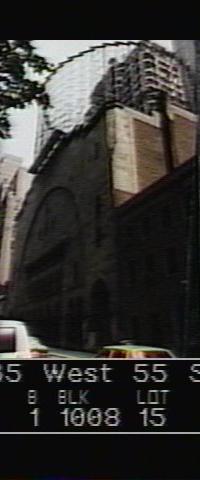
The city photographed every building for its tax records around 1940 and again in the 1980s. NYC Municipal Archives.
Written with AI from the source each entry cites, then fact-checked.
- 1922
The Shriners buy a block-through tract from Yale where an abandoned film studio stands
On January 31, 1922, the Shriners, acting as the Mecca Holding Company, bought four lots on West 55th Street and three on West 56th Street from Yale University. The tract held an abandoned motion picture studio, and stables and garages filled the rest of the block. The order hoped its new temple would attract apartment houses and office buildings and raise land values on both streets. Two more lots on 55th Street were secured about three months later.
- 1923
Architect Harry P. Knowles dies nine months before the Mecca Temple's cornerstone is laid
The Mecca Temple was the last work of Harry P. Knowles, a Master Mason who also belonged to the Shriners as a Noble, who died in January 1923. The cornerstone was not laid until October 13 of that year, and the firm of Clinton & Russell supervised his design after his death. His program called for lodge and club rooms, a stage, an auditorium able to meet any demand placed on it and a banquet hall, which he fitted onto an irregularly shaped site.
- 1923
A 65-ton steel girder crushes manhole covers on its way to the site
Workers haul a 92-foot, 65-ton steel girder along Manhattan streets to the Mecca Temple construction site, and the load is heavy enough to snap more than 50 manhole covers along the route. It is the largest single piece of steel yet used in a New York building, helping architect Harry P. Knowles create an auditorium free of interior columns.
Source: Daytonian in Manhattan
- 1924
The Shriners dedicate the Mecca Temple with its Moorish dome
Architect Harry P. Knowles, a Shriner and master mason who dies in January 1923 before construction finishes, designs a Moorish Revival meeting hall for the Ancient Arabic Order of the Nobles of the Mystic Shrine; the firm Clinton & Russell completes his plans. The building's dome, covered in nearly 28,000 tiles, and its horseshoe-arched, terra-cotta facade make it one of Midtown's most exotic buildings.
Source: Daytonian in Manhattan
- 1925
John Philip Sousa's band plays the Mecca Temple's first public concert
The auditorium first opened to the public in May 1925 with a fashion show, when the building still lacked its interior decoration and some of its first-floor seating. That October, John Philip Sousa's band gave the first public concert there. The New York Symphony Orchestra also moved its performances into the hall from the Aeolian Building on 42nd Street.
“John Philip Sousa's band performed in the temple's first public concert that October…”
Source: Wikipedia
- 1943
Susan and God becomes City Center's first stage play, with Doris Day far down the cast
Two days after City Center opened with a New York Philharmonic concert, its first stage play, Susan and God, was offered on December 13, 1943. Gertrude Lawrence and Conrad Nagel starred. Far down the supporting cast was a fledgling singer named Doris Day. The highest ticket price at the opening concert had been $1.65.
Source: Daytonian in Manhattan
- 1943
The city reopens the former Mecca Temple as New York City Center
After the city forecloses on the foundering Mecca Temple for $622,543 in unpaid taxes, Mayor Fiorello La Guardia joins with Newbold Morris and other civic leaders to found City Center of Music and Drama. The renamed hall reopens with a New York Philharmonic concert, launching a subsidized home for opera, ballet, and theater in Midtown.
Source: Daytonian in Manhattan
- 1944
Leopold Stokowski donates his salary and $20,000 to launch the New York City Symphony
Conductor Leopold Stokowski took up City Center as a way to make symphonic music and opera available to listeners who could not afford them. In 1944 he gave away his entire first-year salary and added $20,000 of his own money to the project. With most men overseas during the war, he built the orchestra from scratch by recruiting women and very young players, so about a third of the original New York City Symphony was female.
Source: Daytonian in Manhattan
- 1948
The newly formed New York City Ballet moves into City Center
City Center becomes the resident home of the new New York City Ballet, joining the New York City Opera that had moved in four years earlier. The venue's low ticket prices make ballet and opera accessible to audiences who cannot afford Broadway or the Metropolitan Opera House.
Source: Wikipedia
- 1972
The Alvin Ailey company becomes a City Center resident troupe
Alvin Ailey's company joins City Center as a resident dance troupe, six years after the Robert Joffrey Ballet had also made the venue its home. The building's mid-century dance residencies cement its reputation as a hub for companies outside the classical ballet mainstream.
Source: Daytonian in Manhattan
- 1984
The Manhattan Theatre Club moves into the basement and splits it into two theaters
The space under the main auditorium was built as the Shriners' banquet hall. In 1981 it became a 299-seat off-Broadway house called The Space, though dance companies used it only occasionally. The Manhattan Theatre Club moved in during 1984 and divided it into two auditoriums. Today the club runs Stage I, with 299 seats, and Stage II, with 150, plus a coatroom and members' lounge on the landing of the staircase to the lobby.
Source: Wikipedia
- 1994
City Center launches Encores! to revive forgotten musicals in concert
Executive director Judith Daykin started Encores! Great American Musicals in Concert in 1994, a series whose early offerings were seldom-heard shows, among them Du Barry Was a Lady and Pal Joey. She saw it as an experiment to draw new audiences, and it brought in people who had not visited the hall in 20 years. In 2000 the American Theatre Wing gave City Center a Tony Honors for Excellence in Theatre for the series.
“New York City Center launched its first Encores! Great American Musicals in Concert productions in 1994.”
Source: Wikipedia
- 2011
A $75 million renovation reopens City Center with its original colors restored
Work began in March 2010 on a $75 million renovation designed by Ennead Architects, carried out in two phases over the 2010 and 2011 seasons. It improved sightlines and seating and added a new canopy. Six rows were removed in 2011, bringing the house to about 2,250 seats, and the original color scheme and the mezzanine lobby murals were restored. Mayor Michael Bloomberg led a ceremony marking completion in October 2011.
Source: Wikipedia
Further reading
- New York City CenterWikipedia
- A Moorish Fantasy - The New York City Center, 131 West 55th StreetDaytonian in Manhattan
Nearby
- Avenue of the Americas Plaza125 West 55th Street | 7 entries
- CitySpire150 West 56th Street | 13 entries
- Ziegfeld Theatre141 West 54th Street | 6 entries
- Metropolitan Tower146 West 57th Street | 9 entries
- Le Parker Méridien111 West 56th Street | 9 entries
- 130 West 57th Street4 entries