Consolidated Edison Building
133 East 14th Street | also 146 East 15th Street, 124 East 15th Street, 4 Irving Place | Gramercy | built 1911
Open on the map13 entries

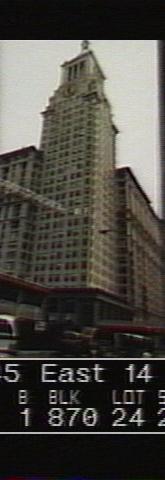
The city photographed every building for its tax records around 1940 and again in the 1980s. NYC Municipal Archives.
Written with AI from the source each entry cites, then fact-checked.
- 1854
The Academy of Music, New York's leading opera house, opens on this site
An earlier building on this site, the 4,000-seat Academy of Music, opened on October 2, 1854, at 14th Street and Irving Place. It gave the American premieres of Rigoletto, La traviata and Aida, and hosted a reception for the Prince of Wales in 1860. The Metropolitan Opera's opening in 1883 drew away its wealthy patrons; the Academy stopped presenting opera in 1886, turned to vaudeville and film, and was torn down in 1926.
Source: Wikipedia
- 1866
A fire destroys the Academy of Music that once stood on the site
New York's third opera house, which had opened on this site in 1854, burns to the ground. Rebuilt, it continues hosting opera until 1887, when it is converted into a movie theater. Consolidated Gas buys the property in 1925, and its headquarters tower eventually rises on the same block.
Source: Wikipedia
- 1868
The Democratic National Convention meets in Tammany Hall's new 14th Street headquarters
Tammany Hall's new headquarters on East 14th Street, on part of what is now the Con Edison site, hosted the 1868 Democratic National Convention from July 4 to July 9. It was the party's first national convention since the end of the Civil War. On the opening day a separate Soldiers and Sailors National Convention met at Cooper Institute, also in New York.
Source: Wikipedia
- 1870
The Lotos Club makes a mansion on the future Con Edison block its first home
In 1870 the Wood mansion on this block became the first home of the Lotos Club, a private social club whose members came from journalism, the arts, music and the stage. After 1876 it served as the Brewers' Exchange, and the building later passed to the gas company.
“In 1870, the Wood mansion became the first home of the Lotos Club, a private club for journalists, artists, musicians, and actors…”
- 1881
Tony Pastor leases a theater in the Tammany Hall building and shapes American vaudeville
In 1881 the impresario Tony Pastor leased the former Germania Theatre on 14th Street, in the building that also housed Tammany Hall. He alternated operettas with family-oriented variety shows, the mix that became known as vaudeville. Aiming at a mass audience, he served no liquor in the theater and asked for decent acts, which drew women and families.
Source: Wikipedia
- 1884
Six gas companies merge into Consolidated Gas, and the Wood mansion becomes the president's residence
The Consolidated Gas Company was formed in 1884 when the Manhattan Gas Light Company combined with five other gas companies. The Manhattan company's office building on this block became the headquarters of the new firm. The company also acquired the former Wood mansion, once the Lotos Club's home, to serve as a residence for its president.
- 1911
Consolidated Gas raises a 12-story wing in nine months, then hangs seven more floors above it
To keep operating, Consolidated Gas built Hardenbergh's new headquarters in two stages, starting in January 1911 with a 62-foot-wide section on East 15th Street finished by late September. The company then bought adjoining lots and decided to rise to 18 stories plus a penthouse cafeteria. Because the 12-story center could not carry seven more floors, trusses shifted their weight onto the new wings, engineered by W. Cullen Morris and built by the George A. Fuller Company.
- 1926
Warren & Wetmore's designs are ready and the old Academy of Music is demolished
After Consolidated Gas hired Warren & Wetmore and the engineering firm T.E. Murray, Inc., preliminary designs for the new tower were ready by April 1926, and by August the former Academy of Music had been torn down. Plans went to the Department of Buildings that October, and the first phase was complete by November 1928.
“Preliminary designs for the new building were ready by April 1926 and the former Academy of Music was demolished by August.”
- 1928
Tammany Hall holds its last Fourth of July in the 14th Street building before leaving for Park Avenue
The Tammany Hall building on 14th Street, which stood on part of this site, was sold in December 1927 to a real estate syndicate, which resold it to Consolidated Gas in January 1928 amid allegations that Tammany leaders had profited. Leader George Washington Olvany denied them, and Joseph P. Day, a longtime Tammany member and one of the syndicate's principals, agreed to hand the $70,000 profit to Tammany. The society stayed on until July 4, 1928, to celebrate Independence Day there, then moved to temporary space at 2 Park Avenue.
“Tammany Hall remained in its old headquarters until July 4, 1928, so it could celebrate the U.S. Independence Day at that location.”
Source: Wikipedia
- 1929
Warren and Wetmore's tower, crowned by the Tower of Light, completes Con Edison's headquarters
Henry Hardenbergh's headquarters for the utility went up in 1911–14. From 1926 to 1929 Warren and Wetmore added a 26-story tower on the old Academy of Music site, topped by a lantern called the Tower of Light, with four clock faces and bells that strike every quarter hour. The building held 7,000 employees. It was designated a city landmark in 2009.
Source: Wikipedia
- 1929
The tower's nighttime light show is switched on, with a bronze lantern beaming to the four compass points
A program of nighttime illumination for Con Edison's tower, called the Tower of Light in company literature, was inaugurated on July 3, 1929. A searchlight in the bronze lantern threw a beam upward while horizontal beams marked the four points of the compass. Behind the colonnade a slowly changing display of lights passed through every color of the spectrum. The illumination was meant to double as a memorial as well as a symbol of power and light.
- 1975
A Puerto Rican nationalist group bombs Con Edison's headquarters
A bomb set off inside the Consolidated Edison building causes minor damage but no injuries; the Puerto Rican nationalist group FALN claims responsibility. The same group claims a second bombing at the same site in 1978, which also causes only minor damage.
Source: Wikipedia
- 2009
The city designates the Consolidated Edison headquarters a landmark
The Landmarks Preservation Commission designates the Consolidated Edison Building, with its clock tower and illuminated Tower of Light beacon, an individual New York City landmark. The designation covers Henry Hardenbergh's 1910s office block along with the Warren and Wetmore tower and annex completed in 1929 that together form Con Edison's headquarters complex.
Source: Wikipedia
Further reading
- Consolidated Edison BuildingWikipedia
Nearby
- Zero Irving124 East 14th Street | 4 entries
- University Hall, site of Lüchow's110 East 14th Street | 7 entries
- 143 East 13th Street3 entries
- New York University 145 4 Av137 4th Avenue | 2 entries
- Hotel Europe138 1/2 East 13th Street | 3 entries
- Billy Madden's Athletic Hall120 East 13th Street | 4 entries