135 Hudson Street warehouse
135 Hudson Street | also 47A Beach Street, 47B Beach Street | Tribeca | built 1887
Open on the map5 entries

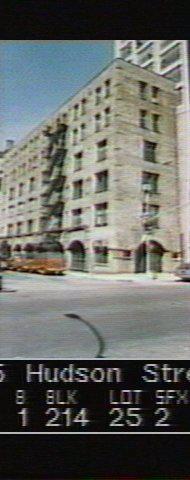
The city photographed every building for its tax records around 1940 and again in the 1980s. NYC Municipal Archives.
Written with AI from the source each entry cites, then fact-checked.
- 1882
An older house on the lot operates as a boarding house before the warehouse
Before the current warehouse, an older residence stood here on land the Cary family had owned since 1829. By 1882 it was a boarding house, and an advertisement in The Sun on May 17 offered board to gentlemen, ladies and married couples. Four years later the owner, Edward M. Cary, commissioned a warehouse to replace it.
Source: Daytonian in Manhattan
- 1887
Kimball & Ihnen build a plain warehouse that critic Montgomery Schuyler praises
Edward M. Cary, a principal of the Cary Brothers storage firm, built the six-story warehouse in 1886-87 to designs by Kimball & Ihnen. The architects left structural iron exposed, rounded the brick piers so wagons would not chip them, and placed an unusual terra-cotta street sign at the corner. Critic Montgomery Schuyler admired the restraint and said the building had no style, yet had style.
- 1910
Crandall-Pettee, reorganized after a fire, leases the warehouse for grocers' and bakers' supplies
On April 21, 1910 it was announced that owner Augustus Bechstein had leased the building to Crandall-Pettee Co., starting at $7,000 a year in rent. The firm sold fixtures and supplies to grocers, confectioners and bakers. It was the successor to the Crandall & Godley Company, founded in 1871, whose own building burned to the ground on January 7, 1909. The company stayed here into the 1920s before moving across Hudson Street.
Source: Daytonian in Manhattan
- 1921
A Crandall-Pettee driver is hurt on a delivery and sues August Belmont for $100,000
On November 16, 1921 truck driver Louis Coughlin left this warehouse to deliver a barrel of glucose to the Park Row Building. As he rolled it onto the sidewalk elevator the chain snapped and the platform dropped into the subcellar. Coughlin, who had been on the Fire Department's eligible list, said his injuries would cripple him and sued the Park Row Building's owner, multimillionaire August Belmont, for $100,000.
Source: Daytonian in Manhattan
- 1923
Chemical maker Ernst Bischoff buys the building and stays more than two decades
According to The New York Times in 1923, Ernst Bischoff paid $135,000 for the six-story building, which Augustus E. Bechstein sold. Bischoff planned to use it for his wholesale chemicals business. Ernst Bischoff Co., which made technical and medicinal products, remained for over two decades and sold the building in 1946.
Source: Daytonian in Manhattan
Further reading
- An Unadorned Beauty -- No. 135 Hudson StreetDaytonian in Manhattan
Nearby
- 3 Collister Street2 entries
- 49 Beach Street2 entries
- 3 Hubert Street2 entries
- 145 Hudson Street3 entries
- 7 Hubert Street2 entries
- 60 Beach Street2 entries