Lefferts-Laidlaw House
136 Clinton Avenue | Fort Greene | built 1835
Open on the map7 entries

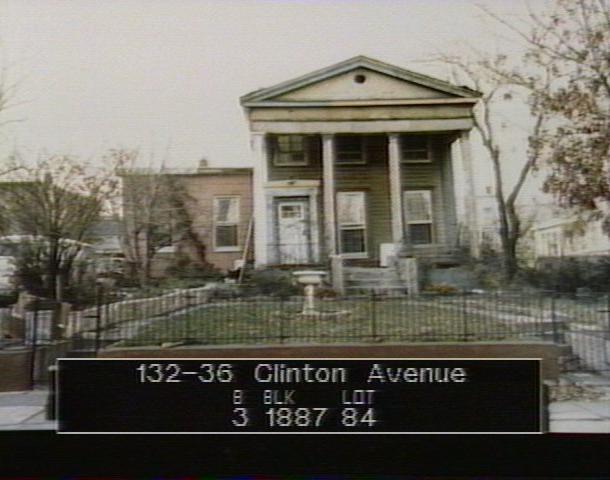
The city photographed every building for its tax records around 1940 and again in the 1980s. NYC Municipal Archives.
Written with AI from the source each entry cites, then fact-checked.
- 1836
Rem Lefferts and John Laidlaw move an older house to the back and build a temple-fronted villa
Carver Richard H. White bought the lot in 1835 and apparently built a small house on it. In 1836 Rem Lefferts and his brother-in-law John Laidlaw bought that house and appear to have had it moved to the rear, where it became part of a service wing. In front of it Lefferts erected a two-story Greek Revival villa with a temple front.
- 1840
Amelia Lefferts and her son Marshall, later a telegraph industry leader, live in the house
Rem's sister-in-law Amelia Lefferts, listed on Clinton Avenue in the Brooklyn directory by May 1840, occupied the house for three years with her three unmarried children. One was Marshall Lefferts, who took a job with an importing firm that dealt in wire used for telegraph lines. He later played a leading role in the telegraph industry, made inventions that improved it, and commanded the Seventh Regiment during the 1863 Draft Riots.
- 1843
Judge A. Orville Millard buys the house and owns it until 1854
Rem Lefferts sold the property to his brother-in-law A. Orville Millard in November 1843. Millard, a lawyer from Ulster County, served as a Brooklyn supervisor and was among the original members of the Board of Education, and in 1843 he became Master of the Court of Chancery. His wife Sarah died in 1849 after the birth of their sixth child, and the house was bought by real estate investor Robert Bage in April 1854.
- 1867
German-born hardware dealer William Mannheim moves in, and his family stays until 1881
James Cosgrove, a cooper with a business on Burling Slip in Manhattan, bought the house in 1866 and sold it a year later to William Mannheim. Mannheim was a German immigrant who ran a Manhattan hardware and tool firm on Mott Street. His family lived here until 1881, when his widow Louise sold the house to Mary J. Wilson.
- 1881
The Wilson family buys the house and keeps it for over forty years
Widow Mary J. Wilson bought the house in 1881 and lived here with three adult sons and a teenage daughter. The sons worked as clerks and bookkeepers, and one became a real estate broker. The house later passed to Frank W. Wilson and was split into a two-family residence by 1935, and his estate sold it in 1948.
- 1980
Allen Handelman and Richard Arnow restore the house after decades under faux brick and shingles
Probably in the 1940s or 1950s the original columns were swapped for square pillars, and the facades were covered in asphalt shingles and brick-patterned siding. Between the late 1970s and early 1980s owners Allen Handelman and Richard Arnow restored the house, with new porch columns and an entrance surround that replicate the originals shown in historic photographs. The National Register of Historic Places added it in 1985.
- 2001
The city designates the house as a landmark, calling it perhaps Brooklyn's last temple-fronted villa
The Landmarks Preservation Commission designated the house on November 13, 2001. Its report called it a rare surviving freestanding Greek Revival house with a temple front, possibly the only one left in Kings County. The house was built in three sections: the main house from about 1836 to 1840, a southwest wing moved to the lot, and a southeast wing built before 1855.
Further reading
- Lefferts-Laidlaw HouseWikipedia
Nearby
- Henry and Susan McDonald House128 Clinton Avenue | 7 entries
- Feuchtwanger Stable159 Carlton Avenue | 4 entries
- Caroline Ladd Pratt House229 Clinton Avenue | 6 entries
- Pratt Institute Library261 Hall Street | 4 entries
- Pratt Institute Memorial Hall205 Ryerson Street | 3 entries
- Pratt Institute Main Building207 Ryerson Street | 7 entries