First Houses
136 East 3rd Street | also 138 East 3rd Street, 112 East 3rd Street | East Village | built 1920
Open on the map10 entries

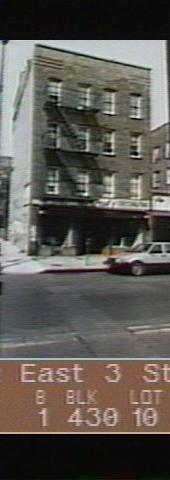
The city photographed every building for its tax records around 1940 and again in the 1980s. NYC Municipal Archives.
Written with AI from the source each entry cites, then fact-checked.
- 1934
The Housing Authority buys Vincent Astor's old tenements for less than half their assessed value
Vincent Astor, who had inherited the Lower East Side properties from his grandfather John Jacob Astor, offered the new Housing Authority 38 parcels in March 1934 and said he wanted to help clear the slums. On December 20, 1934, the Authority bought most of the site's old tenements from him for $189,281.31, paying with a sixty-six-year purchase-money mortgage. The bond established the young agency's credit, and the project went by the name "the Astor project" until shortly before its dedication.
“…acquired the property from Mr. Astor for $189,281.31, a figure which represented less than half the assessed valuation…”
- 1935
A crowd of 1,500 protests at the Astor project over relief workers on the job
The Housing Authority used federal work-relief labor for the demolition and rebuilding, an experiment that caused serious friction between union labor and the relief workers. The friction was the chief cause of a turbulent demonstration by 1,500 people at the site, then still called the Astor project, on September 13, 1935. Labor troubles were also among the reasons the dedication slipped from its first date of October 1, 1935.
“…a turbulent demonstration of 1500 people at the "Astor project" on September 13, 1935…”
- 1935
Between 3,000 and 4,000 applications flood the Housing Authority for First Houses
The Housing Authority opened a rental office for the project in mid-January 1935 and was deluged with applications. It had received between 3,000 and 4,000 by early March, when it closed the list. The project had been planned for 120 to 122 families. A team of social workers picked the tenants, favoring families from the worst slums and smaller households, and all but one of the families chosen lived on the Lower East Side. Six of them had come from the Astor tenements that stood on the site.
“Between 3,000 and 4,000 applications were received by early March, and then applications were closed.”
- 1935
Demolition begins on the tenements that stand where First Houses will rise
On March 1, 1935, demolition began on the mid-19th-century tenements at the site of First Houses. Most had been bought by the New York City Housing Authority from Vincent Astor for $189,281, less than half their assessed value. The project was the Authority's first and was planned as a partial clearance that would remove every third building.
Source: Village Preservation
- 1935
Structural problems force architect Frederick Ackerman to rebuild rather than renovate
Architect Frederick L. Ackerman first planned to tear down every third tenement and remodel the rest to gain light and air. His engineers found the 19th-century buildings too fragile to rebuild, so they were demolished and First Houses was built new, reusing a small number of original foundation supports and the old bricks.
Source: Wikipedia
- 1935
First Houses opens as the nation's first publicly funded low-income housing project
First Houses was dedicated and opened on December 3, 1935. It was the first project of the New York City Housing Authority and the first publicly funded low-income housing project in the United States. Within two months of opening a rental office, the Authority had received between 3,000 and 4,000 applications for the 120 to 122 apartments.
Source: Village Preservation
- 1936
New York's highest court upholds the Housing Authority's power to condemn slum property
Andrew Muller owned two tenements at 130 and 132 East 3rd Street that sat between the Astor properties, and he refused to sell at the price offered. He tried to stop the demolition and challenged the constitutionality of the condemnation the Authority began in March 1935. On March 17, 1936, the State Court of Appeals ruled in NYCHA v. Muller that using eminent domain to remedy slum conditions beyond the reach of private enterprise served the public benefit. The building put up on the Muller site was paid for with a Housing Authority bond that Bernard Baruch took, and it was finished for the last of the first tenants in mid-June 1936.
“…the New York State Court of Appeals handed down a major decision in the case of NYCHA vs. Muller…”
- 1936
Mayor La Guardia unveils a tablet as First Houses is formally handed to the city
On July 2, 1936, Victor Ridder, the local Works Progress Administration chief, presented the project's key to Housing Commissioner Langdon Post. Harry Hopkins came from Washington to defend the project in his remarks, as did Mayor Fiorello La Guardia. The mayor unveiled a tablet saying the houses were an initial step toward slum clearance and low-cost housing, and the landmark report of 1974 notes it was still fixed to 112-114 East 3rd Street.
- 1966
Chess tables and flower tubs arrive in the First Houses courtyard
In 1966 the city's Mobilization for Youth put chess tables and flower tubs in the courtyard behind 29, 31 and 33 Avenue A. By the time of the 1974 landmark report, a majority of the residents were senior citizens, and a single original resident was still there. The tenants' council ran arts and crafts sessions twice a week and a weekly bingo game.
“…chess tables and flower tubs were installed in the courtyard behind Nos. 29, 31 and 33 Avenue A…”
- 1974
First Houses is designated a New York City landmark
First Houses became a New York City landmark on November 12, 1974. The complex has 122 three- and four-room apartments in eight buildings, built in 1935 and 1936 to designs by Frederick L. Ackerman. The New York State Register of Historic Places added it in 1980.
Source: Wikipedia
Further reading
- First HousesWikipedia
Nearby
- Ageloff Tower43 Avenue A | 1 entry
- St. Nicholas Rectory135 East 2nd Street | 3 entries
- Max Meltzer Tower94 East 1st Street | 4 entries
- Podhajcer Shul108 East 1st Street | 3 entries
- Church of the Most Holy Redeemer206 East 4th Street | 5 entries
- 101 East 2nd Street1 entry