14 East 11th Street
Greenwich Village | built 1852
Open on the map5 entries

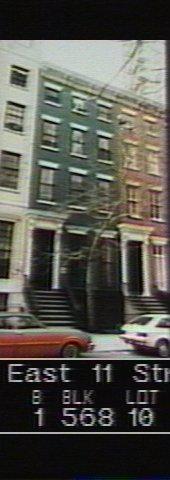
The city photographed every building for its tax records around 1940 and again in the 1980s. NYC Municipal Archives.
Written with AI from the source each entry cites, then fact-checked.
- 1852
Banker James Gallatin builds a pair of Italianate brick houses, one of them No. 14
In 1852 James Gallatin put up two matching brick houses with stoops on the south side of East 11th Street, and No. 14 is one of them. Gallatin was the son of Treasury Secretary Albert Gallatin and had succeeded his father as president of the Wall Street bank later named Gallatin Bank; he lived next door at No. 16 after buying it in 1849. No. 14 still has its original oblong cast-iron stoop railings, and its brownstone doorway carries a heavy cornice on vertical console brackets.
“This pair of dignified brick houses with stoops was built for James Gallatin (resident of No. 16) in 1852 in the Italianate style.”
- 1860
Dr. Elisha Reynolds Belcher dies at 69 and his funeral is held in the parlor
The Belcher family lived here in the early 1850s, when the house was numbered 54 East 11th Street (renumbered 14 in 1868). Dr. Elisha Reynolds Belcher, born in Fairfield, Connecticut, in 1791, died on March 19, 1860, and his funeral took place in the parlor two days later. It was the second family funeral in the house: his daughter-in-law Emma Snyder Belcher had died here at 25 in January 1858. His widow and her children left in 1865.
Source: Daytonian in Manhattan
- 1914
Suffrage pioneer Eliza Richards dies in the house her family bought in 1865
Real estate broker Benjamin Richards and his wife, Eliza Fenno Verplanck Richards, bought the house in 1865, and the family held it for six decades, renting it to a string of well-off tenants along the way. Eliza died here on November 25, 1914. The New York Times described her as an early worker for the women's suffrage cause and a member of several of the city's clubs. Her daughter Louise sold the house in 1925.
Source: Daytonian in Manhattan
- 1920
Charles MacVeagh Jr. of this house dies in a blizzard on Mount Monadnock
Charles MacVeagh, a U.S. Steel lawyer and son of a U.S. Attorney General, lived here with his wife and six sons. On February 14, 1920, his 22-year-old son Charles Jr., a recent Harvard graduate, set out with a friend to climb Mount Monadnock in New Hampshire. A snowstorm caught them near the summit, and MacVeagh died around 4:00 the next morning; the family's caretaker found the friend and got him to a farmhouse. His father became U.S. Ambassador to Japan in 1925.
Source: Daytonian in Manhattan
- 1950
Frank Lloyd Wright apprentice Edgar Tafel buys the house and later dies in it
In March 1950 architect Edgar Tafel and his wife, Lucille Blair, bought the house, planning a home and office. Tafel had spent nine years training under Frank Lloyd Wright and had worked on Fallingwater, the Johnson Wax Headquarters and Wingspread. He divided the house into apartments and remodeled it again in 1959. He died here on January 18, 2011, aged 98, with about 80 houses and 35 religious buildings among his own designs, according to The New York Times.
Source: Daytonian in Manhattan
Further reading
- The 1852 Elisha R. Belcher House - 14 East 11th StreetDaytonian in Manhattan
Nearby
- The Isaac Labagh House12 East 11th Street | 4 entries
- 16 East 11th Street2 entries
- 20 East 11th Street1 entry
- 41 5th Avenue1 entry
- 22 East 11th Street1 entry
- Lockwood de Forest House7 East 10th Street | 2 entries