143 Chambers Street
Tribeca | built 1915
Open on the map5 entries

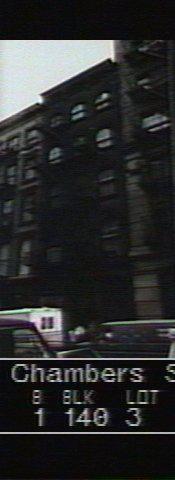
The city photographed every building for its tax records around 1940 and again in the 1980s. NYC Municipal Archives.
Written with AI from the source each entry cites, then fact-checked.
- 1835
Ellis Potter and his wife live in a brick house on the lot before the present building
From 1835 and for years afterward, Ellis Potter and his wife made their home in a brick house on this lot, an earlier building on the site. Mrs. Potter sat on the board of managers of the New-York Female Assistance Society, an organization that helped the sick poor. Ellis was a prosperous businessman and eventually became the Susquehanna and Wyoming Valley Railroad and Coal Company's secretary. The Potters left by 1853, probably as commerce moved onto the street.
Source: Daytonian in Manhattan
- 1861
Ellis Potter sues over a party wall removed when his neighbor rebuilt, and wins nearly $3,500
In May 1854 Potter's neighbor at 145 Chambers tore down his house and removed the party wall between the two properties. On April 2, 1861, Potter sued him. The defendant, named White, claimed No. 143 was already ruinous, but Potter said it was renting for $1,200 to $1,400 a year. He won a judgment of nearly $3,500. This happened in the earlier house on the site.
Source: Daytonian in Manhattan
- 1864
Potter completes a new Italianate building with a cast-iron storefront and four sandstone floors
Potter had a replacement building finished in spring 1864. It had a cast-iron storefront below four floors of light sandstone, arched second-floor openings with shared pilasters and scrolled keystones, and an Italianate bracketed cornice. J. Goldstein & Bro. managed it and took the ground floor, and one early tenant, William Lehman, made hoops for hoop skirts. The facade survives remarkably intact today.
Source: Daytonian in Manhattan
- 1882
Ryan & Co., baseball makers, advertise for workers to sew the Ryan Dead Ball
Ryan & Co., which made baseballs and other baseball goods, rented space here after moving from 149 Fulton Street. On March 17, 1882, it advertised for people to sew its Ryan dead ball, with piece rates from 85 cents for a dead ball to 16 cents for a small O K ball. The company said professional and junior clubs across the country had adopted the ball.
Source: Daytonian in Manhattan
- 1899
Wholesale grocer Francis B. Thurber, a tenant here, is admitted to the bar at 57
Francis B. Thurber, who led the Thurber-Whyland Company, a wholesale grocery firm, was a tenant here. The Sun reported on March 12, 1899 that, at 57, he had joined the bar, making him the oldest man admitted as a lawyer in New York then. In 1901 the Tribune reported that his firm had gone bankrupt, which he blamed on the Panic of 1893, and he said he hoped to build a law practice to help his creditors.
Source: Daytonian in Manhattan
Further reading
- No. 143 Chambers Street Daytonian in Manhattan
Nearby
- 145 Chambers Street5 entries
- 153 Chambers Street5 entries
- Van Orden House135 Reade Street | 5 entries
- 150-152 Chambers Street150 Chambers Street | 7 entries
- 154 Chambers Street5 entries
- 113 Reade Street2 entries