Gabay Building
143 Franklin Street | Tribeca | built 1898
Open on the map5 entries

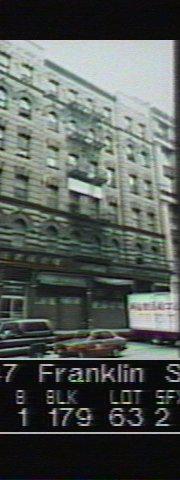
The city photographed every building for its tax records around 1940 and again in the 1980s. NYC Municipal Archives.
Written with AI from the source each entry cites, then fact-checked.
- 1897
Plumber-turned-builder Henry Gabay buys three small buildings on Franklin Street for $105,000
In 1897 the widow Margetta Welsh put three two-story buildings of brick and frame, holding tenements and stores, at Nos. 143-147 Franklin Street up for sale, and the titles changed hands several times within days. The last buyer, on June 19, was Henry G. Gabay, who began as a plumber and, with a co-worker, took over the firm in 1877 as McAuliffe & Gabay. These low earlier buildings were later cleared for his loft building.
Source: Daytonian in Manhattan
- 1898
Henry Anderson designs a six-story, iron-framed loft for heavy industrial tenants
Gabay hired Henry Anderson, an architect better known for houses, to design a loft building 69 feet wide and six stories high. Its front was yellow Roman brick trimmed with limestone and terra cotta. As it neared completion in January 1898, the Record & Guide described an iron frame, electric lighting and an electric freight elevator. The upper floors were built to carry 430 pounds per square foot, so tenants could store or run heavy machinery.
Source: Daytonian in Manhattan
- 1899
The American Woolen Company, a $65 million mill combine, is among the building's early tenants
One of Gabay's early tenants was the American Woolen Company, which signed a three-year lease at $14,000. The company was organized in the spring of 1899 as a combination of East Coast mills, with $65 million in capital, and worried many smaller firms. Its spokesman insisted that the aim was not to raise prices, and within days it had taken over the Mascoma Flannel Company and the Riverside Woolen Company.
Source: Daytonian in Manhattan
- 1905
Gans Salvage Company auctions $75,000 of salvaged rain gear at the building
Two salvage firms, Underwriters' Salvage and the Gans Salvage Company, held auctions here of goods recovered from fires, ships and floods. In March 1905 Gans advertised $75,000 worth of raincoats and rubber garments, including cravenettes, firemen's coats and other stock from the Merchants' Rubber Company. J. W. Doane had bought the building from Gabay five years earlier for $250,000.
Source: Daytonian in Manhattan
- 1911
Leo Popper & Sons moves its art-glass button and mirror business into the building
By 1911 the glass firm Leo Popper & Sons occupied the building. In that year the company had four men, two women and two children aged 14 to 16 making glass buttons and beads, and others cut mirrors and signs. Founded in 1879 by Austrian immigrant Leo Popper, the firm stayed for decades, and the blog credits it with colored glass for two cathedrals and for repairs to the Statue of Liberty's torch.
Source: Daytonian in Manhattan
Further reading
- The 1898 "Gabay Bldg." -- Nos. 143-147 Franklin StreetDaytonian in Manhattan
Nearby
- Thomas J. Lipton Building149 Franklin Street | 5 entries
- 139 Franklin Street3 entries
- Former Fifth Precinct Station House19 Leonard Street | 5 entries
- Knickerbocker Ice Company stable17 Leonard Street | 5 entries
- 23 Leonard Street2 entries
- 25 Leonard Street1 entry