146 Spring Street
SoHo | built 1819
Open on the map5 entries

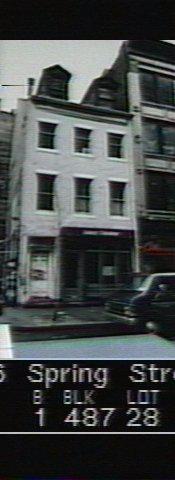
The city photographed every building for its tax records around 1940 and again in the 1980s. NYC Municipal Archives.
Written with AI from the source each entry cites, then fact-checked.
- 1819
George Wragg completes a row of Spring Street houses after beating a plan to widen the street
George Wragg bought the south side of Spring Street between West Broadway and Wooster from the Watkins estate. When the city proposed widening the street in 1817, he went door to door and brought a petition before the Common Council on October 20 of that year, and the council abandoned the plan. Wragg finished the row in 1819, and No. 146, one house from the Wooster Street corner, was among them.
Source: Daytonian in Manhattan
- 1819
The Federal doorway of 146 Spring Street keeps its original columns and egg-and-dart transom
Read more
The Landmarks Preservation Commission's SoHo-Cast Iron Historic District report names this house as a surviving example of a common Federal treatment: a rectangular transom outlined with egg-and-dart molding. It notes that 146 Spring and 156 Spring still have their original entry columns. Like most surviving Federal houses in the district, they are three stories high and about 25 feet wide.
- 1850
A pharmacy at 146 Spring advertises James Quinn's Cough Candy as a sure cure for coughs and colds
A pharmacy was operating in the house by 1850. On November 16 of that year an advertisement in the New-York Daily Tribune pitched James A. Quinn's Cough Candy, said to cure coughs, colds, asthma, whooping cough, influenza and every ailment leading to consumption. It told readers where to buy the lozenges: No. 146 Spring Street.
Source: Daytonian in Manhattan
- 1890
Hat makers Samuel and Isidore Epstein move into the upper floors after a fire destroys their Greene Street shop
The old house's upper floors were turned to factory work. In 1890 brothers Samuel and Isidore Epstein arrived after their shop at 213 Greene Street burned. Their firm, S. Epstein & Sons, made hats and caps; in 1895 its ten men and two women worked an average of 54 hours a week. That year the brothers retired and passed the business to Louis W. and Benjamin Epstein.
Source: Daytonian in Manhattan
- 1981
Vintage shop Pinx opens on the ground floor as SoHo turns from factories to artists
Spring Street was rediscovered in the second half of the twentieth century as artists made SoHo the nucleus of Manhattan's art community. In 1981 a vintage clothing store called Pinx took the ground floor, where cough candy had been sold in 1850. In 2005 the upper floors were converted to one apartment each. The 1819 doorway and dormers survived all of it.
Source: Daytonian in Manhattan
Further reading
- The 1819 No. 146 Spring StreetDaytonian in Manhattan
Nearby
- 148 Spring Street1 entry
- 150 Spring Street1 entry
- The Half House154 Spring Street | 5 entries
- 83 Wooster Street1 entry
- 156 Spring Street4 entries
- 90 Wooster Street2 entries