Studebaker Building
1469 Bedford Avenue | also 737 Sterling Place | Crown Heights | built 1920
Open on the map6 entries

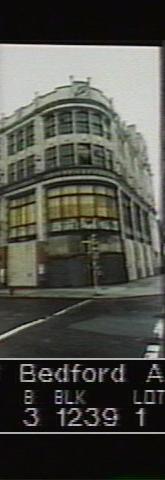
The city photographed every building for its tax records around 1940 and again in the 1980s. NYC Municipal Archives.
Written with AI from the source each entry cites, then fact-checked.
- 1920
Studebaker buys the corner of Bedford Avenue and Sterling Place for a Brooklyn showroom
The Studebaker Corporation of America acquired the northeast corner of Bedford Avenue and Sterling Place in December 1919. The Brooklyn Eagle reported on February 1, 1920 that Studebaker had many customers in the borough and would put up a $250,000 concrete and terra cotta service station and salesroom there. The lot sat on Bedford Avenue's Automobile Row, where Trow's directory already listed 25 automobile businesses by 1912.
“In December 1919, the Studebaker Corporation of America acquired the property at the northeast corner of Bedford Avenue and Sterling Place.”
- 1920
Tooker and Marsh design a neo-Gothic showroom clad in white terra cotta
By April 7, 1920 the architects Tooker and Marsh had filed permits for a four-story building with a mezzanine for offices, with the showroom in front and the garage in the Sterling Place tower. Its brick walls were clad in terra cotta from the Atlantic Terra Cotta Works and topped by a parapet with wheel emblems bearing the Studebaker name. Unlike other automobile buildings of the period, it was neo-Gothic, with exuberant ornament.
- 1939
Studebaker stops operating at the building, which had also sold used cars
By 1934 the building served as a showroom and sales office for used cars as well as new ones. By 1939 Studebaker had ceased operating there, though it kept selling through independent dealers in Brooklyn and ran a parts department at 1375 Bushwick Avenue.
“By 1939, Studebaker had ceased its operations at this location but still maintained sales operations through independent dealers and distributors throughout Brooklyn.”
- 1946
The former showroom becomes a dress store, sweater-packing space and furniture factory
William Heitner was the owner of record in 1941, when architect Irving Cohen filed permits to change the building's architecture and use. By 1946 the first floor held a dress store and showroom, the second floor was used for packing sweaters, the third for a furniture showroom and the fourth for making furniture. The mezzanine remained offices.
- 2000
A developer converts the Studebaker Building into 27 apartments
A Brooklyn-based developer bought the building in 1999. In 2000 he converted it into 27 apartments for homeless, disabled and low-income families, dividing the first story into two stories.
- 2000
The Studebaker Building is designated a New York City landmark
The Landmarks Preservation Commission designated the building on December 19, 2000, after an October 31 hearing at which the Historic Districts Council spoke in favor. The Friends of Terra Cotta and the owner also sent letters of support. The commission called it among the few automobile showrooms left on Brooklyn's Automobile Row.
“The Historic Districts Council spoke in favor of the designation. In addition, the Commission received letters from the Friends of Terra Cotta and the owner…”
Nearby
- Congregation Kol Israel603 St Johns Place | 5 entries
- Bedford Union Armory1561 Bedford Avenue | 6 entries
- Imperial Apartments1339 Bedford Avenue | 1 entry
- Imperial Apartments1198 Pacific Street | 6 entries
- St. Bartholomew's Episcopal Church and Rectory1223 Pacific Street | 2 entries
- St. Bartholomew's Church1234 Atlantic Avenue | 5 entries