147 Christopher Street
also 684 Greenwich Street | West Village | built 1900
Open on the map3 entries

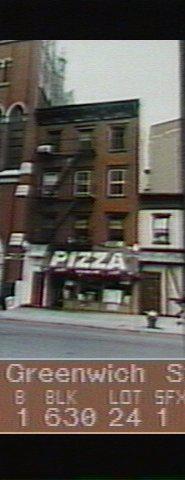
The city photographed every building for its tax records around 1940 and again in the 1980s. NYC Municipal Archives.
Written with AI from the source each entry cites, then fact-checked.
- 1870
Peter Hagan runs a saloon at 684 Greenwich Street, starting a long run of bars in the building
Liquor dealer Peter Hagan kept a saloon at 684 Greenwich Street from 1870 to 1890, among the earliest known tenants of the two small buildings that butcher Thomas E. Broadway Jr. had put up at 143 and 145 Christopher Street. Those buildings were joined in 1906 and housed John J. Coogan's saloon until 1925, then the Cathedral Cafeteria and Bar & Grill until 1965. Later came the Ballybay Pub in the 1970s and Two Potato, a gay bar, in the early 1980s.
- 1871
Butcher Thomas E. Broadway Jr. builds a four-story flats building at 147 Christopher Street
Read more
Broadway, a butcher in the firm T.E. Broadway & Son at Clinton Market, bought the lot in 1865 and had builder Nicholas Connor raise this brick apartment house in 1871, with room for three families above a ground-floor store. A barber shop run by the Guerriero family held the storefront from about 1902 to 1929 and sometimes served as a polling place for the 5th Assembly District. Broadway's heirs kept the property until 1959.
- 1897
Butcher Thomas E. Broadway Jr. dies and leaves $400,000 to a teenage step-granddaughter, and 70 relatives contest it
Thomas E. Broadway Jr., who had built 147 Christopher Street, was divorced from his wife Martha when he died in 1897. He left his whole estate, about $400,000 and including this building, to his teenage step-granddaughter Fannie L'Hommedieu. His former wife and some 70 relatives challenged the will, but the courts upheld it. The property later passed to Mary Brown King, and when her estate sold it in 1959 the Times noted it was the first change of ownership since 1865.
Nearby
- Two Potato building684 Greenwich Street | 5 entries
- 690 Greenwich Street3 entries
- St. Veronica's Church149 Christopher Street | 8 entries
- 157 Christopher Street2 entries
- 692 Greenwich Street2 entries
- 659 Washington Street1 entry