Kosciuszko Foundation (J. J. Van Alen House)
15 East 65th Street | Upper East Side | built 1917
Open on the map6 entries

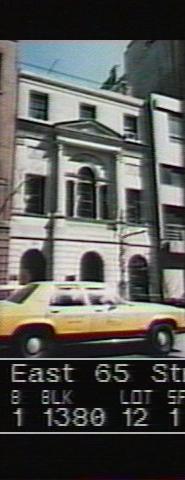
The city photographed every building for its tax records around 1940 and again in the 1980s. NYC Municipal Archives.
Written with AI from the source each entry cites, then fact-checked.
- 1894
Miss Chisholm's School joins the millionaires' protest against Astor's stable
In the 1890s the older house on this lot, at 15 East 65th Street, was home to Miss E. T. Chisholm, who ran a school for the daughters of the very wealthy. In 1894 John Jacob Astor planned a huge private stable at 65th Street and Madison Avenue. Miss Chisholm signed a letter from an indignation meeting of local millionaires that called the plan a great discourtesy that injured neighbors and their property.
Source: Daytonian in Manhattan
- 1916
James J. Van Alen buys the old house on East 65th Street and tears it down
James J. Van Alen, a millionaire who adored England and was John Jacob Astor's brother-in-law, was reported by The New York Times on April 26, 1916 to have bought the four-story house at 15 East 65th Street. It stood in the middle of Astor territory, with Astor's double mansion around the corner. Van Alen had the old house demolished and hired Harry Allan Jacobs, known for homes in historic styles, to design a new one.
Source: Daytonian in Manhattan
- 1917
Harry Allan Jacobs completes a near-copy of a London Regency mansion
Jacobs was told to model the new house almost exactly on a Regency mansion in London's St. James's Square, and it was finished in 1917. The limestone house has three stories and three matching arched openings in its rusticated base. Its second floor has a Palladian window framed by Corinthian pilasters and columns under a pediment, the feature that draws the eye from the street.
Source: Daytonian in Manhattan
- 1919
Van Alen sells the mansion rather than live under Prohibition
James J. Van Alen had said he would sell if Prohibition came. After the Volstead Act passed on October 28, 1919, he sold the house for $275,000 to Rufus L. Patterson, an American Tobacco Company vice president, and was reported to be moving to England, with summers in Newport. The New York Times reported the sale on December 13. The Pattersons stayed for more than twenty years.
Source: Daytonian in Manhattan
- 1925
Stephen Mizwa's scholarship committee becomes the Kosciuszko Foundation
Dr. Stephen Mizwa set up the Polish American Scholarship Committee in 1923 to bring students to American universities, working with Vassar president Henry Noble MacCracken. In December 1925 it became the Kosciuszko Foundation, named for the Polish general who fought in the American Revolution, and widened its mission to cultural and educational exchange between the United States and Poland.
“In December 1925, the Scholarship Committee changed into the new Kosciuszko Foundation.”
Source: Wikipedia
- 1945
The Kosciuszko Foundation buys the mansion after Margaret Patterson cuts her price
Rufus Patterson died in April 1943, and two years later his widow Margaret put the house up for sale at $250,000. The Kosciuszko Foundation badly wanted it as headquarters but lacked the money, so she lowered the price to $85,000 for them. She later gave another $16,000 to help the foundation pay off its mortgage.
Source: Daytonian in Manhattan
Further reading
- Kosciuszko FoundationWikipedia
- The J. J. Van Alen House -- No. 15 East 65th St.Daytonian in Manhattan
Nearby
- Temple Emanu-El840 5th Avenue | 8 entries
- Wildenstein & Co. Building19 East 64th Street | 4 entries
- Lotos Club5 East 66th Street | 7 entries
- New India House3 East 64th Street | 4 entries
- The Parkview45 East 66th Street | 9 entries
- 834 Fifth Avenue834 5th Avenue | 10 entries