McSorley's Old Ale House
15 East 7th Street | East Village | built 1865
Open on the map14 entries

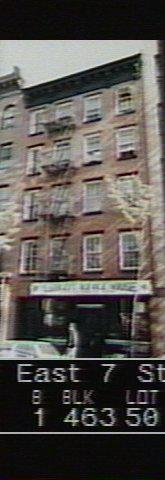
The city photographed every building for its tax records around 1940 and again in the 1980s. NYC Municipal Archives.
Written with AI from the source each entry cites, then fact-checked.
- 1882
Harrigan and Hart set their comedy "McSorley's Inflation" in the saloon
In 1882 the theater team of Harrigan and Hart, whom the press then billed as the Gilbert and Sullivan of America, made the saloon the setting of one of their slum comedies, called "McSorley's Inflation." Founder John McSorley admired the pair and liked to sing their numbers, such as "Muldoon, the Solid Man," with a chorus of customers. Joseph Mitchell later noted that the stage tribute pleased him greatly.
Source: The New Yorker
- 1883
Peter Cooper dies, and his back-room chair is draped in black each April 4 for years
Cooper Union founder Peter Cooper spent so many late-life afternoons philosophizing with workingmen in McSorley's back room that he was given his own chair, fitted with an inflated rubber cushion. He also had a pewter mug with his name scratched in by icepick and gave the saloon a life-size portrait of himself, which hung over the back-room mantel by 1940. After his death on April 4, 1883, the chair was draped in black cloth on that date for a number of years.
Source: The New Yorker
- 1908
A signboard blows down and the Old House at Home becomes McSorley's Old Ale House
John McSorley patterned his saloon on a public house he had known in Ireland and first named it the Old House at Home. When the old signboard blew down, around 1908, the replacement he ordered carried a new name, McSorley's Old Ale House. That remains the official name, though by Joseph Mitchell's account customers never called the place anything but McSorley's.
Source: The New Yorker
- 1911
Anarchist Hippolyte Havel and the Ashcan painters become McSorley's regulars
Around 1911 painters including John Sloan, George Luks, Glenn O. Coleman and Stuart Davis began drinking at McSorley's, and one night they brought the anarchist Hippolyte Havel. Bartender William McSorley, a Tammany Democrat, befriended the long-haired Czech and let him run up two dollars on credit, a privilege no one else had. When a police captain warned that Havel wanted to blow up every bank, Bill replied that he did too.
Source: The New Yorker
- 1916
Painter John Sloan etches McSorley's back room
Ashcan school painter John Sloan made the etching "McSorley's Back Room" in 1916, showing two men seated by the fireplace in the tavern's back room. Printed by Peter J. Platt in an edition of one hundred, the print now belongs to the Whitney Museum of American Art's collection.
Source: whitney.org
- 1920
McSorley's stays open through Prohibition by serving watered-down beer
When Prohibition banned alcoholic beverages nationwide, McSorley's kept pouring by selling "near beer," brewed with too little alcohol content to break the law. The workaround let the bar remain in continuous operation while many neighboring saloons shut their doors.
Source: Wikipedia
- 1924
A Greenwich Village feminist in men's clothes buys an ale and sends the bartender into a fit
One winter night in 1924, a Greenwich Village feminist wore trousers, a man's topcoat and a cap, clamped a cigar in her mouth and walked into the all-male saloon. She bought an ale and drank it, then took off the cap, let her hair fall and denounced bartender William McSorley over the equality of the sexes before running out. Bill, realizing he had served a woman, howled and jumped up and down.
Source: The New Yorker
- 1933
William McSorley reluctantly lets a carpenter prop up the sagging bar
For twenty years the bar sagged in the middle, and a carpenter kept warning that it would collapse. In 1933 William McSorley finally told him to go ahead and shore it up, then sat in the back room, upset and unable to eat for days. That year flaking ceiling paint also began falling into customers' ale, and he grudgingly had the ceiling repainted.
Source: The New Yorker
- 1936
William McSorley sells the saloon and tenement to a retired policeman
William McSorley had often said that the saloon would go with him when he died, but in March 1936 he sold it, along with the tenement above, to Daniel O'Connell. O'Connell, who had spent much of his spare time at a back-room table since 1900, retired from the police department two days before buying, and one condition of the sale was that nothing would change. Bill's health soon failed, and he died on September 21, 1938.
Source: The New Yorker
- 1943
Joseph Mitchell's collection McSorley's Wonderful Saloon is published
The saloon, which claims an 1854 founding, drew writers and artists long before it drew tourists. John Sloan painted five scenes of its back room between 1912 and 1930, and The New Yorker's Joseph Mitchell wrote about the place at length, titling his 1943 collection of stories McSorley's Wonderful Saloon. City directories first list John McSorley in 1862, and the building dates from roughly 1858 to 1865.
Source: Wikipedia
- 1970
McSorley's serves women for the first time after a discrimination lawsuit
After being refused service in 1969, National Organization for Women lawyers Faith Seidenberg and Karen DeCrow sued the bar. The court held that its liquor license made the men-only policy a matter of state action subject to equal protection. McSorley's began admitting women on August 10, 1970, and Barbara Shaum was the first served. A ladies' room was not installed until 1986.
Source: Wikipedia
- 1977
Matthew Maher buys the bar and tends it for over four decades
Matthew "Matty" Maher, who had worked as a doorman at McSorley's, purchased the ale house in 1977 and remained its proprietor until his death in January 2020. He continued a chain of ownership that began when founder John McSorley's son William sold the bar to retired policeman Daniel O'Connell in 1936.
Source: Wikipedia
- 1986
McSorley's finally installs a ladies' room, sixteen years after admitting women
After a court forced the bar to open to women in 1970, it complied reluctantly, and the bathroom simply became unisex. The bar did not install a ladies' room until 1986, sixteen years later.
Source: Wikipedia
- 1994
The Rangers drink from the Stanley Cup at McSorley's and dent it
After the New York Rangers won the Stanley Cup in 1994, players brought the trophy to McSorley's and drank from it. The celebration left a dent, and the National Hockey League took the cup back for several days to have it repaired.
“After the New York Rangers hockey team won the Stanley Cup in 1994, they took the cup to McSorley's and drank out of it; the resulting dent…”
Source: Wikipedia
Further reading
- McSorley's Old Ale HouseWikipedia
- 15 East 7th StreetVillage Preservation: East Village Building Blocks
Nearby
- 13 East 7th Street1 entry
- 17 East 7th Street1 entry
- Surma Book and Music Company11 East 7th Street | 4 entries
- 19 East 7th Street2 entries
- 21 East 7th Street2 entries
- Metropolitan Savings Bank Building59 Cooper Square | 3 entries