Sea and Land Church
15 Market Street | Two Bridges | built 1900
Open on the map6 entries

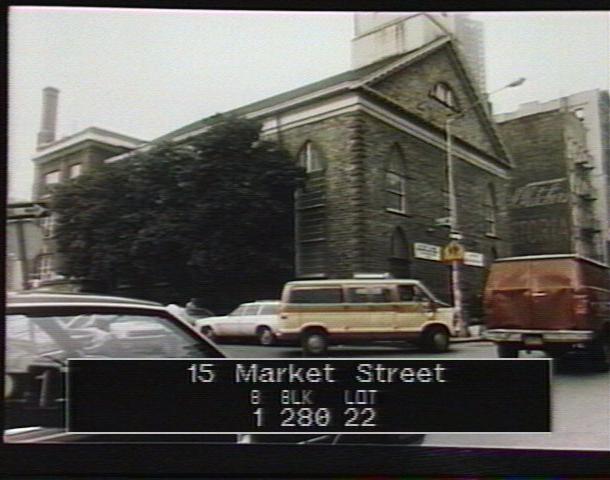
The city photographed every building for its tax records around 1940 and again in the 1980s. NYC Municipal Archives.
Written with AI from the source each entry cites, then fact-checked.
- 1819
Northeast Dutch Reformed Church is dedicated on Henry Rutgers's donated lots
In 1816 Henry Rutgers offered building lots along Henry Street to churches, and the Dutch Reformed congregation accepted five at the corner of Market Street. Construction began in 1817 on a fieldstone building by an architect whose name is lost, with pointed Gothic openings that were unusual for the date. Dr. Milledoler preached the first service on June 27, 1819. Rutgers himself was elected to the church's consistory.
Source: Daytonian in Manhattan
- 1866
Shipping merchant Hanson K. Corning buys the church for a congregation of sailors
By the 1860s the Dutch Reformed families had moved uptown. A Presbyterian group had begun holding services for seamen in a Market Street boarding house in 1864, and in December 1865 it formed the Sea and Land Church with 32 members who were sailors or former sailors. Shipping merchant Hanson K. Corning bought the building for $36,500 on May 1, 1866. When he passed it to the Presbytery in October 1868 he accepted $10,000 less than he had paid and insisted that the pews be free, with a "Seats Free" sign over the doorway.
Source: Daytonian in Manhattan
- 1871
Pastor Edward Hopper's hymn for sailors, "Jesus, Savior, Pilot Me," appears in print
Edward Hopper took the pulpit of the Sea and Land Church in 1869. A reserved man who wrote poetry and hymns in private, he composed "Jesus, Savior, Pilot Me" for sailors, using charts, compasses and the need for a pilot in stormy seas as images. It first appeared, unsigned, in The Sailor's Magazine in 1871, and his authorship came out only in 1880, at a Seamen's Friend Society anniversary. Hopper died in April 1888.
Source: Daytonian in Manhattan
- 1895
Presbytery votes to sell the church, and John Hopkins Denison steps in to save it
After a failed 1893 auction, whose top bid fell $15,000 short, the Presbytery voted again in 1895 to sell the Sea and Land Church. Rev. Charles H. Parkhurst of Madison Square Presbyterian angrily condemned the decision. John Hopkins Denison saved the church by starting a church house, Fresh Air retreats for children on Long Island and a boys' camp in Vermont, and a later historian counted 9,546 people gathered in the church over five weeks that summer. His Saturday meetings aimed at converting Jews drew protests that required three police officers from the Madison Street station.
Source: Daytonian in Manhattan
- 1966
Landmarks Commission designates the church for its early Gothic windows and doors
The Landmarks Preservation Commission designated the church an individual landmark on January 18, 1966. It found the pointed Gothic windows and doors to be probably among the earliest in Manhattan, set in a simple, well-built church of the Federal period that came some thirty years before the Gothic Revival. The report singled out the interlaced wooden muntins that follow the curves of the window heads, and credited Colonel Henry Rutgers's gift of land for making the church possible.
- 1974
Sea and Land congregation fades away and the building goes to the First Chinese Presbyterian Church
By 1954 the columnist Meyer Berger found the interior dusty and the Sea and Land congregation down to about 30 members. It survived partly by sharing the building with the First Chinese Presbyterian Church, led by Rev. K. C. Yeung, which helped pay expenses. The Sea and Land Church was dissolved in June 1972, and in 1974 the Presbytery gave the building to the Chinese congregation.
Source: Daytonian in Manhattan
Nearby
- Sea and Land Church61 Henry Street | 5 entries
- 56 Henry56 Henry Street | 1 entry
- 123 Madison Street40 Market Street | 5 entries
- 47 Market Street1 entry
- Bilger Stable49 Market Street | 4 entries
- Chatham Square Library33 East Broadway | 5 entries