P.S. 122 (Performance Space New York)
150 1st Avenue | also 409 East 9th Street | East Village | built 1920
Open on the map7 entries

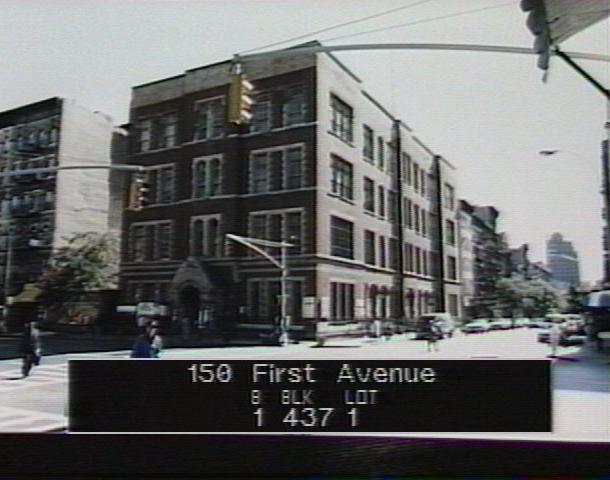
The city photographed every building for its tax records around 1940 and again in the 1980s. NYC Municipal Archives.
Written with AI from the source each entry cites, then fact-checked.
- 1885
Charles B.J. Snyder designs a Jacobean-style public school facing First Avenue
The four-story brick school was built in 1885 for the city's Department of Education to designs by Charles B.J. Snyder, who spent decades with the Board of Education reshaping school buildings. Snyder set the main entrance off-center, in a gabled portico on the west side. For years the western windows faced the First Avenue elevated train, which ran until 1942.
- 1976
The shuttered school is taken over by neighborhood activists, including Katharine Wolpe
Public School 122 was abandoned in 1976, and community activists, among them Katharine Wolpe, set up the 122 Community Center in the empty building. Painters, including Keith Haring, and performers began sharing the rooms soon after. By 1980 the old school name had been reclaimed as shorthand for Painting Space 122 and Performance Space 122.
Source: Village Preservation
- 1979
Director Alan Parker films dance scenes for the movie Fame inside the old school
Alan Parker had trouble finding a location to stand in for the interiors of the High School of Performing Arts in Fame, so he shot in the building in 1979. The P.S. 122 staff stepped aside while the crew sanded and finished a second-floor dance floor, and the production also gave the organization money for further renovations. Fame opened on May 12, 1980.
Source: Village Preservation
- 1979
Choreographer Charles Moulton starts rehearsing in the second-floor cafeteria
While visual artists were already using classrooms as studios, Charles Moulton started to hold rehearsals and workshops in the cafeteria on the second floor in 1979. He brought in the performers Charles Dennis, John Bernd and Peter Rose to help manage and use the space, and Tim Miller joined them afterward. That small group launched Performance Space 122.
Source: Wikipedia
- 1980
P.S. 122 presents its first full-length play, by More Fire! Productions
After a first multidisciplinary showcase called Avant-Garde-Arama and a published calendar of performances and classes, the space staged its first full-length public production in October 1980. It was an experimental piece by Robin Epstein and Dorothy Cantwell's women's theater company, More Fire! Productions. Stephanie Skura also ran a weekly improvisational dance event called Open Movement here from the early days.
Source: Wikipedia
- 1986
The first-floor gym becomes a second stage, doubling P.S. 122's programming
Mark Russell was hired as artistic director in 1983 and turned the rental space into a year-round presenting venue. In 1986 the old first-floor gym was converted into a performance room for extended runs by small theater companies and for community meetings, which doubled the programming. Russell stayed until 2004.
“P.S. 122 doubled its programming in 1986 when it converted the old gym on the first floor into a performance space…”
Source: Wikipedia
- 2018
A $37 million renovation ends and the building reopens as Performance Space New York
City cultural funding started a $37 million renovation in 2011 of the First Avenue building, which houses P.S. 122 along with four other organizations. Through the six years of construction, the company put on programs at partner venues around the city. The renovated spaces reopened in January 2018 with Heather Kravas's Visions of Beauty, and the group adopted the name Performance Space New York under Jenny Schlenzka.
Source: Wikipedia
Further reading
- Performance Space New YorkWikipedia
- 150 First Avenue; 409 East 9th StreetVillage Preservation: East Village Building Blocks
Nearby
- 156 1st Avenue1 entry
- 256 East 10th Street2 entries
- Russian & Turkish Baths268 East 10th Street | 9 entries
- 345 East 9th Street3 entries
- 253 East 10th Street2 entries
- 168 1st Avenue3 entries