Barbara Rutherford Hatch House
153 East 63rd Street | also 155 East 63rd Street | Upper East Side | built 1919
Open on the map10 entries

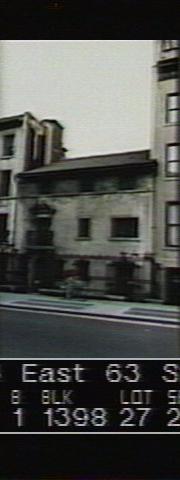
The city photographed every building for its tax records around 1940 and again in the 1980s. NYC Municipal Archives.
Written with AI from the source each entry cites, then fact-checked.
- 1916
A Vanderbilt buys two Drexel stable sites for a daughter's wedding-gift house
The Times reported in June 1916 that Mrs. William K. Vanderbilt was the real buyer of the Drexel stables at 153 and 155 East 63rd Street, acquired as a gift for her daughter Barbara C. Rutherford and her fiance Cyril Hatch. Architect Frederick J. Sterner then designed a Spanish Revival house with a grey stucco facade, a red clay tile roof and a central courtyard.
Source: Daytonian in Manhattan
- 1919
Frederick Sterner finishes a U-shaped Spanish Colonial townhouse around a private courtyard
Frederick J. Sterner completed the house in 1919 after two years of work, giving it gray stucco walls, a low red tile roof and ornate iron grilles. Its U-shaped plan, with two wings parallel to the street, leaves room for an interior courtyard, which is rare for a New York townhouse. Sterner, an English-born architect who had practiced in Colorado before moving to New York in 1909, also remodeled the houses at 151, 152 and 154 East 63rd Street, turning the block into a small Mediterranean-flavored enclave.
“The house is U-shaped in plan, with the two main wings parallel to the street. This allows for a rather spacious interior courtyard…”
- 1921
Broadway producer Charles B. Dillingham moves in with his second wife
Charles B. Dillingham, who began as a reporter and critic before becoming a theatrical agent, lived in the house from 1921 until his second marriage ended in divorce in 1924. A partner of Florenz Ziegfeld and A. L. Erlanger and an owner of the Globe Theatre, he managed stars such as Irene Castle and Beatrice Lillie and was responsible for staging over 200 plays and musical comedies, among them The Red Mill. In 1914 he had taken over the Hippodrome from the Schuberts.
“He was married twice and lived in the East 63rd Street house with his second wife from 1921 to 1924, when the marriage ended in divorce.”
- 1935
Aviation engineer Charles Lawrance sells the house and moves next door
In 1935 the family of Charles Lanier Lawrance sold No. 153 and relocated to the house next door at No. 151, another Sterner design. Lawrance, a Yale and Ecole des Beaux-Arts graduate, founded the Lawrance Aero Engine Corporation, later merged into Wright Aeronautical, and invented the air-cooled Wright Whirlwind engine. The landmark report credits that engine with Admiral Byrd's 1926 North Pole expedition and Lindbergh's 1927 flight to Paris. A lawyer apparently acting for Mrs. W. K. Vanderbilt then took title to No. 153.
“In 1935 the Lawrance family sold the house and moved next door to No. 151 East 63rd Street, which had also been designed by Sterner.”
- 1940
Gypsy Rose Lee buys the house on East 63rd Street
Louise Hovick, known as Gypsy Rose Lee, bought the house in 1940 after the family of aeronautical engineer Charles Lawrance, its previous owner, moved next door. She had gold monograms put on the doors and frescoes painted on the walls, and ran a salon there.
Source: Daytonian in Manhattan
- 1962
Gypsy Rose Lee sells the house for $175,000 and holds the mortgage
Gypsy Rose Lee sold the house in 1962 for $175,000 and gave the buyer a mortgage loan herself. During her years there she painted the dark ceilings sky blue and built a colonnade from pillars found on Third Avenue, paying $5 for each column and $40 to haul them. She hung works by Pablo Picasso, Pavel Tchelitchew, Max Ernst and Marc Chagall, and the New York Times reported a large semicircular fountain and a small greenhouse in the courtyard.
“Lee sold the building for $175,000 in 1962, giving a mortgage loan to the buyer.”
Source: Wikipedia
- 1977
The city landmarks the house, crediting its owner for keeping Gypsy Rose Lee's decor
When the Landmarks Preservation Commission designated the house in 1977, its report noted that the interior still carried the fanciful decor of the Gypsy Rose Lee years: trompe l'oeil paintings on the walls and the initials GRL in gold on every door. The commission credited the then owner, Dr. Ferruccio di Cori, for maintaining much of that decoration. The report also recalled the New York Times description of her salon in a 26-room house with seven baths and a marble living-room floor.
- 1993
Architects rebuild the stucco facade after Jasper Johns renovates the interior
Painter Jasper Johns, who lived in the house in the 1980s, first spent $150,000 renovating the interior but gave the exterior little attention. By 1993 the architecture firm 1100 Architect had rebuilt the gray stucco facade. During the work the ironwork was removed to be restored, and the wall was patched where it had cracked.
“The house's stucco facade was rebuilt by 1100 Architect in 1993.”
Source: Wikipedia
- 1998
Filmmaker Spike Lee buys the house from Jasper Johns for a reported $16.6 million
Spike Lee and his wife reportedly bought the house at 153 East 63rd Street from the artist Jasper Johns in 1998 for $16.6 million. They joined a line of owners that DNAinfo's account traces back through Gypsy Rose Lee, the aeronautical engineer Charles Lanier Lawrance and the Broadway producer Charles B. Dillingham to the Vanderbilt wedding gift of 1916.
Source: dnainfo.com
- 2013
Spike Lee puts the former Hatch house on the market for $32 million
Filmmaker Spike Lee, the house's owner, listed the property in November 2013. Its earlier residents had included painter Jasper Johns, who moved in during the 1980s. The city had designated the house a landmark in 1977.
Source: Daytonian in Manhattan
Further reading
- Barbara Rutherford Hatch HouseWikipedia
- From Gypsy Rose Lee to Spike Lee - 153 East 63rd StreetDaytonian in Manhattan
Nearby
- The Barbizon140 East 63rd Street | 13 entries
- Society of Illustrators128 East 63rd Street | 11 entries
- Manhattan Eye, Ear and Throat Hospital210A East 64th Street | 2 entries
- Trump Plaza1030 3rd Avenue | 7 entries
- Church of St. Vincent Ferrer869 Lexington Avenue | 16 entries
- Cosmopolitan Club122 East 66th Street | 5 entries